Game Cheat Glossary: Aimbot to Wallhack
A game cheat glossary defines the labels used for features, implementation methods and provider status claims in PC game listings. This September 29, 2026 edition explains 22 terms, including silent aim, ESP and HWID. A label describes what a source calls a feature; it does not show that a named product works, avoids detection or is permitted by a publisher. Use the linked concept guides and game comparisons for the specific context behind each term.
Browse the terms
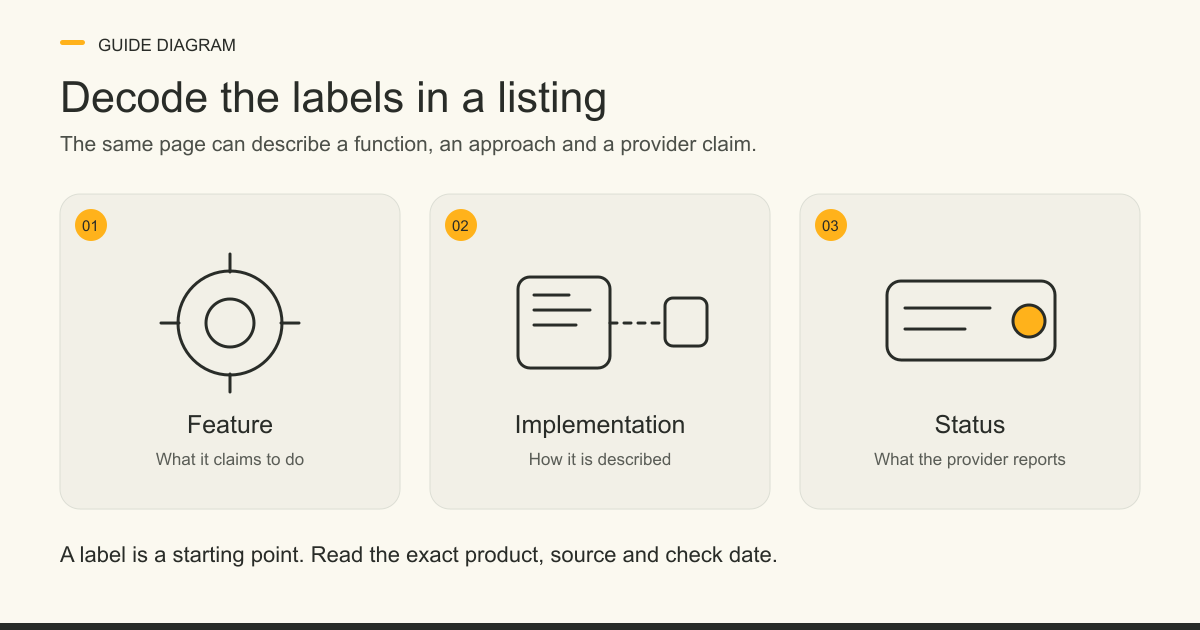
Game cheat listings mix at least three kinds of language: a feature describes a claimed function, an implementation label describes a claimed approach and a status label reports what a provider says about availability or detection. This index separates those uses so the same word is not asked to prove more than its source supports.
Aim and firing: aimbot, silent aim, aim assist, triggerbot. Visual information: ESP, wallhack, radar. Implementation: internal, external, colorbot, DMA. Hardware identity: HWID, HWID ban, HWID reset, spoofer. Marketplace and status: P2C, reseller, lifetime key, undetected, detected, updating. Enforcement: account ban.
The guide directory collects longer explanations of these terms. The game directory lets a reader move from these category definitions to named listings with their own game, product and provider context. The Fortnite aimbot comparison is one game-specific example.
Aim and firing features
Aimbot
An aimbot is software that automates or alters aiming toward a target in a game. Anti-cheat research uses the term for an aim-related cheat category, while a product listing may use it as a feature label. The word alone does not specify how a named product works, which game it supports or whether the provider's description has been independently tested.
Sources: [1]
Silent aim
Silent aim is a label for a less conspicuous aimbot configuration in the anti-cheat research cited here. Collins and colleagues contrast it with abrupt crosshair redirection and describe an attempt to make aim look more like a player's natural movement. That is a description of the category, not evidence that a seller's product escapes detection or that an unusual shot proves cheating.
Sources: [1]
Aim assist
Aim assist is an in-game aiming feature when the game itself provides it under its own rules. EA describes aim assist in its Apex Legends help article and separately names third-party aimbots among prohibited tools in its rules. The distinction is authorization by the publisher; it should not be erased because a listing uses the broader phrase “aim assistance.”
Triggerbot
A triggerbot is a cheat that automates firing when a target enters the player's reticle, as Riot describes it. An aimbot concerns aiming, while a triggerbot concerns the firing action; a product could claim both functions. This definition does not describe input timing, settings or a way to use either feature. Riot's account is about cheat categories, not a test of a listed product.
Sources: [4]
Visual and information features
ESP
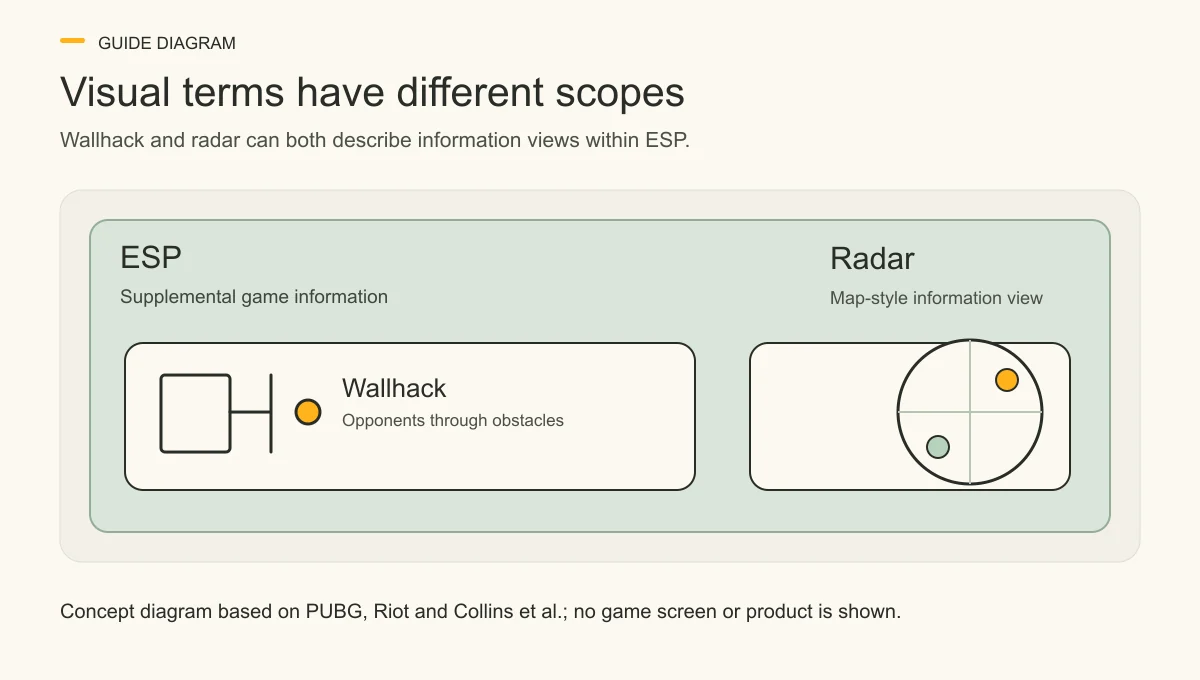
ESP stands for Extra Sensory Perception in PUBG's anti-cheat terminology. PUBG describes an ESP cheat as showing information about other players that a normal player should not see in the same way. Academic research uses the term more broadly for supplemental information on a map or screen. The label does not tell you exactly which information a particular provider claims to show.
Wallhack
A wallhack is a visual cheat associated with seeing opponents through obstacles. Riot's Fog of War explanation uses hidden opponents as the central example; academic research calls wallhacks a common kind of ESP. The two labels can overlap without being exact synonyms. A listing that says only “ESP” needs its own feature description before it can be treated as a specific wallhack claim.
Radar
Radar is a map-style display of game information in cheat terminology. The academic anti-cheat paper's ESP example shows opponent locations on a minimap alongside on-screen visual markers. In a product listing, a radar label therefore describes a claimed information view, not how the information is obtained or whether the display works in every mode of the named game.
Sources: [1]
Implementation and hardware terms
Internal
Internal describes a cheat operating within the game process in the academic taxonomy used here. It is an implementation label, not a feature: an internal product could claim aim, visual or other functions. A provider's use of the label is still its own description. It does not establish permission, a complete feature set or a predictable detection outcome.
Sources: [1]
External
External describes a cheat operating separately from the game process in the same taxonomy. The word does not by itself mean a second computer, a particular hardware device or one fixed set of features. CheatsMatch records the provider's specific implementation claim separately from function and game support. The named product's documentation must supply any additional hardware requirement.
Sources: [1]
Colorbot
Colorbot is a label Riot uses for a pixelbot category that reads visual information from the screen. Riot discusses it as a cheating category in its Vanguard reporting. A colorbot label does not establish a particular product's target recognition, performance or detection status. This glossary stays at the category level.
Sources: [5]
DMA
DMA means Direct Memory Access. Riot discusses DMA devices in the context of cheats that can access game data through hardware. In a listing, “DMA” is an implementation claim, not a list of features, a guarantee about enforcement or evidence that a specific product was tested. Hardware requirements and supported games remain separate facts that need their own sources. The internal-versus-external guide compares these implementation labels.
Sources: [8]
Hardware identity terms
HWID
HWID means hardware ID, a label for information associated with a device or its components. In a game enforcement discussion, the exact information a publisher uses is specific to that service. A product page's claim about changing a hardware identifier should therefore be read as a provider statement about a particular tool, not as a universal description of every game restriction.
Sources: [9]
HWID ban
An HWID ban is a restriction associated with hardware identity rather than only a player account. Riot's support material distinguishes hardware restrictions from account restrictions in its own system. The term does not reveal which identifiers were used, how long a different publisher's restriction lasts or whether a launch error is a ban. The exact notice and official source matter.
HWID reset
In this glossary, HWID reset refers only to a provider's claimed change to a device's reported hardware identity. It does not mean that a game account sanction or a publisher's stored records have changed. The provider's product description must identify the claimed scope and persistence. This definition supplies no instructions for altering identifiers or returning to a restricted game.
Sources: [11]
Spoofer
A spoofer is a tool whose provider claims it changes or masks supported device identifiers. Providers describe different scopes and persistence, so the category name is not a technical specification. An HWID spoofer claim is separate from a publisher restriction and whether the tool works as described. The HWID-ban guide explains account and device restrictions. Read the named product's source and check date.
Sources: [11]
Marketplace and status labels
P2C
P2C means pay-to-cheat in some game-cheat market writing. It is shorthand for a paid cheat product or service, not a feature or a publisher classification. The label says nothing by itself about what software does, how it is distributed or whether any provider's claims are accurate. Compare the named listing and its access terms instead of inferring quality from the abbreviation.
Sources: [10]
Reseller
A reseller is a seller offering software it did not originally develop. A store may sell its own products, resold products or both, and a multi-brand catalogue is only a clue unless a source confirms the relationship. CheatsMatch records that relationship as an inference when the evidence is incomplete. The seller's price, support and refund terms still need to be read for the exact offer.
Sources: [13]
Lifetime key
A lifetime key is a seller's access-period label. It does not, without the written plan terms, identify whose lifetime is meant, what updates are included or how long a claimed software effect persists. A product can be described as temporary while its access is sold under a longer license. Keep access period, product function and restart behavior in different fields.
Sources: [13]
“Undetected”
“Undetected” is a provider status claim when it appears in a game-cheat listing. CheatsMatch can document that the provider published that word and when it was checked; that is not a firsthand detection test or a promise about later enforcement. The label does not establish safety. Read it with the exact product, game and date, and keep unknown details as unknown.
“Detected”
“Detected” is a provider status word describing what the provider reports about a named product. It is not a universal statement about every version, game or account. The source date and product specificity matter, because a store-wide banner can differ from a particular listing. CheatsMatch records the reported label without turning it into an independent technical finding.
“Updating”
“Updating” is a provider status word that can indicate a product is under maintenance or revision in the provider's own records. It should be read beside plan availability: a checkout or price can remain visible while the provider reports an updating status. The word does not promise when work will finish or whether the next version will function as advertised.
The provider guide compares status pages with listings. CheatsMatch's scoring method covers evidence labels.
Ban and enforcement terms
Account ban
An account ban is a restriction applied to a game account under the publisher's rules. It is distinct from a restriction described as hardware-based, although a particular service may apply more than one kind of enforcement. A provider claim about a device identifier does not establish any change to an account's status. Use the publisher's notice or official account route for a specific case.
How to read a listing
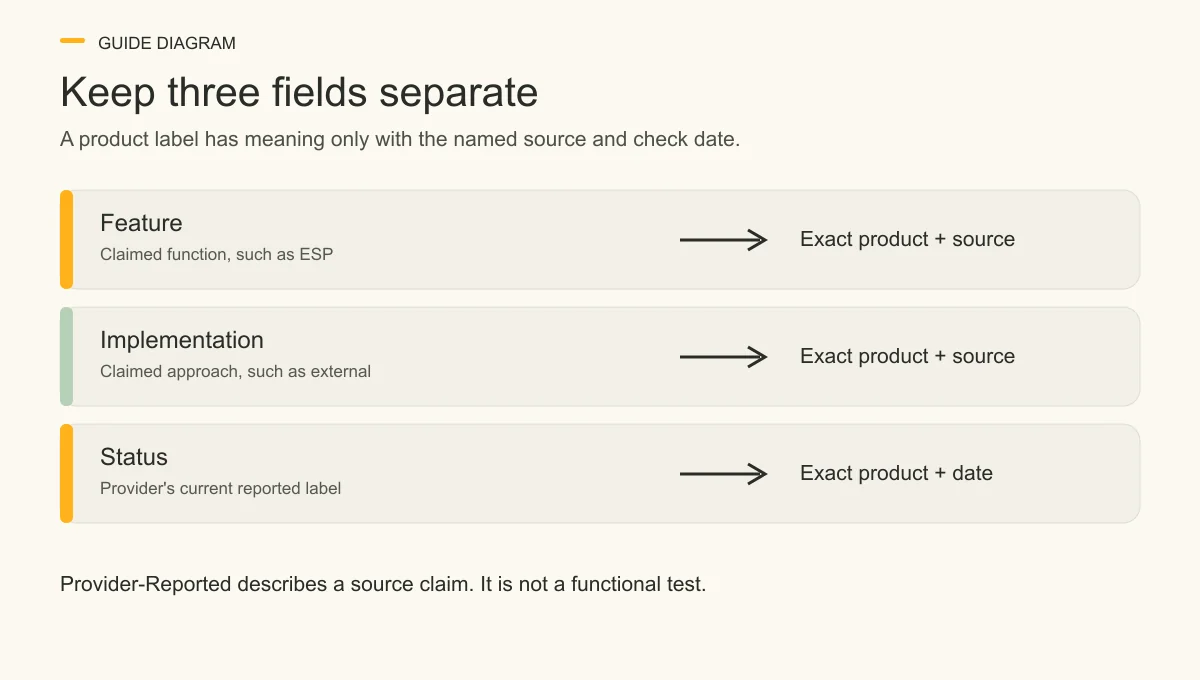
CheatsMatch treats a feature, implementation and status as separate fields. Each field can be useful when the source names the exact product and game. None is a substitute for a current publisher policy, a product-specific source date or independent evidence of actual software behavior.
The game directory is the next step when you need a named product's advertised feature set, price period and provider status in its actual game context. The documentation score describes source clarity and coverage, not a hands-on performance test. Read the cited source and its date before drawing a conclusion from a label.
For a recoil-control claim, the no-recoil scripts guide adds game-specific publisher rules and source limits.
| Listing field | Examples | What it establishes | What it does not establish |
|---|---|---|---|
| Feature | Aimbot, ESP, radar | What function the provider claims | Implementation, performance or permission |
| Implementation | Internal, external, DMA | What approach the provider claims | Full features or detection outcome |
| Status | “Undetected”, “detected”, “updating” | What status word the provider published at a check date | Independent safety or future availability |
Frequently asked questions
What is silent aim?
Silent aim is a term anti-cheat researchers use for a less conspicuous aimbot configuration intended to resemble ordinary aiming more closely than abrupt crosshair redirection. The term is not evidence that a particular product avoids detection.
Is ESP the same as a wallhack?
ESP is a broader label for otherwise unavailable game information. A wallhack concerns seeing opponents through obstacles and can be one kind of ESP. The exact feature in a listing still depends on the provider's description.
Does “undetected” mean a cheat is safe?
An “undetected” label is a provider's status claim, not evidence that a cheat is safe. CheatsMatch can verify that the label was published without verifying the software's behavior or future enforcement outcome.
What does HWID stand for?
HWID stands for hardware ID. In game enforcement, a hardware-related restriction is separate from an account-only restriction, but the publisher's current notice defines the particular case.
What is P2C?
P2C is shorthand for pay-to-cheat in some game-cheat market writing. It describes a paid cheat product or service, not a feature or a claim of quality.
Sources and check dates
Numbers beside a fact or score refer to the sources below. Provider descriptions are claims, not independent product tests.
- Collins et al.: Anti-Cheat: Attacks and the Effectiveness of Client-Side Defences · checked 2026-09-29
- EA Help: How to turn off aim assist in Apex Legends · checked 2026-09-29
- EA Help: Play by the rules in Apex Legends · checked 2026-09-29
- Riot Games: Vanguard On-Demand · checked 2026-09-29
- Riot Games: Vanguard hits new Bans-Per-Second record · checked 2026-09-29
- PUBG: Dev Letter: Anti-ESP · checked 2026-09-29
- Riot Games: Demolishing Wallhacks With VALORANT's Fog of War · checked 2026-09-29
- Riot Games: Vanguard Security Update: Closing the Pre-Boot Gap · checked 2026-09-29
- Riot Games Support: Understanding Hardware ID (HWID) Bans · checked 2026-09-29
- sebwebneb: Understanding Anti-Cheat Architecture, term expansion only · checked 2026-09-29
- CheatsMatch: What Is an HWID Spoofer? · checked 2026-09-29
- CheatsMatch: What Is an HWID Ban? · checked 2026-09-29
- CheatsMatch: How to Evaluate Game Cheat Providers · checked 2026-09-29
- CheatsMatch: Editorial Policy · checked 2026-09-29
- CheatsMatch: How We Rate · checked 2026-09-29