What Is a Triggerbot? How It Differs from an Aimbot
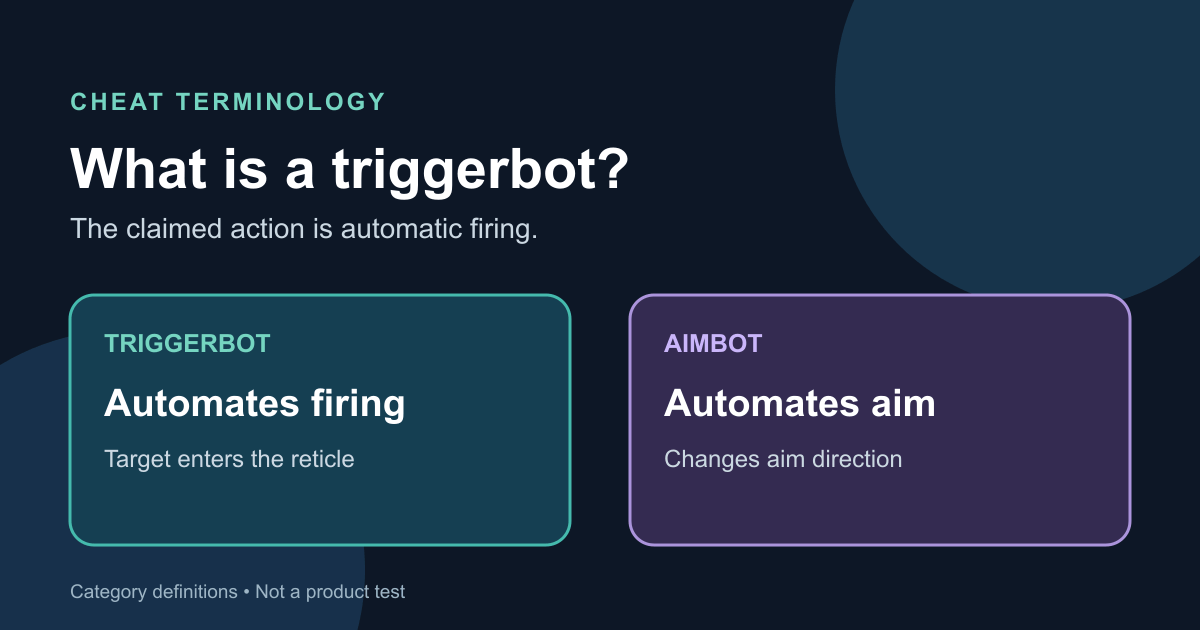
A triggerbot automates firing when an opponent enters the player's reticle, as Riot describes it for VALORANT. The key distinction is the action it automates: a triggerbot fires; an aimbot changes aim direction. A product can claim both. CheatsMatch's catalogue snapshot checked through September 23, 2026 records 135 triggerbot-tagged provider-product listings among 1,492 in-scope listings. Those tags document provider claims, not a test of whether any product works.
What a triggerbot means
Riot's June 2026 anti-cheat update gives a concrete example: a cheat may pull the trigger when an enemy enters the player's reticle. That is the narrow meaning used here. The player's view and aim can still matter; the automated step is firing. This definition describes a category of prohibited assistance, not an operating guide or a claim that every product sold under the label behaves alike.
The spelling varies between “triggerbot” and “trigger bot.” Both refer to the same term in this guide. A seller may group the label with aiming, vision or other features. Its category name alone does not identify its implementation, game compatibility or actual performance. For concise neighboring terms, use the glossary. A named VALORANT aimbot comparison covers a distinct feature category and shows where product-specific claims are recorded.
Triggerbot and aimbot automate different actions
An aimbot concerns the direction of aim. Collins and colleagues describe it as automating the aiming process. Riot's triggerbot example concerns firing after a target enters the reticle. The difference is useful because “automatic shot” does not by itself say the software moved the reticle, and “automatic aim” does not by itself say who fired. A product listing can advertise both without making the terms interchangeable.
The table compares definitions, not products or anti-cheat outcomes. Neither label verifies a working feature. The aimbot guide explains that category more fully, including the limits of a provider's description. Readers comparing named offers should keep the game's rules, feature claims and evidence dates separate.
| Record | Triggerbot | Aimbot |
|---|---|---|
| Action described | Fires when the relevant reticle condition occurs | Moves or controls aim toward a target |
| Question to ask of a listing | Does it claim automatic firing? | Does it claim automated aim direction? |
| What a label proves | A provider used the triggerbot label | A provider used the aimbot label |
What publisher rules establish
Riot describes triggerbots as cheats in its VALORANT anti-cheat update. Activision's July 2026 Call of Duty policy says it looks for automated actions with superhuman speed or accuracy and treats cheating as sanctionable. Activision does not use that sentence to define every triggerbot; its policy applies to the Call of Duty titles it names. Each publisher's current rules are the authority for its own game.
A seller's compatibility claim is not permission from a publisher. Nor does a provider's “safe” or “undetected” badge establish an enforcement outcome. Riot discusses anti-cheat enforcement in aggregate; its article is not a result for any named commercial product. A player should read the official rule for the game being discussed rather than infer a universal rule or penalty from one publisher's article.
How publishers discuss detection
Riot's report describes several categories of cheating and outlines its own defenses and enforcement. Activision says its anti-cheat uses client and server systems, application monitoring, gameplay anomalies and other signals. Those are publisher accounts of their systems. They do not establish that a specific triggerbot is detected, that a different one avoids detection or that a suspicious shot proves cheating.
The evidence boundary matters when reading a product page. A named tool's advertising and a publisher's general anti-cheat explanation are different types of evidence. Neither can be combined into a product-level test that no one performed. This guide records definitions and policies; it does not measure detection rates or offer a safety assessment for particular software.
What the CheatsMatch snapshot records
The generated catalogue extract checked through September 23, 2026 contains 135 in-scope provider-product listings tagged triggerbot among 1,492 in-scope provider-product listings. These are listing records, not a count of distinct programs or users. One record may have multiple feature tags, and different providers may describe related offers. The extract does not test functional support or cover every seller in the market.
This count helps show how often the term appears in CheatsMatch's documented slice. It is not a prevalence rate for cheating, a per-game availability count or proof of a working feature. Game associations in the underlying extract can include unresolved or inferred bindings, so a game-specific claim needs its own product-source check.
| Record | Value | What it counts |
|---|---|---|
| Triggerbot tag | 135 | In-scope provider-product listings with the triggerbot type |
| Catalogue denominator | 1,492 | In-scope provider-product listings checked through September 23, 2026 |
| Functional support verified | No | Source-backed tags and claims, not an independent software test |
Sources: [4]
How to read a named listing
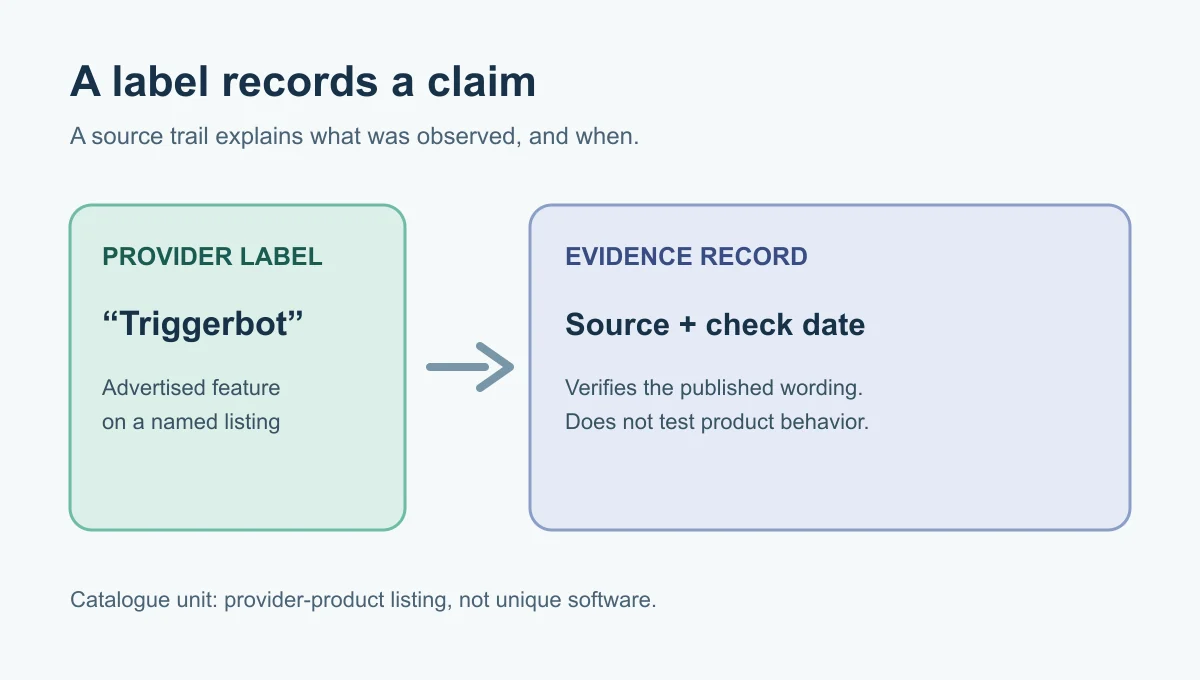
Start with the exact game, provider and product. Look for a dated provider statement that explicitly claims firing automation. If the listing says only “aim assistance,” it does not establish a triggerbot claim. If it lists both triggerbot and aimbot, record both labels while keeping their actions distinct. Then read access terms, platform claims, status and source dates as separate statements; none verifies behavior in a match.
The game directory leads to named comparisons. The VALORANT aimbot page is an aim-feature comparison, not a triggerbot ranking. CheatsMatch's rating method scores documentation and evidence clarity, not cheat effectiveness or protection from enforcement. A check date tells the reader when a claim was observed. It does not extend a provider's promise into the present.
Dates and review triggers
The public sources for this guide were checked September 30, 2026. Riot's definition comes from its June 2026 report, Collins and colleagues' category discussion from a 2024 paper, and Activision's enforcement policy from July 2026. The site catalogue was checked through September 23, 2026. Each date belongs to its own source and should travel with any repeated claim.
Publisher rules, product descriptions and catalogue tag counts may change after their check dates. Use current sources for a particular product or game. The high-level firing-versus-aiming distinction can remain useful while game rules and seller claims change. Do not read the page date as a live compatibility or detection guarantee.
Frequently asked questions
What does a triggerbot do?
In Riot's VALORANT example, it automates firing when an enemy enters the player's reticle. The term describes the firing action, not a guarantee about any named product.
Is a triggerbot the same as an aimbot?
No. A triggerbot automates firing in Riot's example; an aimbot automates aim direction in the cited research. A product can claim both features, so the terms are distinct rather than mutually exclusive.
Are triggerbots allowed in VALORANT?
Riot identifies them as cheats in its VALORANT anti-cheat report. Check Riot's current game rules for enforcement details; the report does not assess a particular seller's product.
Does a triggerbot label mean the product works?
No. The tag records a provider's advertised category. CheatsMatch's catalogue extract does not run the software or verify a product's firing behavior.
Sources and check dates
Numbers beside a fact or score refer to the sources below. Provider descriptions are claims, not independent product tests.
- Riot Games: Vanguard On-Demand · checked 2026-09-30
- Collins et al.: Anti-Cheat: Attacks and the Effectiveness of Client-Side Defences · checked 2026-09-30
- Activision: Call of Duty Security and Enforcement Policy · checked 2026-09-30
- CheatsMatch: Editorial Policy · checked 2026-09-30
- CheatsMatch: How We Rate · checked 2026-09-30