What Is an Aimbot? Types, How Aimbots Work and How Games Detect Them
An aimbot is software that automates or changes a player's aim toward a target in a game. The label describes an aim feature, not one fixed implementation or a test of any seller's product. CheatsMatch's September 23, 2026 catalogue snapshot records 429 aimbot-tagged provider-product listings among 1,492 in-scope listings. This guide explains the category, publisher rules and detection statements, then shows how to read game-specific comparisons without treating a published claim as verified performance.
What an aimbot is
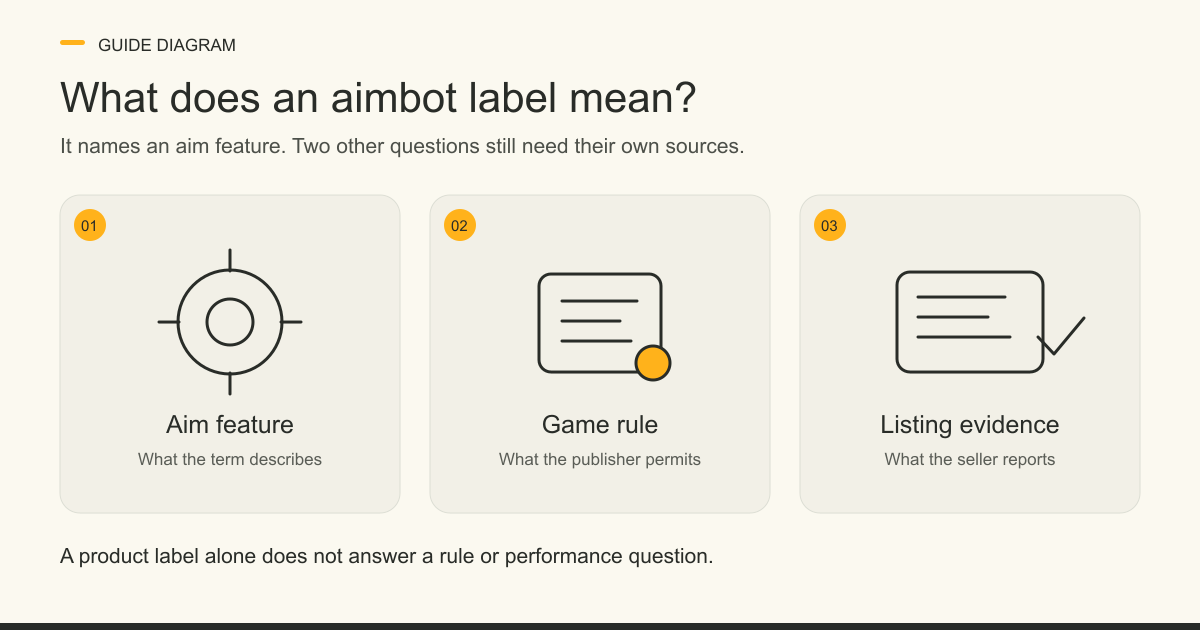
An aimbot changes the aiming part of play. In anti-cheat research, it is a cheat category that can direct or assist a player's aim toward a target. The term does not tell you what information the software uses, where it runs or whether a specific seller's feature functions as described. Those are separate facts to establish for each named product and game.
An aimbot listing may sit beside other feature labels such as ESP or radar. Those visual labels concern information shown to the player; an aimbot label concerns aiming. A provider can advertise several functions in one listing, but a shared store page does not make the terms interchangeable. The glossary defines the neighboring terms. The Fortnite comparison shows how this vocabulary appears on one game-specific page with product and provider context.
The ESP guide explains the separate information feature and its overlap with wallhack terminology.
How aiming automation works at a high level
At a concept level, an aimbot takes some representation of a possible target and produces a change in aim. The target information, the way the change is expressed and the surrounding game rules vary. Calling a feature an aimbot describes the intended result, not a universal technical design.
The 2022 GAN-Aimbots paper describes a research proof of concept in a first-person shooter setting. It studies cheating through aiming behavior in that setting. Its controlled result cannot be transferred to an unnamed commercial product, a different game or a current anti-cheat system. Research about one model is not a performance measurement of the products in a comparison directory.
Broad types and neighboring terms
Aimbot types can be described along more than one axis. One description can refer to the aim behavior a tool claims, another to the information it uses, and a third to its implementation. A feature name cannot prove a hardware requirement, and an implementation name cannot prove a feature set. An “external aimbot” claim joins two assertions that each need their own product-specific source.
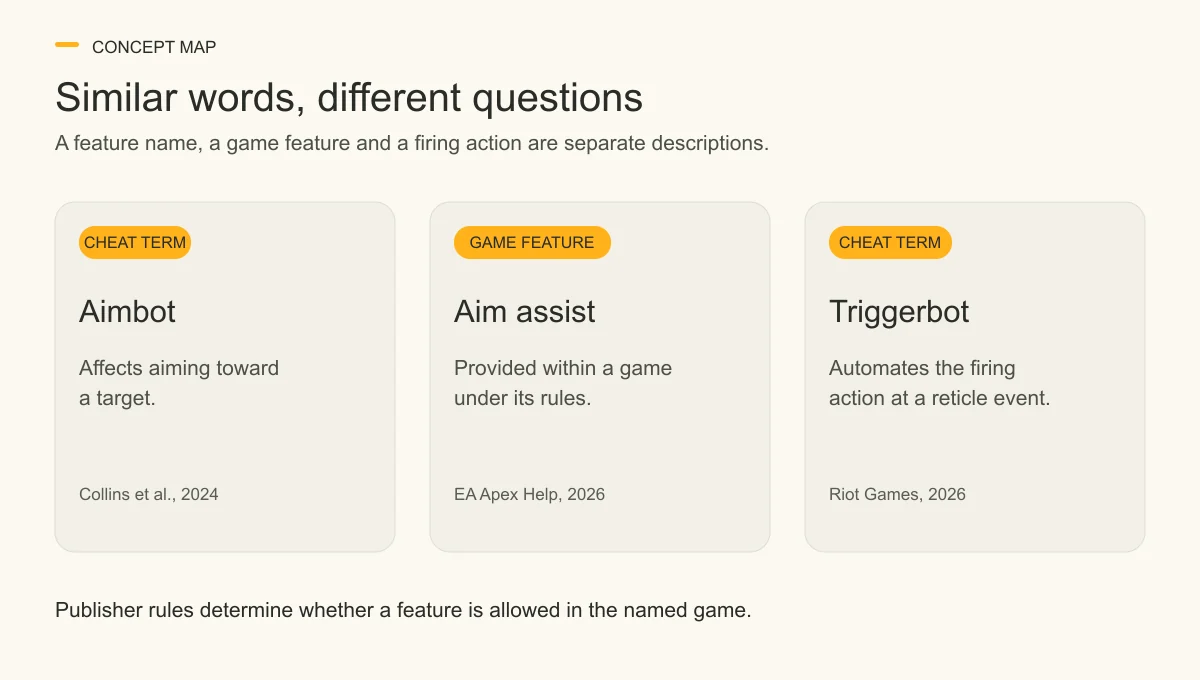
Riot's June 2026 Vanguard article names pixelbots as computer-vision cheats and includes aiming among their possible effects. That is one publisher's category example, not proof that every “AI” or “colorbot” label works the same way. Riot also uses “triggerbot” for a firing action when a target enters a reticle. That concerns firing rather than aim movement. A product may advertise both; its listing needs to name them separately.
EA describes aim assist as a built-in Apex Legends controller feature. EA's Apex rules separately name third-party aimbots among prohibited cheating tools. In that game, the difference is publisher authorization, not whether both descriptions happen to contain the word “aim.” This does not settle how another game's built-in assistance or third-party tools are treated. Use the rule of the named game.
The triggerbot guide explains firing automation separately from aim movement.
The AI aimbots and colorbots guide examines Riot's pixelbot terminology and the limits of AI claims.
Rules differ by game
EA's current Apex Legends rules identify third-party aimbots as cheating tools used for an unfair advantage. Activision's Call of Duty Security and Enforcement Policy, dated July 31, 2026, also explicitly lists aimbots under unauthorized software. These are publisher policies for their own games. They do not supply a universal penalty period or a verdict about another publisher's game.
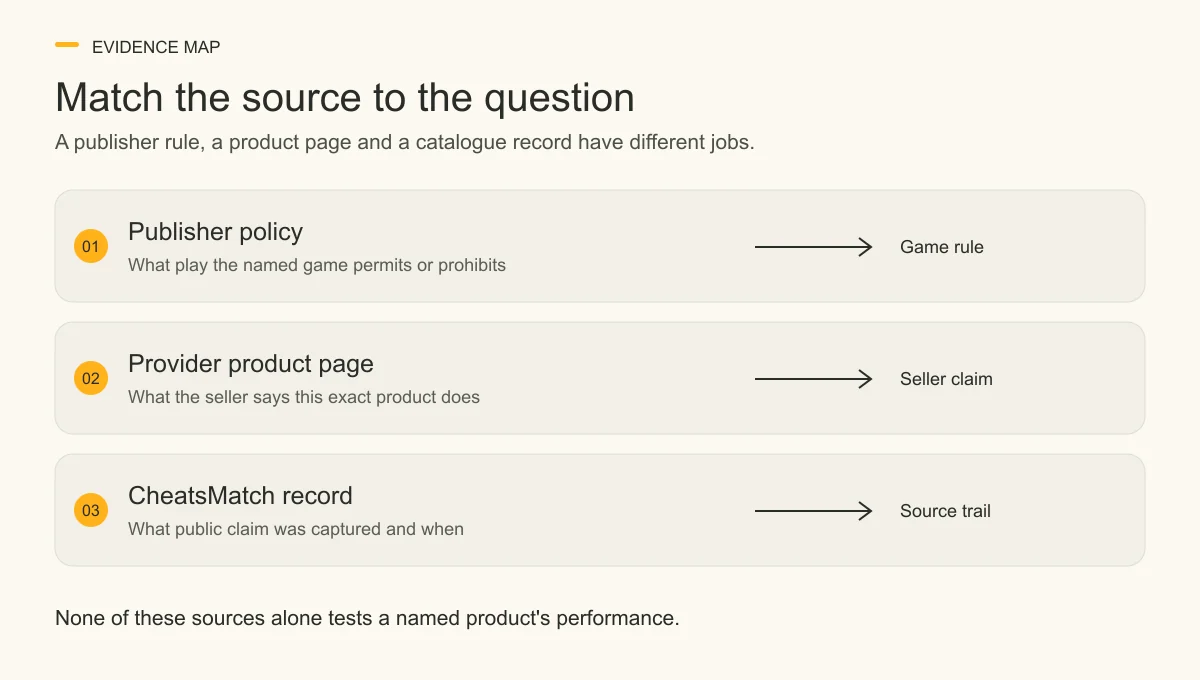
A product page may say it supports Apex, Call of Duty or VALORANT. That is a provider's compatibility claim. It does not change the publisher's rule or demonstrate that the software works in that game. The game's current official policy is the source for permitted play, while the product-specific provider page is the source for what the seller advertises. Keep those source roles separate.
How publishers address aimbots
Activision says RICOCHET Anti-Cheat looks for cheating through client and server systems, applications running during play, behavioral models and reports from other players. Its July 2026 policy describes the channels at a high level; it does not say which channel catches a given product or when enforcement follows. An individual match, unusual shot or missing ban notice is not enough to infer a particular technical result.
Riot's published VALORANT anti-cheat strategy describes layers: game design, anti-tamper measures, cheat detection, player reports and data analysis. Riot presents these as its own approach, not as a guarantee that every cheat is immediately found. In its later Vanguard article, Riot distinguishes several cheat categories, including computer-vision pixelbots. A category name does not state whether a named seller's implementation is detected, and a provider's “undetected” label remains a provider report rather than a direct test.
The research paper's controlled proof of concept does not override a publisher's current policy or establish a current detection rate. For a specific account or enforcement notice, use the publisher's official account and appeal route. CheatsMatch does not turn public anti-cheat descriptions into a safety prediction for a product.
What the CheatsMatch catalogue records
The catalogue extract checked through September 23, 2026 contains 429 provider-product listings tagged aimbot among 1,492 in-scope provider-product listings. The denominator is the site's eligible listing set, not all cheats sold online or all players. A listing may have several feature tags, and separately sold or resold offers can represent the same underlying software. The count measures recorded labels, not independent functioning products or the prevalence of cheating.
The same extract records game associations, but an association can be unresolved or inferred. This page therefore uses the four named game comparisons as routes to inspect exact offers rather than presenting a cross-game compatibility count. Each comparison should retain the product, provider, source date, plan period and status wording beside the advertised feature.
| Measure | Value | Unit and limit |
|---|---|---|
| Aimbot tag | 429 | Provider-product listings with the aimbot type; overlapping tags possible |
| Catalogue scope | 1,492 | In-scope provider-product listings, checked through September 23, 2026 |
| Functional support verified | No | The extract records published claims and sources, not a software test |
Sources: [8]
How to compare named listings
Start with the named game and the exact product. Find where the provider states an aiming feature, then read any separate implementation, platform and support terms. A store's general category heading is less specific than a product page. A published feature description can be documented without being independently verified in play.
Next read the status source and date. “Undetected”, “detected” and “updating” are provider status words; a price or checkout does not settle the product's current status. Compare plans over the same access period, and read the documentation score as a measure of source clarity and coverage. It is not an aim-performance score or an anti-cheat safety score.
The game directory groups comparisons by game. The VALORANT aimbot page, Escape from Tarkov aimbot page and Call of Duty: Warzone aimbot page give three distinct places to inspect product-specific claims. Similar feature labels across those games do not establish the same publisher rules or current software behavior. The rating method explains the documentation score.
Source dates and change checks
This guide's public sources were checked on September 29, 2026. Activision's cited policy is dated July 31, 2026; Riot's anti-cheat strategy dates to 2020 and its Vanguard category report to June 2026. The catalogue extract was checked through September 23, 2026. The dates answer different questions: a publisher's current rule, an explanation of its approach and a snapshot of what listings were recorded.
The cited rules, anti-cheat descriptions, catalogue figures and game comparisons are dated and may change; check the current source for a specific decision. The 2022 research paper remains historical context. A later enforcement outcome or seller status word must not be inferred from the date of this guide.
Frequently asked questions
What is an aimbot?
An aimbot is software that automates or changes aim toward a target in a game. The name describes an aim feature, not one implementation or a verified result for a named seller.
Is an aimbot the same as aim assist?
An aimbot label is not the same as EA's built-in Apex Legends controller aim assist. EA's Apex policy names third-party aimbots as cheating tools. Another game's policy must be checked separately.
Can games detect aimbots?
Publishers describe multiple detection and enforcement channels. Activision names client and server systems, behavioral models and player reports for Call of Duty; Riot describes several defensive layers for VALORANT. Neither statement predicts the outcome for a particular product or account.
Does an external aimbot label mean it is safe?
An “external aimbot” label does not establish safety. “External” describes a claimed implementation relationship to the game process. It does not verify the advertised aim feature or establish a detection outcome.
Are the catalogue's aimbot listings independently tested?
The September 23, 2026 extract counts provider-product listings tagged aimbot without testing the software. It does not identify unique underlying products or measure cheating prevalence.
Sources and check dates
Numbers beside a fact or score refer to the sources below. Provider descriptions are claims, not independent product tests.
- Collins et al., Anti-Cheat: Attacks and the Effectiveness of Client-Side Defences · checked 2026-09-29
- Kanervisto, Kinnunen and Hautamäki, GAN-Aimbots · checked 2026-09-29
- EA Help, How to turn off aim assist in Apex Legends · checked 2026-09-29
- EA Help, How to play by the rules in Apex Legends · checked 2026-09-29
- Activision, Call of Duty Security and Enforcement Policy · checked 2026-09-29
- Riot, VALORANT Anti-Cheat: What, Why, and How · checked 2026-09-29
- Riot Games, Vanguard On-Demand · checked 2026-09-29
- CheatsMatch, Editorial Policy · checked 2026-09-29
- CheatsMatch, How We Rate · checked 2026-09-29