
What Is ESP (Wallhack) in Games? Types and How Games Detect It
ESP means Extra Sensory Perception in PUBG's anti-cheat terminology. In game-cheat listings, it describes a claimed display of information that ordinary play would not show in the same way, often another player's position. Wallhack is a related label for seeing opponents through obstacles, not a perfect synonym for every ESP claim. CheatsMatch's catalogue snapshot checked through September 23, 2026 records 456 ESP-tagged provider-product listings among 1,492 in-scope listings; the tags are not functional tests.
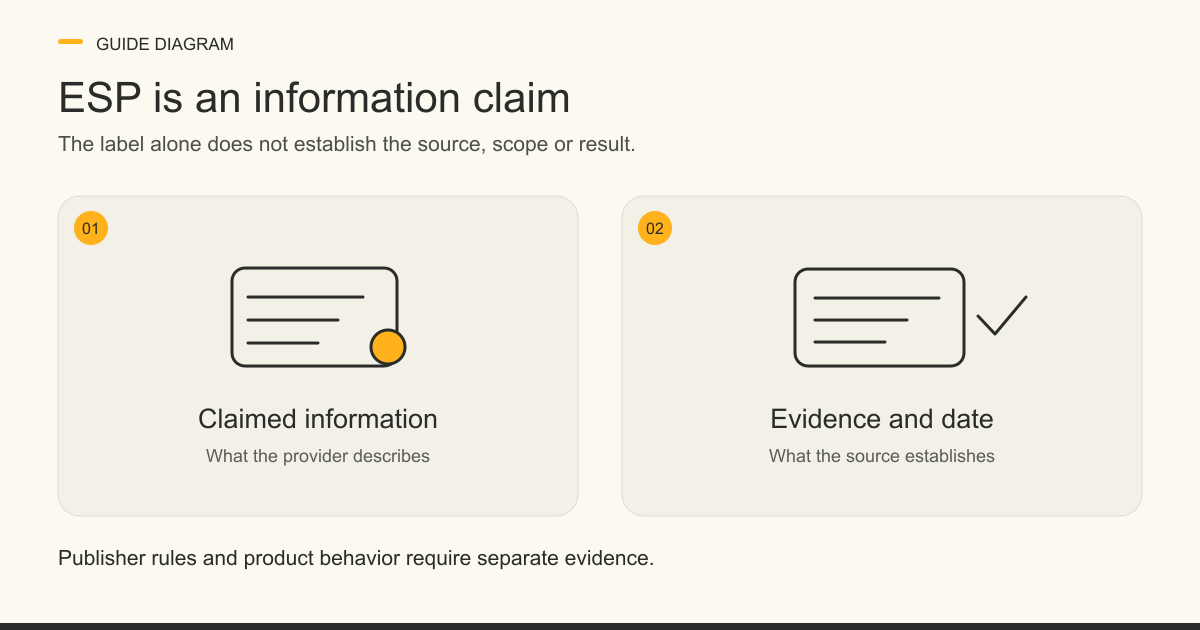
What ESP means in games
PUBG's 2024 Anti-ESP letter expands ESP as Extra Sensory Perception and describes a cheat that pinpoints other players' positions. Its description concerns information that ordinary play should not give the same way. A store may use “ESP” for a broader set of visual claims, but the word alone cannot tell you exactly which information a named product advertises or whether it displays anything in practice.
This page uses the gaming meaning of ESP. It does not concern ESP32 hardware, which appears in search results for the same letters. The glossary gives short definitions of adjacent terms. A game-specific comparison, even when it covers a separate aim feature such as the VALORANT aimbot page, shows where named product and provider claims belong; it is not a test of ESP.
ESP and wallhack are related, not identical
Riot describes a wallhack in VALORANT as a cheat that lets a player see opponents through walls. Anti-cheat research calls wallhacks a common form of ESP and also gives a map-style opponent-location example. These descriptions overlap around information the normal view withholds, but they do not make every ESP claim a through-wall view or every listing's “visuals” label a verified wallhack.
The practical distinction is a question for the provider's exact product page: does it name opponents behind obstacles, a map view or some other claimed information? A broad ESP category is not a substitute for that detail. Nor does a wallhack label say how the information was obtained, where a tool runs or whether a publisher allows the conduct.
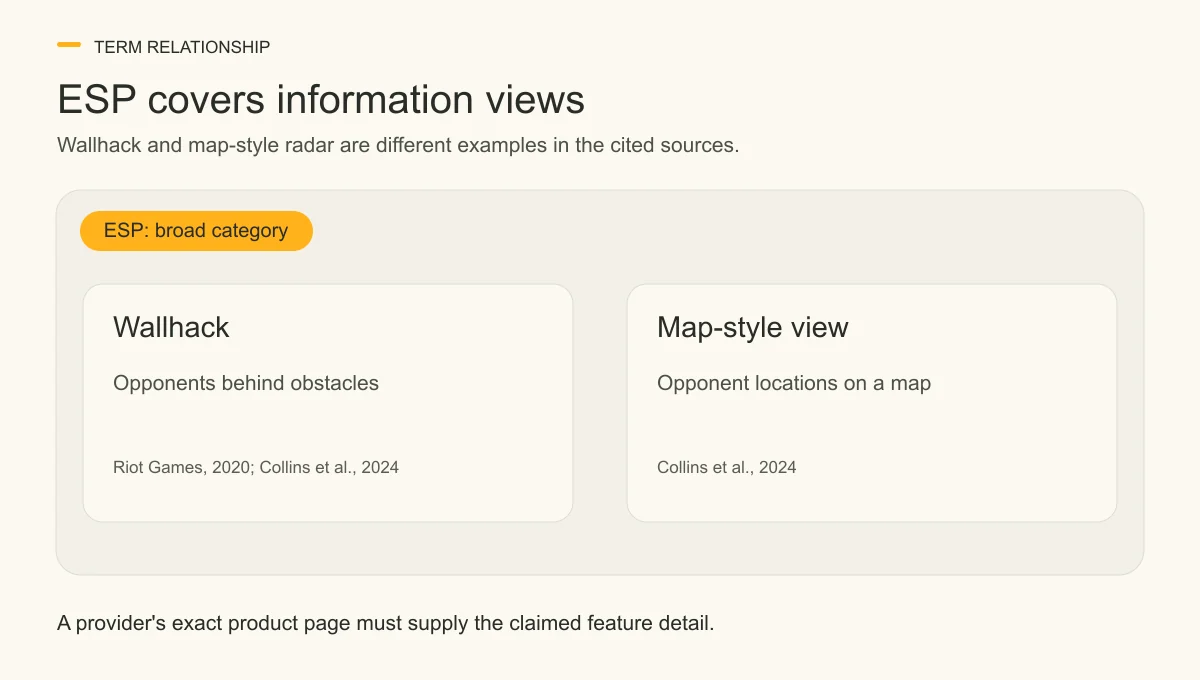
What an ESP label can describe
At the category level, ESP concerns information rather than aiming or firing. PUBG's example is another player's position. Collins and colleagues describe an ESP display that includes both on-screen markers and map-style information. Those are examples in their sources, not a complete list of features present in every game or every seller's product.
“Radar” can describe a map-style information view. “Wallhack” can describe opponents visible through obstacles. Neither label proves that a product functions in the named game. An aimbot, by contrast, concerns aim movement. The guide to aimbots explains that different feature category; a product can claim more than one category without merging their meanings.
The AI aimbots and colorbots guide covers screen-reading aim and firing labels, a different question from what an ESP display claims to show.
How publishers classify ESP and wallhacks
PUBG calls ESP illegal software in its own Anti-ESP letter. EA's Apex Legends rules name third-party wallhacks among cheating tools, and Activision's July 2026 Call of Duty policy treats software that reveals information players should not know as a cheating category. These statements come from three publishers with their own games and rules. They establish neither a single cross-game penalty nor a verdict about a particular seller's listing.
PUBG Support also uses ESP and wallhack as separate violation labels in reporting instructions. That administrative list is not a taxonomy proving they are different technical systems. A current game's official rules and enforcement notice are the source for what that publisher permits. A seller's “supported game” badge is only the seller's compatibility claim.
How games limit hidden information
PUBG's March 2024 developer letter describes Anti-ESP as limiting location details for players out of sight. Riot's 2020 VALORANT Fog of War account describes withholding hidden opponent positions until the player needs the information. Facepunch later reported that Rust enabled server-side player culling by default in May 2025 and said it prevents or significantly limits some ESP features. These are publisher statements about their own systems, not a universal recipe or a measure of today's protection in every game.
Reducing what a game client receives can limit some hidden-information cheats. That design claim is narrower than saying that an anti-cheat detects every ESP program or that a player who sees an unusual action has proved cheating. PUBG's report also discusses detection work, but the cited article does not establish a detection result for an arbitrary provider product. Riot's and Rust's statements have the same product-level limit.
What CheatsMatch records
The generated catalogue extract checked through September 23, 2026 records 456 provider-product listings tagged ESP among 1,492 in-scope provider-product listings. A listing may carry multiple feature tags. The record is an offer from a provider, not necessarily distinct software; the extract does not independently test the feature or count all products sold in the market. The number describes the site's documented labels only.
The extract's game associations can include unresolved or inferred bindings. It would be misleading to turn this total into a per-game working-product count. The useful next step is the named game's comparison page, where a reader can inspect the advertised feature, provider, source and check date together.
| Record | Value | What it counts |
|---|---|---|
| ESP tag | 456 | In-scope provider-product listings with the esp type |
| Catalogue denominator | 1,492 | In-scope provider-product listings checked through September 23, 2026 |
| Functional support verified | No | The extract records claims and sources, not a software test |
Sources: [8]
How to read a named listing
Begin with the exact game and product. Look for the provider's own description of what information its ESP label covers. A general “visuals” category may leave the details unknown. Read implementation, Windows support, access period and current provider status as separate fields. None of them independently verifies that an ESP display works or escapes a publisher's enforcement.
The game directory leads to named comparisons; an aimbot comparison is a separate feature page, not an ESP-only ranking. CheatsMatch's rating method scores how clearly claims and policies are documented, not how effective a visual feature is. A provider status word is reported with its source and date. The source trail shows the checked claim.
Source dates and change checks
The public sources for this guide were checked September 29, 2026. PUBG's definition and Anti-ESP account date to March 2024; Riot's VALORANT Fog of War explanation dates to April 2020; Facepunch's Rust report describes a May 2025 change. CheatsMatch's catalogue snapshot was checked through September 23, 2026. Those dates limit what each source can establish now.
Publisher rules, catalogue counts and product sources can change after their stated check dates. A later provider status cannot be inferred from the date of this guide. The underlying definition can remain useful while a particular game's policy or product listing changes.
Frequently asked questions
What does ESP stand for in games?
PUBG expands ESP as Extra Sensory Perception and uses it for a cheat that reveals other players' positions. In a provider listing, the exact claimed information needs a product-specific description.
Is ESP the same as a wallhack?
ESP is a broader information label in the cited research. Riot describes wallhacks through seeing opponents behind walls, which can be one ESP example. The labels overlap but are not exact synonyms for every product.
Can games detect wallhacks or ESP?
Publishers describe defenses and enforcement in their own games. PUBG and Riot explain systems that limit hidden player information; neither cited article predicts whether a named commercial product will be detected.
Does an ESP label prove a product works?
An ESP label records a provider's claimed feature, not a verified result. CheatsMatch can verify that a claim was published and dated without testing whether the software displays that information in play.
Sources and check dates
Numbers beside a fact or score refer to the sources below. Provider descriptions are claims, not independent product tests.
- PUBG: Dev Letter: Anti-ESP · checked 2026-09-29
- Riot Games: Demolishing Wallhacks with VALORANT's Fog of War · checked 2026-09-29
- Collins et al.: Anti-Cheat: Attacks and the Effectiveness of Client-Side Defences · checked 2026-09-29
- Facepunch: Surviving 12 Years · checked 2026-09-29
- PUBG Support: How are cheaters and hackers being handled? · checked 2026-09-29
- EA Help: How to play by the rules in Apex Legends · checked 2026-09-29
- Activision: Call of Duty Security and Enforcement Policy · checked 2026-09-29
- CheatsMatch: Editorial Policy · checked 2026-09-29
- CheatsMatch: How We Rate · checked 2026-09-29