AI Aimbots and Colorbots: How Computer-Vision Cheats Work
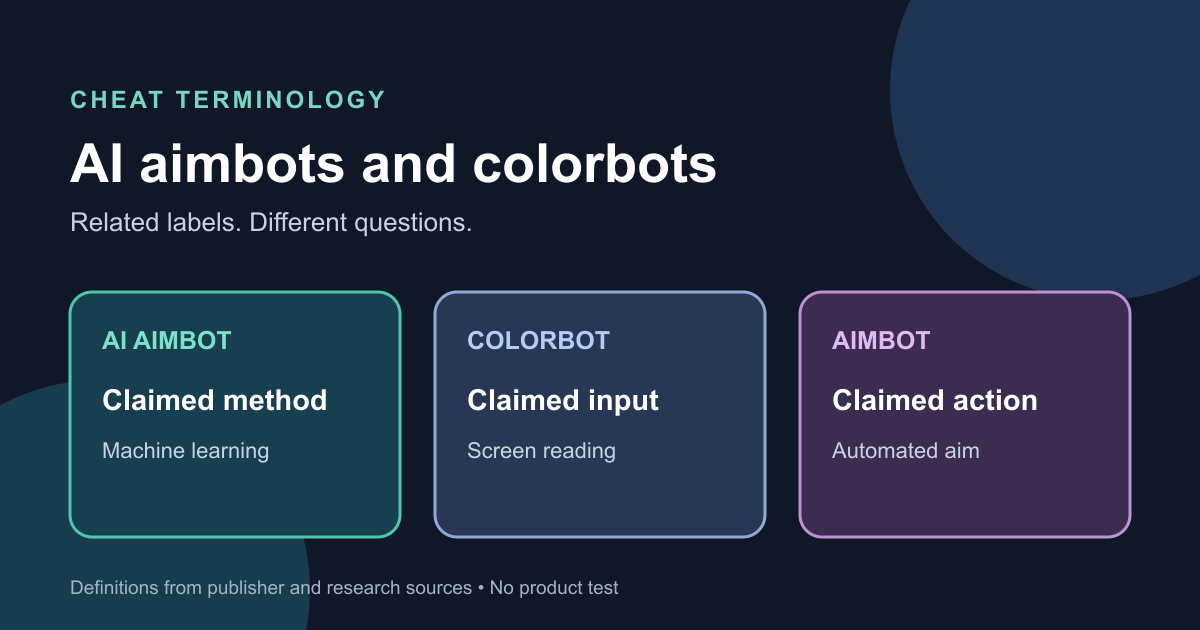
An AI aimbot is an aim-automation claim involving machine learning; a colorbot is a screen-reading cheat label Riot uses for a type of pixelbot in VALORANT. They can overlap, but “AI” does not identify a product's method, and Riot's colorbot wording does not cover every visual aimbot. Research prototypes show possible approaches, not commercial product results. CheatsMatch's September 23, 2026 catalogue snapshot has two ai_vision and two colorbot tagged provider-product listings among 1,492 in-scope listings; those tags are untested claims.
What AI aimbot means here
The 2022 GAN-Aimbots paper describes a proof-of-concept machine-learning method for automated aim in a first-person shooter study. It is evidence that researchers built and evaluated that approach in a defined setting. It is not evidence that a seller's advertised “AI aimbot” uses the same method, works in a named game or has the paper's observed results. In a product listing, “AI” remains a provider's claim until a source explains what the term means for that product.
The general aimbot guide covers aim automation without treating a particular technique as the default. This page focuses on the narrower vocabulary around AI and screen-based claims. A named VALORANT aimbot comparison is where a reader can inspect a game's listed providers and dates; it is a separate product comparison, not proof that an AI-labeled offer functions.
What Riot calls a colorbot or pixelbot
In a February 2025 VALORANT anti-cheat report, Riot calls a pixelbot “aka colorbot” and describes a computer-vision application that reads the screen and identifies an enemy outline or head. The article describes a particular class of abuse observed in its game. Riot's June 2026 update again uses pixelbot for computer-vision cheating and notes that some examples automate firing when a target enters the reticle.
Those publisher descriptions explain why colorbot, pixelbot, visual aimbot and triggerbot can appear near one another. They are not exact synonyms. A visual system can concern aim, firing or both; “colorbot” in Riot's usage is one label for a screen-reading class, while “AI aimbot” says that aim automation is claimed to involve machine learning. The precise function of a commercial listing must be read from its own dated source.
Where the labels overlap and diverge
“AI” describes a claimed analytical approach. “Visual” or “screen-based” describes the kind of information observed. “Aimbot” describes the aim action. “Triggerbot” describes firing automation in Riot's example. These are different dimensions, so one product can carry several labels without making them the same thing. The labels also can be used loosely in advertising; the reader needs a provider statement and a date for a particular offer.
The matrix is a vocabulary aid, not a taxonomy of all cheats. The source papers and Riot reports use different scopes. The glossary supplies short definitions; this guide holds the more careful relationship between the terms.
| Record | What the term describes | What it does not establish |
|---|---|---|
| AI aimbot | Claimed machine-learning involvement in automated aim | A model, implementation or verified result for a seller |
| Colorbot or pixelbot | Riot's screen-reading computer-vision cheat category | Every visual cheat or every AI aimbot |
| Triggerbot | Automatic firing in Riot's reticle example | Automatic aim movement in every case |
What the two research papers establish
Kanervisto, Kinnunen and Hautamäki's 2022 paper reports a machine-learning aimbot proof of concept. Its outcome belongs to the study's game, data and evaluation method. The authors' performance and concealment findings do not transfer to a provider's software or to every current anti-cheat system. The paper shows that “AI aimbot” is a meaningful research topic, not a certification label for the marketplace.
Wang and colleagues' 2026 defense paper studies visual aimbots that operate on rendered frames rather than game memory. It proposes and evaluates a defense in its own study setting. The reported rates are not live-game prevalence, a general detection rate, or a prediction for any seller's product. Together the papers show both an offensive research approach and defensive research; neither supplies a commercial feature test.
What publisher reports can tell us
Riot's 2025 report describes colorbots within its VALORANT anti-cheat context, including a regional episode. Its observations are about that game's reported period and region, not a worldwide count of visual cheats. Riot's 2026 update explains a broader category of pixelbots and its own enforcement. Neither article identifies how a named seller's current product works or whether it will be detected.
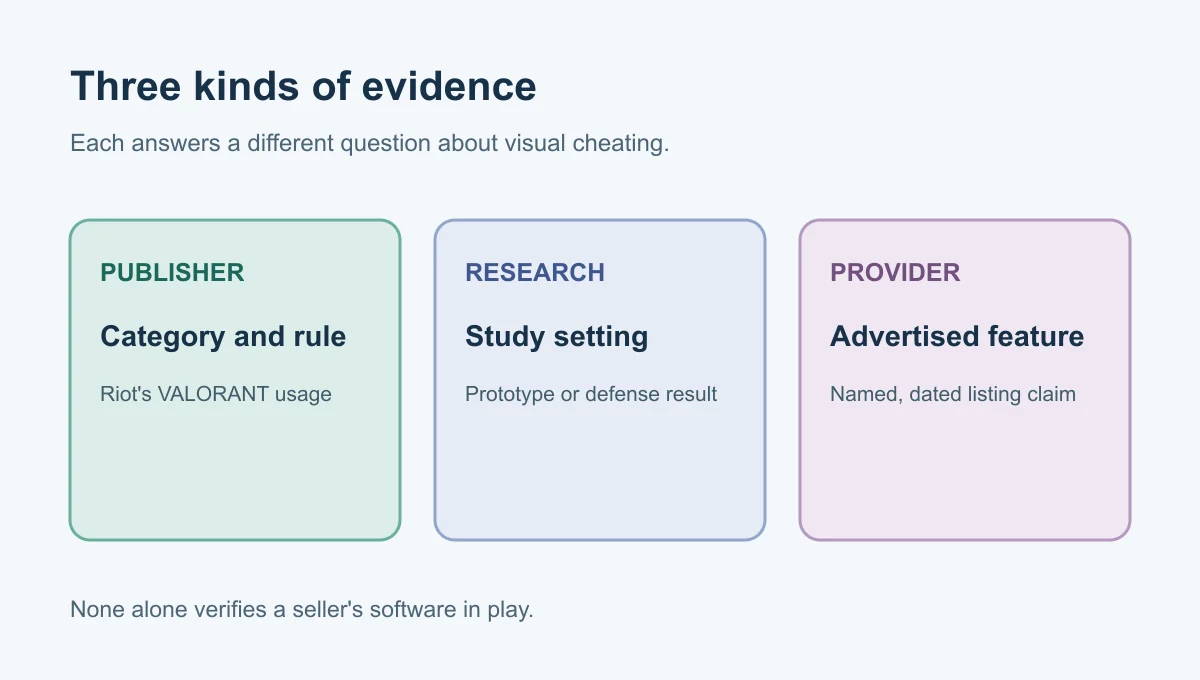
For a publisher's rule or response, use the current official statement for the game in question. A provider's “undetected” advertising cannot be converted into a fact by pairing it with a general anti-cheat article. The reverse inference fails too: Riot's account of action against a category does not prove every visually labeled offer is caught. This page keeps the publisher account, research experiment and provider claim in separate evidence columns.
What the catalogue actually counts
The generated CheatsMatch extract checked through September 23, 2026 contains two provider-product listings tagged ai_vision and two tagged colorbot, out of 1,492 in-scope provider-product listings. It also has 429 aimbot tags, but that broader figure is not an AI-aimbot count. Tags can overlap on the same record, and providers can advertise related offers. Do not add the two narrow counts or treat any of them as distinct tested software.
The extract marks functional support unverified. Its game associations can contain inferred or unresolved bindings, so it cannot answer whether an AI aimbot is available or working for a particular game. A game comparison needs a named product, its exact claim and a check date. Small tag counts here reflect the catalogue's labels, not market rarity.
| Record | Value | Meaning |
|---|---|---|
| AI vision tag | 2 | Provider-product listings tagged ai_vision |
| Colorbot tag | 2 | Provider-product listings tagged colorbot |
| Aimbot tag | 429 | Broader aim-category listings, not an AI-only total |
| Catalogue denominator | 1,492 | In-scope provider-product listings checked through September 23, 2026 |
Sources: [5]
How to read an AI or colorbot claim
Start with the provider's exact wording. Does it claim aim movement, automatic firing, screen-based recognition, machine-learning involvement or only a generic “AI” label? Those are different statements. Record the game's name, product name, platform claim, access terms, source and date. If the provider gives no further description, the mechanism remains unknown. Do not fill that gap with a research prototype or Riot's terminology.
The game directory leads to named comparisons, and the rating method explains how documentation is assessed. A rating is not a software performance score or an anti-cheat outcome. The responsible result may be “provider claim recorded; functionality unverified.” That phrasing preserves useful information without manufacturing a test.
Dates and review triggers
The sources for this guide were checked September 30, 2026. Riot's colorbot wording is from February 2025 and its pixelbot update from June 2026. The GAN-Aimbots paper was submitted in 2022; the visual-defense paper was revised in September 2026. The catalogue check runs through September 23, 2026. These dates limit what each source can establish now.
The cited research, Riot's terminology, catalogue labels and product descriptions are dated and may change. Check the current source for a named product. Do not carry an experimental result or a dated provider claim forward as proof of current compatibility or detection status. A general category explanation does not verify a claim about a particular game.
Frequently asked questions
Is a colorbot the same as an AI aimbot?
No. Riot uses colorbot for a screen-reading pixelbot category in VALORANT. AI aimbot is a broader claim of machine-learning involvement in automated aim. The labels can overlap in advertising, but neither proves a named product's method.
Do AI aimbots always read the screen?
The cited papers study different approaches, and the label alone does not define every product's input. Riot's colorbot example reads the screen; that does not make all AI-aimbot claims screen-based.
Does research prove commercial AI cheats work?
No. The GAN-Aimbots and visual-defense papers report results within their study settings. Neither tests a named commercial product in the CheatsMatch catalogue.
Are colorbots detectable in VALORANT?
Riot reports enforcement against pixelbot or colorbot cheating in VALORANT, but its articles do not predict an outcome for every named product. The current publisher policy and dated evidence are needed for any specific claim.
Sources and check dates
Numbers beside a fact or score refer to the sources below. Provider descriptions are claims, not independent product tests.
- Kanervisto et al.: GAN-Aimbots · checked 2026-09-30
- Wang et al.: Shoot the Honey, Cloak the Player · checked 2026-09-30
- Riot Games: Vanguard hits new Bans-Per-Second record · checked 2026-09-30
- Riot Games: Vanguard On-Demand · checked 2026-09-30
- CheatsMatch: Editorial Policy · checked 2026-09-30
- CheatsMatch: How We Rate · checked 2026-09-30