
DMA Cards, Fusers and Firmware: What the Labels Mean
A DMA card is a hardware board a seller associates with direct memory access; a fuser is a vendor term for video mixing, and firmware is device-resident code or data. As checked September 30, 2026, AMD lists XC7A35T, XC7A75T and XC7A100T as Artix 7 part numbers. Those suffixes explain the 35T, 75T and 100T shorthand, but they do not establish which chip any seller’s board contains or whether a device works with a game.
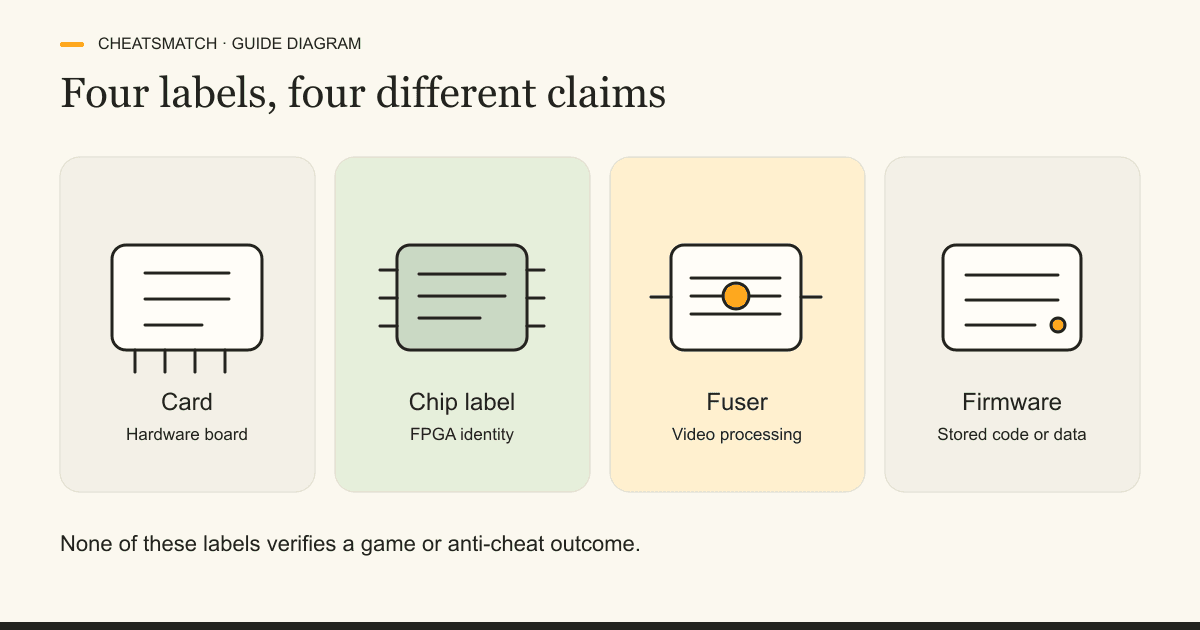
What the hardware labels identify
DMA card, fuser and firmware refer to different things. A card names a physical board and its claimed memory-access role. A fuser names a video-processing device in DICHEN’s terminology. Firmware refers to programs or data stored in hardware, as NIST defines the general term. A listing may bundle these words, but the words do not describe one interchangeable component.
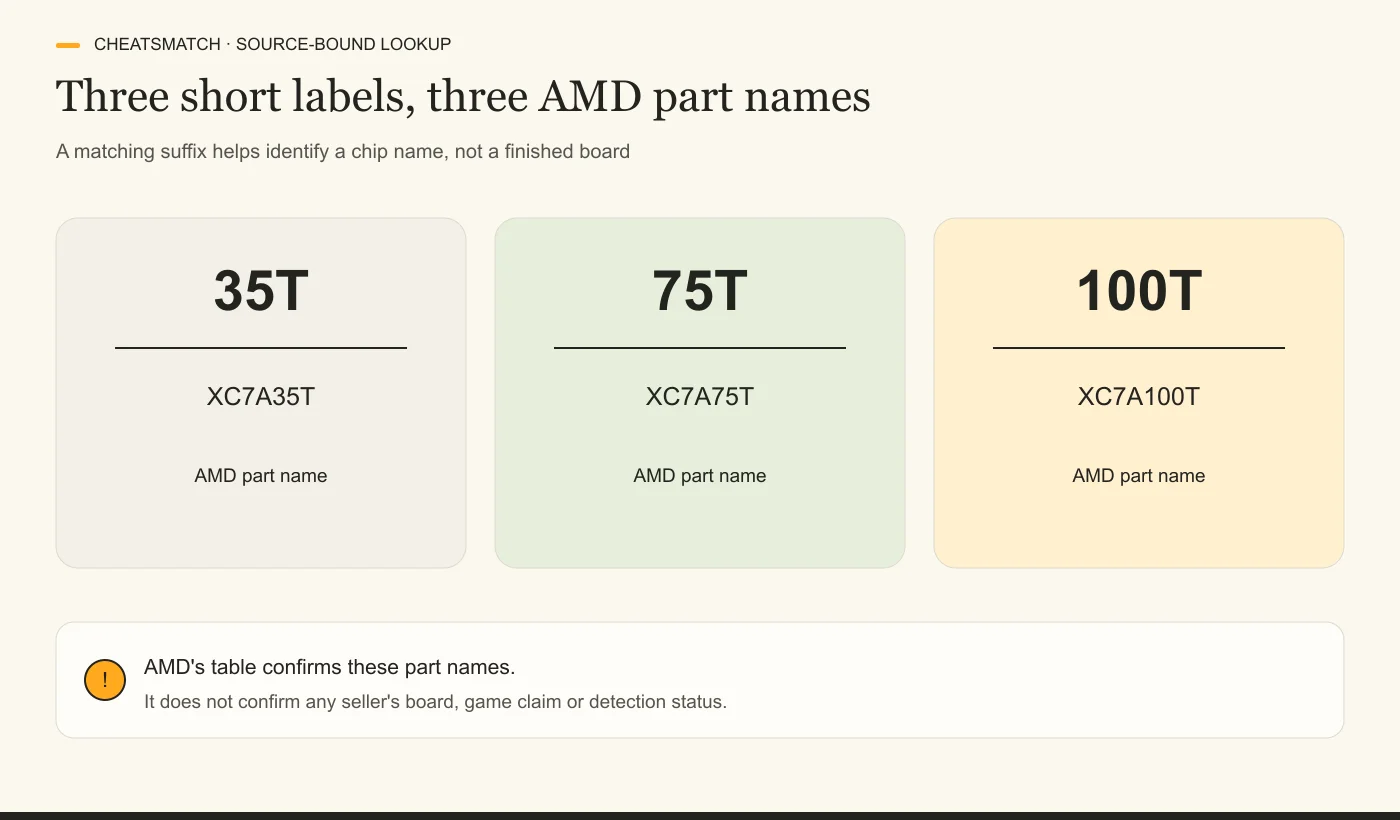
AMD lists Artix 7 FPGA part numbers with 35T, 75T and 100T suffixes. A vendor may use a shorter board label based on a chip, but the shorthand alone does not identify the complete board, its included software, a display device or game compatibility. The DMA concept guide explains the broader term; the DMA comparison hub presents dated listings. Neither is a board test.
| Label | Documented meaning | What the label does not prove |
|---|---|---|
| DMA card | A vendor-described hardware board associated with direct memory access. | A particular game, firmware package or anti-cheat outcome. |
| Fuser | DICHEN’s term for hardware that combines video inputs into a displayed image. | That the device reads system memory or validates a card claim. |
| Firmware | Programs or data stored in hardware, in NIST’s general definition. | A specific version, function or current support status. |
| 35T / 75T / 100T | Shorthand resembling suffixes in AMD Artix 7 part numbers. | Which chip a particular board contains or any game outcome. |
What a DMA card can mean
Direct memory access is an ordinary hardware capability. Microsoft says some DMA-capable PCIe peripherals can read or write system memory without the processor handling each operation. Riot Games separately describes purpose-built PCIe hardware used to abuse that capability in its games. The same technical term therefore appears in legitimate device documentation and in a publisher’s account of cheating.
A seller’s “DMA card” label describes an offered board; it does not establish how that particular board behaves. AMD’s Artix 7 documentation identifies FPGA chips, not finished cheat products. A specific listing needs its own documented board identity and dated source before anyone can compare its claims. This guide does not treat a card name as a compatibility test.
What 35T, 75T and 100T mean
AMD lists XC7A35T, XC7A75T and XC7A100T in its Artix 7 family. The short labels 35T, 75T and 100T resemble those part-number suffixes. AMD’s table verifies the existence of those chip names. It does not establish which chip is on a seller’s board, what else the board includes or what the board can do in a game.
A short “75T card” description can leave the board maker and actual part number unstated. Treat the full AMD part number as an identity anchor, then keep any separate board, firmware and game claim attached to its own dated evidence. A suffix is not a hardware grade or a result from a product test.
| Short label | Matching AMD Artix 7 part | Evidence limit |
|---|---|---|
| 35T | XC7A35T | AMD part name, not a board verification. |
| 75T | XC7A75T | AMD part name, not a board verification. |
| 100T | XC7A100T | AMD part name, not a board verification. |
Sources: [1]
What a fuser does in vendor terminology
DICHEN calls its fuser a device that merges a secondary video feed with a primary image. That is a vendor description of a display-processing role. It is separate from Microsoft’s definition of DMA-capable hardware accessing system memory. A fuser label does not turn a video device into proof that another board can read memory.
The vendor’s video-fusion description does not verify a detection claim. Display-format or performance promises are model-specific marketing claims; this page does not compare models or describe wiring, controls or settings. The useful distinction is between video processing and access to system memory, because a listing may mention both without identifying which device performs which role.
What firmware means on a listing
NIST defines firmware as programs and data stored in hardware. That makes firmware a different claim from the identity of the FPGA chip or the physical card. A listing that names a chip but omits firmware details has not explained what device-resident instructions it includes, what they do or how they are maintained.
“DMA firmware” can be seller shorthand rather than a precise product specification. It should be read as a provider statement until a dated document identifies the device, the firmware and the claim being made. Neither a part-number suffix nor the word firmware can establish a game outcome. This guide does not provide files, configuration details or update procedures.
What official security sources establish
Microsoft’s Kernel DMA Protection documentation describes a Windows defense against unauthorized memory access by certain external peripherals. It says Windows uses an input/output memory management unit, or IOMMU, to constrain access in that scope. The article also states feature requirements and limits. It does not say that one Windows setting settles every internal PCIe or game anti-cheat case.
Riot Games identifies DMA as a cheating category in its own anti-cheat analysis and discusses IOMMU-related protection in a separate security update. Riot’s statements concern Riot’s environment and dates; they do not certify any vendor device or produce a universal detection rate. The VALORANT comparison page offers game-specific listing context, not a DMA certification.
How to compare a hardware claim
A hardware listing is easier to read when each claim has its own source. Identify whether “35T” describes a documented AMD chip, whether “fuser” is the vendor’s video-device term and whether firmware is specified. Then keep the claimed game and the date of the statement attached to that statement. A provider’s description documents what it says, not an independent test.
CheatsMatch’s evidence method separates provider-reported claims from corroborated information. Its game directory links to game pages, and the DMA comparison hub can show documented listings, but neither a board label nor a catalogue row proves effectiveness, safety or a detection result. This guide offers no card or fuser price range because it does not contain a verified package-level price series.
Sources: [7]
Where the terminology fits
DMA hardware terminology is only one part of a buying decision. The concept guide explains the difference between ordinary direct memory access and cheating misuse. The DMA comparison hub is the place to inspect dated product listings; a game page narrows the context to the named game. Those pages should be read as source records rather than assurances about a device.
The useful question is which part of a claim is documented. AMD can identify a chip family, NIST can define firmware, DICHEN can describe its own fuser terminology and a publisher can explain its security position. None of those sources alone verifies an entire commercial bundle. The internal-versus-external guide explains a separate software-location distinction, while this page keeps the hardware labels distinct.
Frequently asked questions
What is a DMA card?
A DMA card is a seller’s label for a hardware board associated with direct memory access. Microsoft defines the underlying capability, while Riot describes its misuse in a gaming context. The label alone does not verify what a particular board does or which games it supports.
Is a fuser the same as a DMA card?
No. DICHEN describes its fuser as combining video inputs into a displayed image. A DMA-capable card concerns memory access. One vendor’s terminology does not establish the function or performance of every product sold under either label.
What do 35T, 75T and 100T identify?
AMD lists XC7A35T, XC7A75T and XC7A100T as Artix 7 FPGA part numbers. Those suffixes identify chip models when the full part number matches. They are not standardized cheat grades, game-compatibility ratings or detection results.
Does a 100T label mean a better DMA card?
A 100T label resembles the suffix of AMD’s XC7A100T part number. It does not verify the chip in a particular board or measure the board’s quality, firmware, game behavior or anti-cheat outcome. Each claim needs separate evidence.
Does DMA firmware make a device undetectable?
No such conclusion follows from the word firmware. NIST defines the term as device-resident programs and data. Riot discusses DMA defenses in its own games, and neither source verifies a seller’s claim about a particular firmware package.
Sources and check dates
Numbers beside a fact or score refer to the sources below. Provider descriptions are claims, not independent product tests.
- AMD: Artix 7 FPGA product table · checked 2026-09-30
- DICHEN: DC505 and DC500 fuser overview · checked 2026-09-30
- NIST: Firmware glossary · checked 2026-09-30
- Microsoft: Kernel DMA Protection · checked 2026-09-30
- Riot Games: Vanguard On-Demand · checked 2026-09-30
- Riot Games: Vanguard pre-boot security update · checked 2026-09-30
- CheatsMatch: How We Rate · checked 2026-09-30