
What Are DMA Cheats? A Plain-Language Explanation
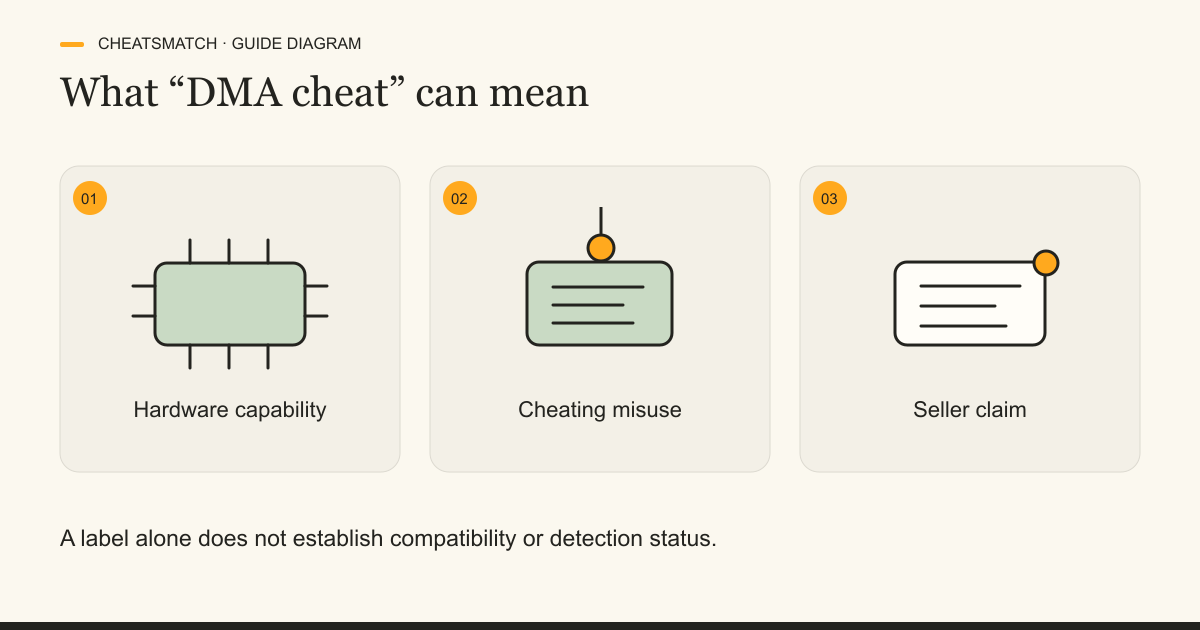
A DMA cheat is a use of direct memory access hardware to obtain game information outside the ordinary game interface. In 2026, the term can refer to three different things: a normal hardware capability, its misuse in a game, or a seller's product claim. Those meanings should be kept separate. Microsoft explains the underlying memory-access capability; Riot Games and Activision describe DMA-based cheating in their own anti-cheat work.
What a DMA cheat means
A DMA cheat means using hardware with direct memory access, or DMA, as part of an attempt to gain information or an advantage in a game. DMA is the underlying memory-access capability. “Cheat” describes the purpose to which that capability is put. Riot Games names DMA abuse among the cheating methods it addresses in League of Legends and VALORANT, while Activision lists DMA-based cheating hardware among categories in the Call of Duty cheating ecosystem. Neither statement verifies a particular product's performance or its status in another game.
The distinction matters because a search result may use “DMA” to describe a technical mechanism, a card, a service or a supposed benefit. Those are different claims. The table below separates what each label can establish from what remains to be checked.
The live game directory is a starting point for documented listings; it is not a DMA compatibility certification.
| Term | What it establishes | What it does not establish |
|---|---|---|
| DMA-capable hardware | A device can be capable of direct memory access. | The device is a cheat or is compatible with a particular game. |
| DMA cheating | A publisher describes the misuse of that capability for an unfair advantage. | A particular method succeeds, avoids detection or works across games. |
| DMA product listing | A seller is making a claim about a product or service. | Independent proof of compatibility, status, safety or effectiveness. |
DMA is an ordinary hardware capability
Direct memory access is a normal capability of some peripherals, not a synonym for cheating. Microsoft says DMA-capable devices can read or write system memory without the processor handling each operation. PCI-SIG describes PCI Express as a general-purpose input/output interconnect. Taken together, these sources explain why a PCIe device and a DMA-capable device can be ordinary PC hardware. They do not make every connected device a game exploit.
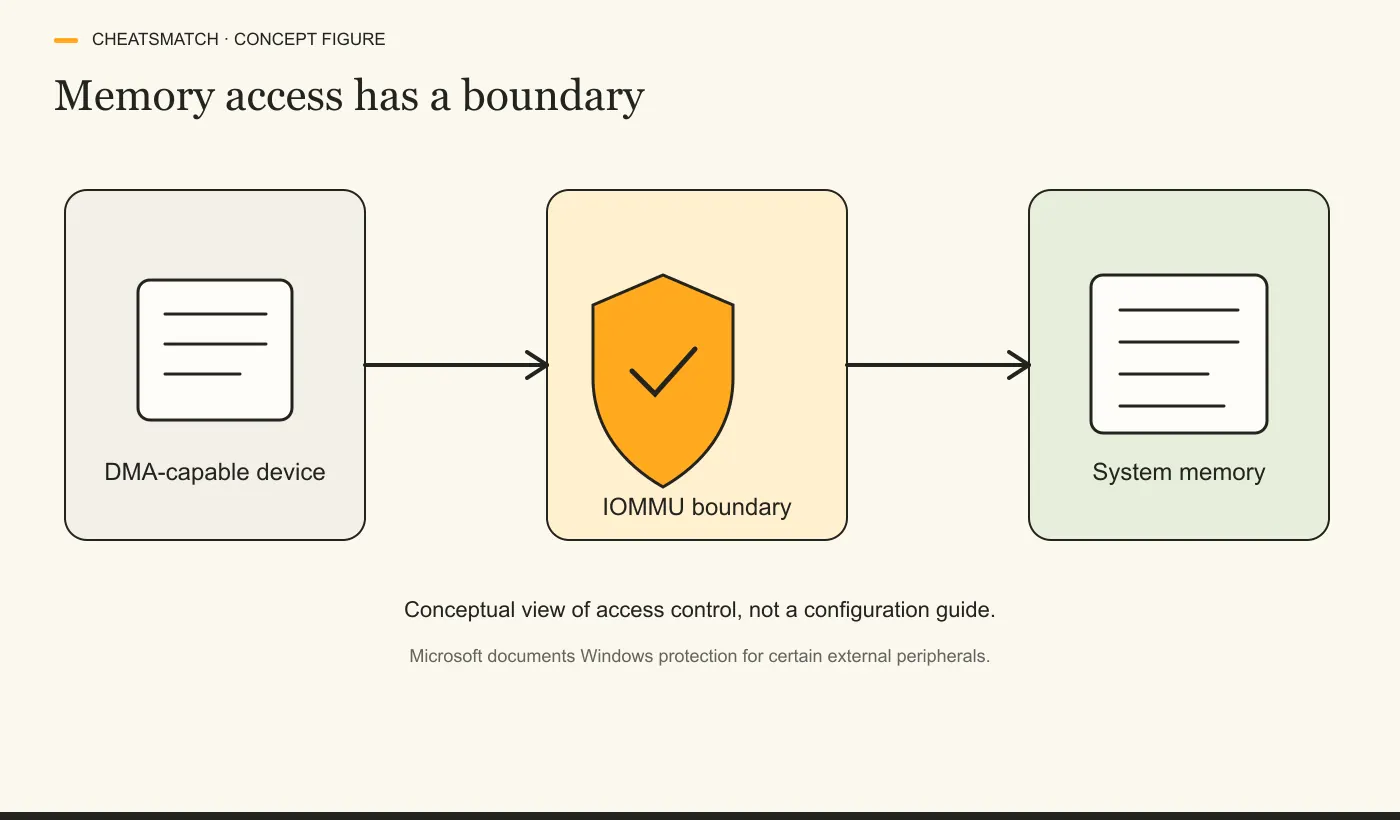
Microsoft's Kernel DMA Protection article is about a Windows defense against unauthorized access by external peripherals. It discusses hot-plug classes such as Thunderbolt, USB4 and CFexpress, and how Windows uses an input/output memory management unit, or IOMMU, to control access in that scope. That article should not be stretched into a claim about every internal card, every machine or every game. A device's presence alone says little about the intent behind it.
Why publishers discuss DMA cheating
Riot Games discusses DMA cheating because its anti-cheat team identifies hardware-assisted memory access as one of the methods used against its games. Its June 2026 Vanguard article describes DMA as a category in its own cheat analysis. A later Riot security update discusses how IOMMU and pre-boot protections relate to that threat. These are Riot's observations about Riot's environment, not a cross-game measurement.
Activision's RICOCHET team also names DMA-based cheating hardware in its September 2026 account of the Call of Duty cheating ecosystem. It describes technical and behavioral anti-cheat work, but that article does not publish a detection rate for every DMA product. A reader looking at a listing should keep the game, publisher and date attached to each statement. The VALORANT comparison page provides game context, while Riot's source provides the narrower publisher statement.
DMA versus internal and external software cheats
DMA cheating is a hardware-assisted category, while “internal” and “external” usually describe where software operates relative to the game process. Riot's Vanguard article discusses internal, kernel-level, DMA and computer-vision methods as distinct categories in its account. Those names classify approaches; they do not form a scale from easy to safe, or a ranking of what anti-cheat can and cannot detect.
This difference is useful when comparing claims. A seller can call something “external” without establishing that it uses DMA, and the presence of DMA-capable hardware does not establish that a particular software claim is true. The separate internal-versus-external guide covers that taxonomy in more detail.
The cheat glossary defines DMA and the neighboring implementation terms in brief.
Sources: [3]
What IOMMU and anti-cheat claims can establish
An IOMMU can constrain which memory regions a device may access. Microsoft describes its use in Windows Kernel DMA Protection for certain external peripherals. Riot discusses IOMMU as part of its own response to DMA abuse and says a motherboard security issue affected some pre-boot protection. The useful conclusion is that protections have defined scopes and conditions. Neither article establishes that every DMA attempt is detected, or that a device is beyond detection.
There are also two different questions: whether a Windows feature is enabled on a specific computer, and whether a game's anti-cheat can identify or respond to cheating. The Microsoft article addresses the first in its stated external-peripheral scope. Riot and Activision describe their own anti-cheat responses. A claim such as “undetectable” would need product-specific, current evidence that these sources do not provide. No listing should be treated as proof of it.
How to read claims about DMA products
A DMA product claim needs a named game, a dated source and a clear evidence label before it can be compared with another listing. A provider statement is evidence that the provider made the statement. It is not independent corroboration of compatibility, safety, detection status or current availability. Hardware labels alone do not fill that gap.
CheatsMatch's rating method separates provider-reported claims from stronger corroboration and records source dates. That method is useful even when a catalogue row has no DMA field: it tells a reader which claims have actually been documented. If a listing lacks a source or a check date, leave the claim unresolved rather than filling it from a vendor slogan.
Where to compare documented listings
The CheatsMatch game directory organizes comparison pages by game. It does not turn a general DMA definition into a promise that a listed product supports DMA or works for that game. The DMA comparison hub brings together eligible public provider listings, recorded game associations and available plan terms. Its broader catalogue count and narrower visible listing set have different eligibility rules.
For now, use the game pages to read exactly what each record says, then check its source and date. Treat any broader conclusion about product reliability or anti-cheat outcomes as unverified unless the cited evidence actually supports it. That is the practical boundary between a useful directory and a claim the directory cannot prove.
The hardware terminology guide explains the separate card, fuser and firmware labels.
Frequently asked questions
What does DMA mean in gaming?
DMA means direct memory access, a general hardware capability that can allow a peripheral to access system memory without the CPU handling each operation. In gaming discussions, publishers sometimes use “DMA” as shorthand for the abusive use of that capability. The hardware term and the cheating term should stay distinct.
Is a DMA card automatically a cheat?
No. PCI Express is a general-purpose interconnect, and DMA-capable peripherals have ordinary uses. Whether a device is involved in cheating depends on its use and context, not simply the label on a card. A seller's description is not independent proof of what a device does.
Are DMA cheats detectable?
Publishers describe defenses against DMA abuse, including Riot's IOMMU-related work and Activision's layered anti-cheat work. These accounts show that DMA is part of their threat models. They do not supply a universal detection rate or verify the current status of a particular product.
Does Windows Kernel DMA Protection stop all DMA cheating?
No such conclusion follows from Microsoft's article. It describes a Windows feature focused on unauthorized memory access by certain external peripherals and states its own system requirements and limits. It does not claim to settle every internal-device or game anti-cheat scenario.
How is a DMA cheat different from an external software cheat?
DMA names a hardware memory-access capability and its abusive use. “External software cheat” describes a different classification based on where software runs relative to the game. A product can be described with overlapping marketing labels, so each technical claim needs its own evidence.
Sources and check dates
Numbers beside a fact or score refer to the sources below. Provider descriptions are claims, not independent product tests.
- Microsoft, Kernel DMA Protection · checked 2026-09-29
- PCI-SIG, What is the PCI Express architecture? · checked 2026-09-29
- Riot Games, Vanguard On-Demand · checked 2026-09-29
- Riot Games, VAN:Restriction and motherboard pre-boot security · checked 2026-09-29
- Activision, Taking on the Cheating Ecosystem · checked 2026-09-29