Free Cheats and Loaders: Malware, Scams and Detection Risks
Cheat Engine is a game and application modification tool, according to its developer; its name alone does not establish whether a particular file is malware. Microsoft distinguishes malware from potentially unwanted applications. Unit 42 documented a backdoored game-cheat distribution campaign in 2025. In the CheatsMatch catalogue checked through September 23, 2026, eight of 1,492 in-scope listings have a free price state. Price is not a security test.
What Cheat Engine is and what its name cannot tell you
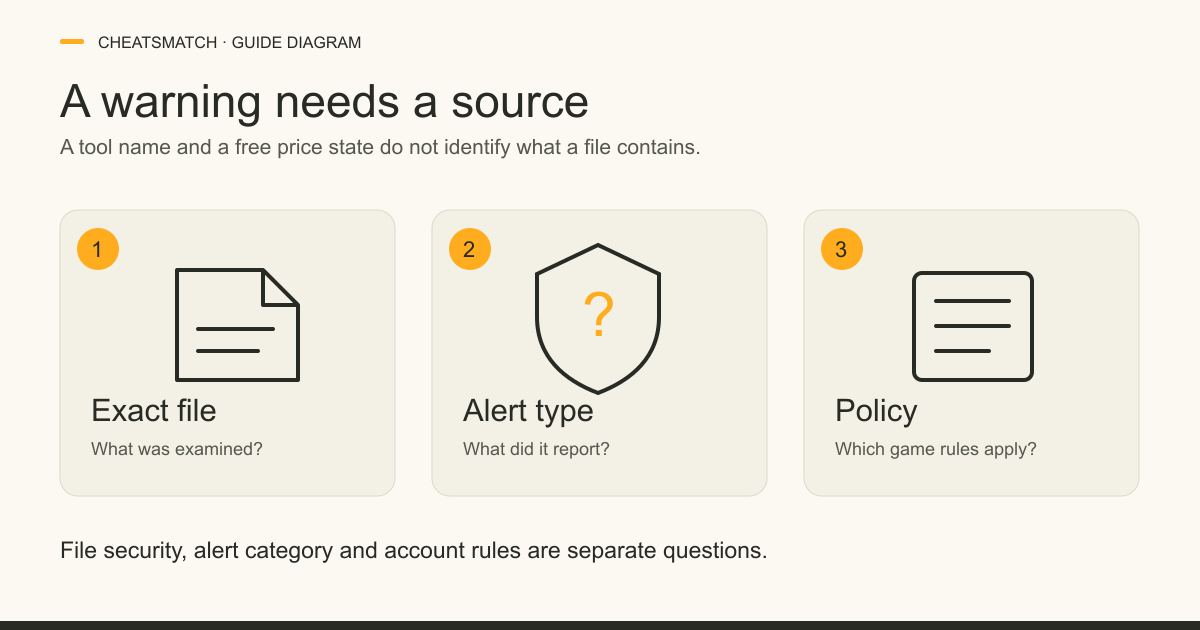
Cheat Engine's official FAQ calls it a tool for understanding and modifying how a game or application works. That describes what the developer says the software is for. It does not identify the contents of every file distributed under that name, and it does not tell you what a security product detected in a particular copy. The question “is Cheat Engine a virus?” needs a specific file and an actual alert category before anyone can answer what was found.
Microsoft's classification guidance separates malware, potentially unwanted applications and software it has not recognized. A product name or a search snippet is not a scan result. An alert can also concern a bundled component or a different file in the same package. Do not convert the developer's description into a clean-file certificate, or an unexplained warning into a verdict about every copy.
The CheatsMatch provider directory compares what sellers publish and what sources support. It does not scan or certify software files.
A loader describes a role, not a safety finding
A cheat loader is commonly a program that starts or delivers another component. That plain-language role does not say whether the component is authorized, unwanted or malicious. The same word can describe different software designs, so a seller's “loader” label is not a security classification.
Unit 42's Blitz analysis gives a dated example of why the distinction matters. In its 2025 game-cheat campaign, the altered package retrieved a downloader, and that downloader retrieved a bot payload. The research supports that observed chain in the investigated packages. It does not establish the behavior of every loader, and this guide gives no steps for obtaining or running one.
The useful question is what an original security analysis found in the exact file. A listing's feature description and an antivirus alert are different kinds of evidence.
One documented malware campaign used altered cheat packages
Palo Alto Networks Unit 42 reported a Blitz malware campaign that used backdoored game-cheat packages in early 2025. Its researchers identified a downloader and bot payload in the investigated distribution, following an earlier 2024 Blitz campaign with a different lure. The described game-cheat packages were the vehicle for that case. Unit 42 did not measure a rate of malicious free cheats across the market.
That case supports a narrower warning: a package presented as a cheat can contain more than the advertised program. Unit 42's article also describes the people and channels it investigated, but those sample names and distribution details are unnecessary for a buyer-safety explanation. The article does not implicate Cheat Engine or every developer whose software might be imitated or altered.
Do not use the 2025 incident as proof that any currently listed CheatsMatch provider distributes malware. A named-party allegation would need its own product-specific primary evidence.
Sources: [3]
Malware, PUA and unknown are different alert categories
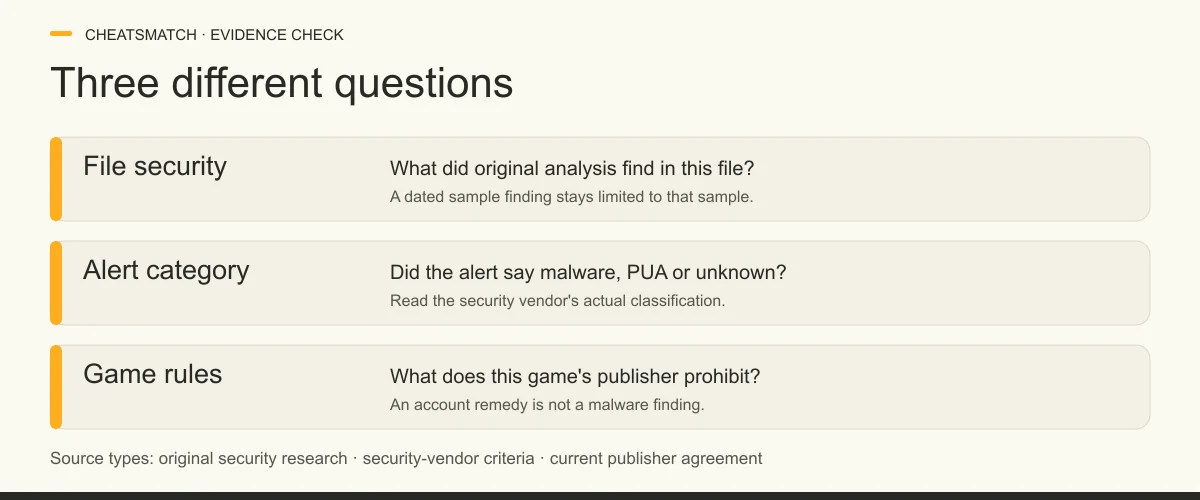
Microsoft defines malware as code or an application that compromises user security. Its criteria list potentially unwanted applications, or PUAs, separately and state that PUAs are not considered malware. Microsoft also has an unknown or unrecognized category, which reflects limited reputation information rather than a confirmed malware finding. None of those general categories assigns a verdict to a file that has not been identified and examined.
The phrase “false positive” is a claim about a specific detection. Microsoft's criteria acknowledge that classifications can change and no protection technology is perfect. That does not make an unexamined alert false. CheatsMatch's evidence labels similarly distinguish a provider's statement from an independently supported finding.
| Question | Evidence source | What the evidence establishes |
|---|---|---|
| Does a specific package contain malicious code? | A security vendor's analysis of that file or campaign, such as Unit 42's Blitz case | A bounded finding about the analyzed sample, not all cheats. |
| What does a Microsoft alert label mean? | Microsoft's malware, PUA and unknown criteria and the device's Protection history | The category and action recorded for that file; a PUA is not automatically malware. |
| Could using an unauthorized program affect a game account? | The relevant publisher's current agreement, such as EA's own terms | The publisher's stated rule and possible service remedy, not a malware classification. |
What the catalogue says about free price states
CheatsMatch's generated catalogue snapshot checked through September 23, 2026, marks eight of 1,492 in-scope provider-product listings with a free price state. The other price states include published, unknown, inaccessible, included with a paid purchase and starting-only. The generator's scope is Windows PC listings tied to a provider with at least one claim and source. A listing is not necessarily a distinct underlying software product.
This count describes how the catalogue records an offer, not how a file behaves. The eight records were not tested here for malware, and the count is not an estimate of all free cheats online. A paid offer also has no automatic security certification. Price and file integrity need separate evidence.
Game account rules are a separate risk
EA's User Agreement, updated May 14, 2026, describes unauthorized third-party programs in Section 7.C and says EA may terminate a license and account if it determines that a user cheated. That is a service-rule and account-consequence statement for EA Services. It does not classify a program as malware, and an antivirus label does not decide whether EA's game rule was broken.
Game-specific directories on CheatsMatch narrow listings by recorded game association. The Valorant comparison is a directory example, not an EA policy page. A product listed for a game is not thereby approved by that game's publisher, tested for security, or assured against account action. Read the relevant publisher's own current terms for a particular game. The separate legal guide explains the difference between an account sanction and a civil or criminal claim.
Sources: [4]
Use the security alert as a reason to stop and check
Windows Security's Protection history shows actions Microsoft Defender Antivirus has taken, including malware and potentially unwanted application events. Microsoft's support page says that when a person is unsure whether a detected item is safe, quarantine is the prudent choice. It warns that allowing a real threat can put data and the device at risk. This is a response to an alert, not a method for getting a cheat to run.
The FTC advises using security software and avoiding unfamiliar sites for free digital material. Keep the source and alert details for any genuine support or security question, but do not follow a seller's request to turn off protection as proof that a warning is harmless. A file's claimed origin, a social post and a scan category answer different questions. If an alert concerns a device already in use, follow current guidance from the security vendor or a qualified support channel.
This guide does not tell readers to override, suppress or bypass a security product's decision.
Compare documented provider claims without treating price as proof
CheatsMatch compares published provider information, source dates and documentation quality. A provider-reported status or “clean” claim remains a claim by that provider until supported by independent evidence about the exact file and date. A documentation score measures how clearly an offer is described; it does not measure malware resistance, detection by a game or transaction safety.
The provider evaluation guide offers a broader method for reading support, terms and status claims. Use it to keep the seller's description separate from a developer's original statement, an official security alert and a publisher rule. The catalogue's free price state is one field in that comparison, never a substitute for those records. The reseller guide addresses who supplies a product; that identity question is separate from whether a file is malicious.
The reviews and vouches guide treats customer reports as context, not proof that a file is safe.
Sources: [7]
Frequently asked questions
Is Cheat Engine a virus?
Cheat Engine's developer describes it as a tool for understanding and modifying games and applications. That description does not certify a specific file, and the name alone does not identify malware. Check the exact file and the security product's recorded category; this page does not classify any particular copy as clean or malicious.
Does a hacktool or PUA alert mean a file is malware?
Under Microsoft's published taxonomy, a hacktool appears in its malware-category list; Microsoft defines it as a tool that can be used to gain unauthorized access. Microsoft separately says PUAs are not considered malware. Check the exact file and alert rather than assigning either label to every copy of a named program, and do not call a detection a false positive solely because a seller says so.
Can a free cheat contain malware?
A free cheat can contain malware. Unit 42 documented a 2025 Blitz campaign distributed through altered game-cheat packages containing a malicious downloader and bot payload. That observed case does not establish how common malware is among free cheats. The price or “free” label alone is not a security test.
Should I turn off antivirus to use a loader?
Antivirus protection should not be turned off to use a loader. Disabling protection removes a security check without establishing that the file is harmless. Microsoft's Protection history guidance favors quarantine when the status of a detected item is uncertain. Use the security vendor's current guidance to understand the alert; this guide does not provide loader-use steps.
Sources and check dates
Numbers beside a fact or score refer to the sources below. Provider descriptions are claims, not independent product tests.
- Cheat Engine: FAQ · checked 2026-09-29
- Microsoft Defender XDR: How Microsoft identifies malware and potentially unwanted applications · checked 2026-09-29
- Palo Alto Networks Unit 42: Blitz Malware, A Tale of Game Cheats and Code Repositories · checked 2026-09-29
- EA User Agreement · checked 2026-09-29
- Microsoft Support: Protection History in the Windows Security App · checked 2026-09-29
- FTC: Malware, How To Protect Against, Detect, and Remove It · checked 2026-09-29
- CheatsMatch: How we rate products · checked 2026-09-29