Is Cheating in Online Games Illegal? Laws and Lawsuits Explained
Whether cheating in an online game is illegal in the United States depends on the conduct and the legal claim. As of September 2026, four different questions help separate game rules, contract remedies, civil lawsuits and criminal provisions. A publisher's account penalty does not answer what a court decided about a cheat seller. This guide uses publisher terms, federal statutory text and an appellate record to explain those differences. This page is general information, not legal advice.
The short answer depends on conduct and jurisdiction
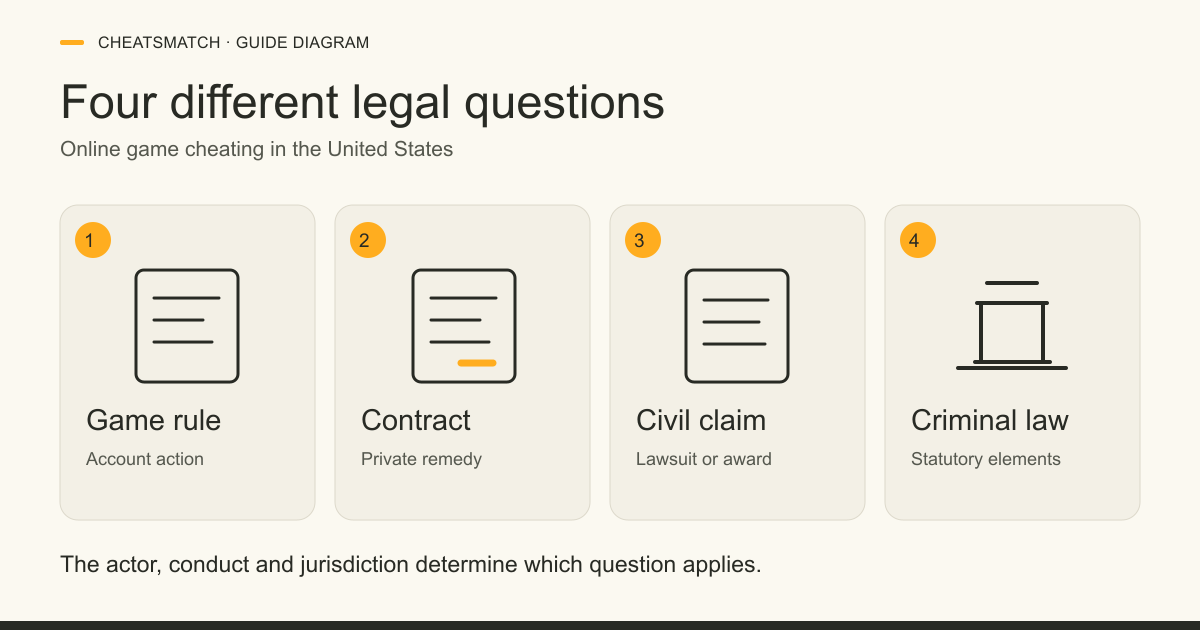
As of September 2026, four consequence categories help answer whether online game cheating is illegal in the United States: a game rule, a contract remedy, a civil claim and a criminal provision. A player using an unauthorized program, a seller distributing one and a person circumventing a copyright access measure present different questions. A publisher can also enforce its own rules without proving a criminal offence.
CheatsMatch's provider directory compares documented listings. A listing is a description of an offer; it does not establish that any conduct is lawful or that a product's claims are independently verified.
| Category | Conduct at issue | Possible consequence | Source type |
|---|---|---|---|
| Game rule | Player conduct prohibited by a game's rules | Account or access sanction under that service's terms | Current publisher agreement |
| Contract | Conduct allegedly breaching an accepted agreement | A private remedy, if the agreement and claim support it | Agreement and any court or arbitration record |
| Civil claim | Conduct meeting the elements of a private legal claim | A court judgment or arbitral award in the particular dispute | Statute and original case record |
| Criminal provision | Conduct meeting the elements of a criminal statute | Prosecution and statutory penalties, if the required elements are proved | Criminal statute and original criminal record |
Game rules and account bans are separate from criminal law
EA's User Agreement, last updated May 14, 2026, describes account and service sanctions in Section 8 and addresses unauthorized third-party programs in its anti-cheat provisions. The agreement says EA may terminate a user's license and account if it determines that the user has cheated. That is EA's stated service remedy. The agreement does not by itself answer whether a different game, legal claim or jurisdiction imposes civil or criminal liability.
Read a ban notice for its source and scope. Which company issued it? Which game and account does it cover? Which part of the agreement does it cite? A technical error or an online accusation is not a court finding. EA's agreement is an example; each publisher's terms must be checked on their own.
The Fortnite comparison on CheatsMatch is a game-specific product directory. Its presence is not an opinion about the legal status of any listed tool or the terms of Epic's service.
Sources: [2]
Contracts can create private remedies
A game license or user agreement can define what a service permits and what the company may do when it finds a violation. EA's agreement includes rules of conduct and a section on termination and other sanctions. Those provisions describe a relationship between EA and the account holder; they should not be presented as a criminal statute.
Contracts can also matter in litigation. In Bungie v. AimJunkies, the Ninth Circuit's August 26, 2024 memorandum explains that six of Bungie's nine causes of action were referred to arbitration under Bungie's limited software license agreement. The appeal before that court concerned confirmation of the resulting arbitration award. The memorandum is a record of a particular dispute involving a cheat business, not a general ruling about every player who breaks a game rule.
Making or selling cheat software can lead to civil claims
US law can address the distribution of certain circumvention tools separately from a player's in-game conduct. Section 1201 of Title 17 regulates specified acts of circumventing technological measures that control access to copyrighted works and specified trafficking in circumvention technology or services. A claim depends on the statutory elements, the facts and any applicable exception. The word “cheat” alone does not establish that those elements are met.
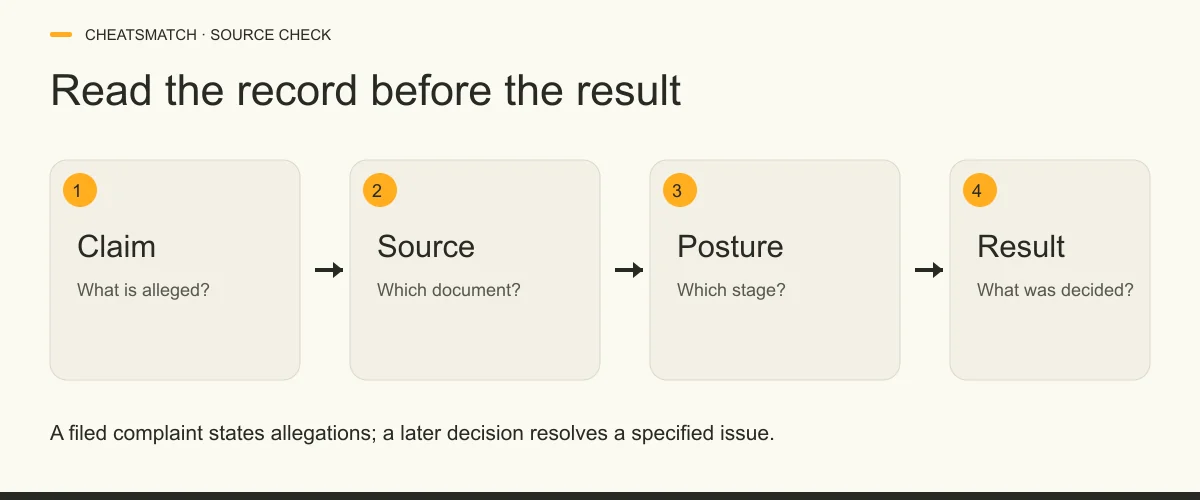
Read the original record behind a lawsuit headline. A complaint records what a party alleges. A decision, confirmed award or settlement has a different procedural meaning. Filing a case does not turn an allegation about a seller into a finding.
CheatsMatch's provider evaluation guide explains how to separate a seller's published description from documented evidence. That same discipline applies when a seller or critic makes a legal claim.
What the Bungie v. AimJunkies decision actually decided
In No. 23-35468, the US Court of Appeals for the Ninth Circuit affirmed a district court order confirming an arbitration award in Bungie's case against AimJunkies and related defendants on August 26, 2024. The appellate question was whether the arbitrator's handling of testimony or authority required the award to be vacated. The panel rejected those challenges. The memorandum identifies other claims as pending before the district court at the time of its decision.
The panel's document is expressly marked as nonprecedential under Ninth Circuit Rule 36-3. It does not say that ordinary use of an aimbot is automatically a federal crime. The court addressed a specific arbitration record and the narrow grounds for vacating an award. Do not use the award as a stand-in for a criminal conviction or treat the defendants' entire business as adjudicated on every possible theory.
| Case | Court and date | Conduct and claim | Procedural posture | What the record establishes |
|---|---|---|---|---|
| Bungie v. AimJunkies, No. 23-35468 | US Court of Appeals for the Ninth Circuit, August 26, 2024 | Bungie's dispute with a cheat business under claims partly sent to arbitration | Appeal from confirmation of an arbitration award | The panel affirmed confirmation; it did not decide a universal criminal rule for players. |
How 17 U.S.C. § 1201 applies to circumvention claims
As of September 2026, 17 U.S.C. § 1201 addresses technological measures protecting access to copyrighted works and certain rights of copyright owners. Its text distinguishes an act of circumvention from making, offering or trafficking in a covered technology or service. It also contains definitions and exceptions. Whether a particular product or action falls within the section cannot be inferred from a marketing label.
Civil and criminal paths must also be separated. Section 1204 describes criminal penalties for a willful violation of section 1201 or 1202 for commercial advantage or private financial gain, subject to the statute's terms and limitations. That additional threshold is one reason a civil cheat-seller case cannot be described as a prosecution of all players. This guide does not decide whether a specific tool meets any statutory element.
Sources: [1]
Read a cheat lawsuit by claim, posture and outcome
A cheat lawsuit should be read as a sequence of documents, not as one verdict. Start with the parties and court, then identify the conduct alleged and each claim. Check whether the document is a complaint, motion, preliminary order, arbitration award, judgment or appellate decision. Read the result only for the issue the decision resolves.
In the Bungie appeal, the Ninth Circuit described the arbitration award and upheld its confirmation. That establishes an appellate result about the award. It does not resolve unrelated games or every separate claim in the district court case. The description here is limited to the August 2024 decision rather than the present status of the wider litigation.
What to check before relying on a legal claim
A legal claim about game cheating needs six labels: jurisdiction, actor, conduct, legal basis, date and procedural posture. “A player lost access under a publisher agreement” is not interchangeable with “a seller faced a civil claim” or “a person was convicted under a criminal provision.” Ask for the original document before repeating the strongest version of any claim.
CheatsMatch distinguishes a provider-reported description from stronger documentation in its evidence method. A seller's statement about legality is still that seller's statement. The provider directory compares documented offers; the statute, agreement and court record answer different legal questions. If a personal dispute affects an account, payment or lawsuit, consult a qualified professional in the relevant jurisdiction.
Frequently asked questions
Is using an aimbot automatically a crime in the United States?
As of September 2026, the word “aimbot” alone does not identify the elements of a US criminal offence. A legal claim must identify the conduct and the statute whose elements it says were met. Section 1204, for example, adds willfulness and a commercial advantage or private financial gain purpose to specified copyright-protection violations; a publisher's account sanction is a different matter.
Can a game publisher ban an account for cheating?
EA's User Agreement, updated May 14, 2026, says in Section 7.C that EA may terminate a license and account if it determines that a user has cheated; Section 8 describes other sanctions. Other publishers' remedies depend on their own current terms and the particular notice. An account action is a service decision, not by itself a criminal judgment.
Is making or selling game cheats the same legal question as using one?
As of September 2026, 17 U.S.C. § 1201 has separate provisions for specified circumvention conduct and for trafficking in covered technology or services. Making or selling a tool can therefore raise different claims from an individual's use of it. The facts and elements matter; neither the product label nor a news report decides the issue.
Does a lawsuit mean a court found the conduct illegal?
Filing a lawsuit states a party's allegations, not a final finding. In No. 23-35468 on August 26, 2024, the Ninth Circuit's Bungie memorandum recorded a specific appellate result: it affirmed confirmation of an arbitration award against AimJunkies and related defendants. Read each document for its own issue, date and posture.
Sources and check dates
Numbers beside a fact or score refer to the sources below. Provider descriptions are claims, not independent product tests.
- US Copyright Office: Title 17 Chapter 12 · checked 2026-09-29
- EA: User Agreement · checked 2026-09-29
- Ninth Circuit: Bungie v. AimJunkies memorandum · checked 2026-09-29
- Western District of Washington: Bungie arbitration confirmation order · checked 2026-09-29
- CheatsMatch: How we rate products · checked 2026-09-29