Cheat Resellers vs Developers: How to Tell Who Actually Makes a Cheat
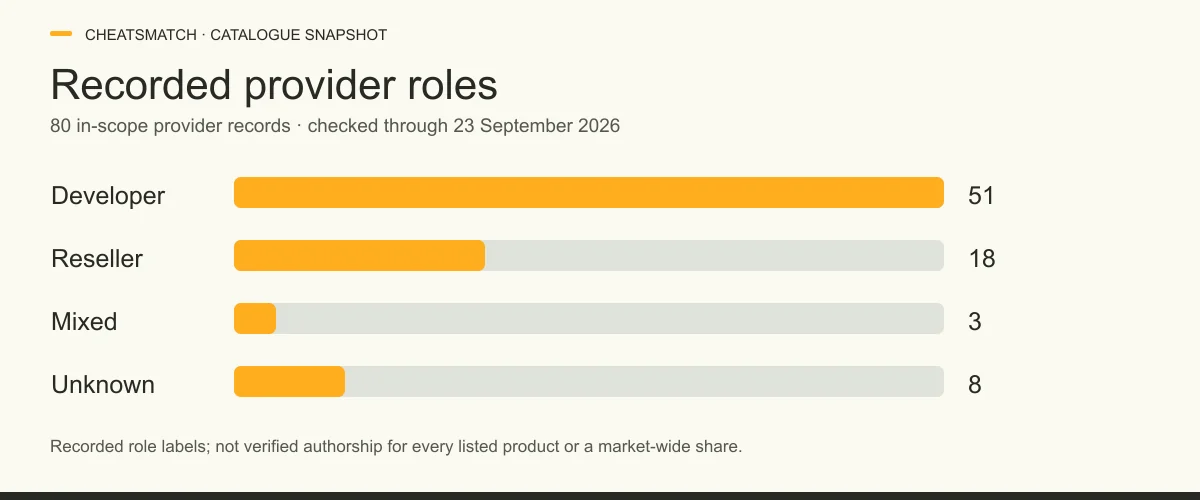
A cheat reseller sells access to software supplied by another party, while a developer makes or maintains the software. A storefront can perform both roles, or its supplier relationship can remain unverified. In the CheatsMatch catalogue checked through September 23, 2026, 18 of 80 in-scope provider records carry a reseller role label. That label describes a recorded provider role; it does not prove who built each product. This guide shows which public records can narrow the question.
Resellers and developers have different roles
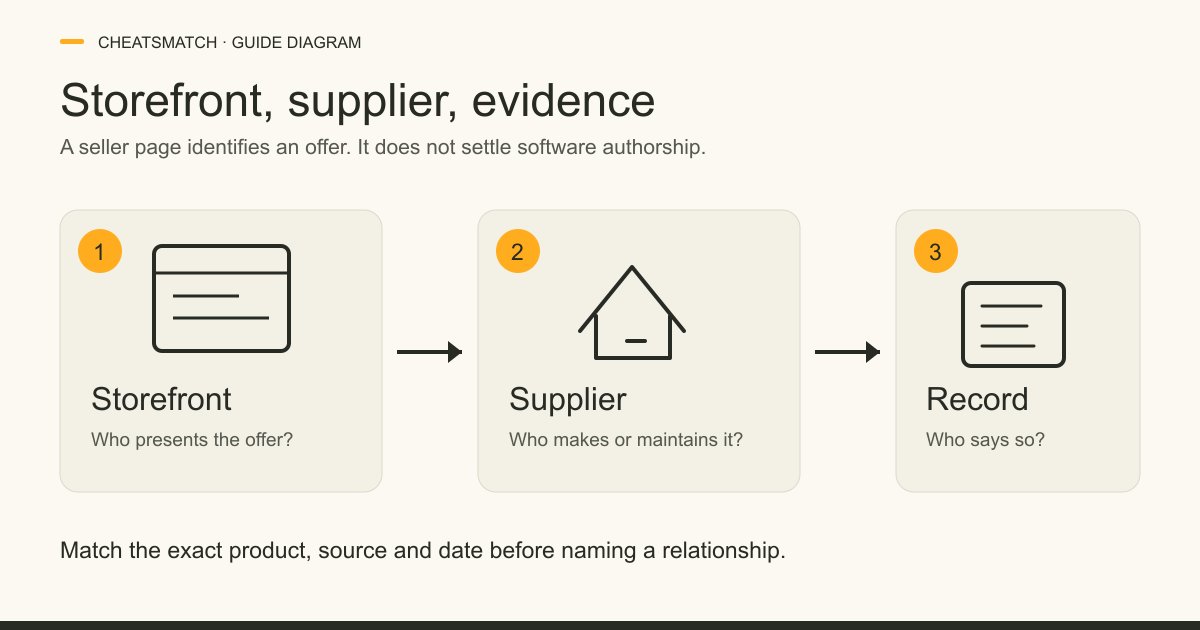
A cheat reseller offers access to software attributed to another supplier; a developer makes or maintains software. One business can sell its own work, distribute another party's product, or do both. A checkout page alone tells you who presents the offer, not who wrote the code or who controls updates. “Mixed” and “unknown” are useful classifications when a single label would overstate what the public record shows.
The distinction matters when reading a listing. The seller that answers an order question may differ from the party that publishes a changelog. The party taking payment may use a separate payment processor. Even a branded launcher or dashboard does not settle underlying authorship. Start with the narrower question that public sources can answer: who says they supply, maintain and support this particular listing?
CheatsMatch's provider directory holds provider records and their documented listings. It is a route for comparing published information, not an authorship certification.
Sources: [1]
A storefront does not prove software authorship
A storefront shows how an offer is presented and may identify the seller, but its design cannot establish who developed the software. Two sites can use similar names or product descriptions without a documented common supplier. A seller can also publish its own description of a supplier relationship. That description is evidence of what the seller says; it is not an independent supplier acknowledgement.
Separate four observations before drawing a conclusion: the exact product listing, a supplier's own statement about that product, the terms shown at checkout, and the source of updates or support. Match the product name and date across the records. A generic “official reseller” badge without a traceable supplier statement does not answer whether authorization covers that product or period. The absence of such a statement is a limit on verification, not proof of an unauthorized arrangement.
The FTC's online marketplace guidance makes a related buyer distinction: the marketplace operator and individual seller can have different roles in payments, returns and problem resolution. That general guidance does not identify the developer of any cheat product.
Sources: [1]
What the CheatsMatch catalogue records
CheatsMatch's generated catalogue snapshot checked through September 23, 2026, contains 80 in-scope provider records with a recorded role classification. It counts 51 developer, 18 reseller, three mixed and eight unknown labels. These are provider-record labels within the site's catalogue, not shares of the wider market. A provider label also does not verify the authorship of every product the provider lists.
The generator includes providers attached to in-scope Windows PC product listings with at least one claim and one source. Its product scope counts a provider-product listing, not an independently verified underlying software product. The catalogue snapshot and the separate product-identity review each have a recorded check date. Those boundaries prevent a role count from becoming a claim about the total number of cheat businesses or unique tools online.
CheatsMatch's evidence method explains why a provider's published claim remains attributed to that provider until stronger documentation supports it.
| Recorded provider role | Count | Scope |
|---|---|---|
| Developer | 51 | Of 80 in-scope provider records |
| Reseller | 18 | Of 80 in-scope provider records |
| Mixed | 3 | Of 80 in-scope provider records |
| Unknown | 8 | Of 80 in-scope provider records |
Sources: [3]
What independence families can and cannot show
CheatsMatch's product-independence records separate a listing from a proposed underlying family and supplier group. In the product-independence file dated September 24, 2026, 1,492 records are classified as follows: 229 are marked documented, 67 held, 866 unknown and 330 unreviewed. Those are workflow states for provider-product records. They do not describe 1,492 independently verified software products, and the 229 documented entries do not imply functional testing or independently confirmed authorship.
A listing contributes to product-identity comparison counts only when it is eligible and has a recorded underlying product family and supplier group. A documented entry can still rely on a provider-reported source. “Unknown” means the reviewed sources did not establish the relationship; “unreviewed” means the identity work has not been completed. A held entry remains out of that identity-ready path. A family field is a way to avoid treating related offers as automatically separate products, not an endorsement of a supplier.
The best conclusion is often narrow: a record has a source-backed attribution, a conflicting signal, or insufficient evidence. Do not convert a database state into a legal authorization claim.
Check a claimed supplier relationship
A claimed supplier relationship is strongest when the identified supplier publishes a product-specific acknowledgement that can be matched to the seller's current listing. The seller's own listing can establish what the seller claims; it cannot, by itself, establish that another company authorized the sale. Dates matter because supplier arrangements and product names can change.
For a broader method, the provider evaluation guide separates published claims, available records and unresolved fields. Keep a URL and check date for each observation, and leave an unsupported relationship as unknown.
| Public record | Question it can answer | Limit |
|---|---|---|
| Seller's product page | What product, access period and support route does this seller advertise? | The seller is the speaker; authorship is not independently established. |
| Supplier's own acknowledgement | Does the claimed supplier identify this seller and this product? | Confirm the statement's date and scope; a general partner list may omit product limits. |
| Terms and checkout information | Which party states the contract, payment and refund conditions? | A payment processor name is not necessarily the software developer. |
| Support and update notices | Who publishes a change and who answers a problem? | A support channel may be delegated; it does not alone prove code ownership. |
Separate payment, access, support and refund terms
A buyer needs to identify the party responsible for each part of an online transaction. The US FTC advises marketplace buyers to check a seller's contact details, terms and return policy, and to read what the marketplace itself will do if a problem arises. Some marketplaces leave refunds to sellers; others provide a separate process. That guidance applies to the roles, without establishing that a particular cheat storefront has either model.
For EU consumer transactions, Your Europe says traders must provide clear pre-purchase information that includes trader identity and contact details, total price, payment arrangements and applicable contract duration. Whether a particular purchase falls under those rules depends on the parties and jurisdiction. The relevant check is the named trader and the terms actually presented, rather than a logo or payment descriptor interpreted in isolation.
Record the seller's stated refund and support routes before assuming the software supplier will answer an order dispute. A reseller arrangement can allocate responsibilities in different ways. The published terms are evidence of what is offered; they are not proof that the service or a refund will perform as described.
The refunds and payments guide shows how to check the named seller's written terms and payment route.
Leave unresolved identity claims unresolved
An unresolved supplier identity should stay unresolved in a comparison. The catalogue has unknown and unreviewed independence states precisely because a storefront name, listing or forum claim is not enough to fill every relationship. A missing supplier acknowledgement does not prove deception. Likewise, a seller's “developer” label does not prove that the seller created every product under the brand.
Avoid turning a role question into a verdict on a named business. A negative claim about a particular provider needs independent, product-specific primary evidence and a date. Screenshots without an identifiable original source, copied testimonials and repeated descriptions from related stores may trace back to one assertion. A source trail should show who made the claim and what it actually supports.
If the evidence conflicts, compare the exact product, version and dates before deciding whether the sources are even describing the same offer. The cautious answer can be useful: the seller is identified, but the software supplier is not confirmed by the reviewed sources.
The reviews and vouches guide explains why a testimonial alone cannot establish a supplier relationship.
Sources: [3]
Use provider records to compare documented claims
CheatsMatch's provider records let readers compare the claims and sources attached to each listed offer. The documentation method distinguishes a provider-reported description from independently corroborated evidence. A score or detailed listing describes the completeness of the public record; it does not test software function, establish reseller authorization or establish the outcome of a transaction.
A game directory narrows the listings by recorded game association. The Valorant comparison is useful for seeing the scope of offers tied to that game, but a game label still does not identify who developed the underlying software. Use the provider profile for the seller's own published terms and source trail, then use the evidence matrix above for any supplier question left open.
Sources: [3]
Frequently asked questions
Is every cheat storefront a reseller?
A cheat storefront is not necessarily a reseller. It can sell a developer's own software, distribute another party's product, do both, or leave its supplier relationship unverified in public records. The label must be tied to the particular provider and product evidence, not inferred from the presence of a checkout page.
Does a developer label prove who wrote a specific product?
A developer label does not prove who wrote a specific product. CheatsMatch's provider-role labels describe recorded provider classifications in a dated catalogue snapshot. A label is not a product-by-product code audit. Check the specific listing, supplier statement and dated source record before making an authorship claim.
How can I check whether a reseller is authorized?
Look for a current, product-specific acknowledgement from the claimed supplier and compare it with the seller's listing and terms. A seller's own “authorized” wording is a claim by that seller. If the supplier's public record does not settle the relationship, report it as unresolved rather than alleging an unauthorized sale.
Who handles a refund when a reseller takes the order?
Read the seller's checkout terms and the marketplace's separate policy, if a marketplace is involved. The FTC notes that marketplaces vary in how they help with refunds and may leave the issue to the seller. The software supplier's role in updates does not automatically make it the party handling payment disputes.
Sources and check dates
Numbers beside a fact or score refer to the sources below. Provider descriptions are claims, not independent product tests.
- FTC: Buying From an Online Marketplace · checked 2026-09-29
- Your Europe: Contract information · checked 2026-09-29
- CheatsMatch: How we rate products · checked 2026-09-29