
Cheat Refunds and Payment Methods: What Provider Terms Actually Say
A published refund policy tells you what a seller says it will consider, but eligibility depends on the exact product, delivery event, payment route and applicable law. In the CheatsMatch catalogue checked through September 23, 2026, 44 of 80 in-scope provider records have a refund-policy-published flag. That is a documentation count, not a refund promise or success rate. This guide explains what to read before paying and where each kind of remedy comes from.
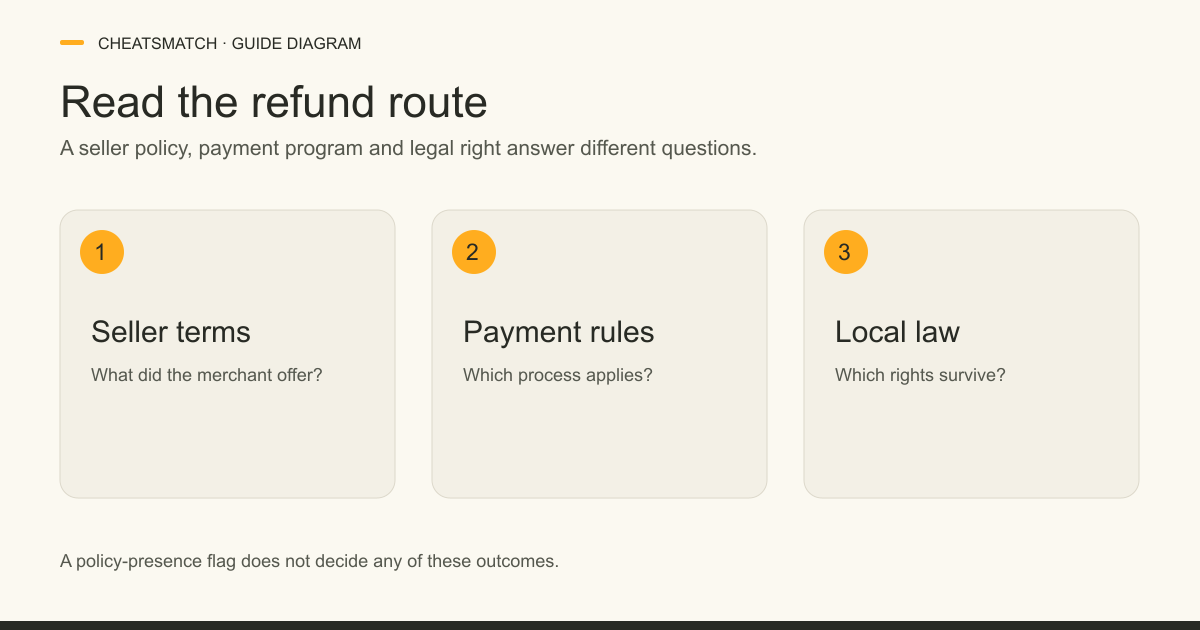
A recorded policy is only the start of the check
CheatsMatch's dated catalogue snapshot has 80 in-scope provider records. It marks 44 with a recorded present refund-policy flag, one recorded absent and 35 not recorded. The count records whether a published refund policy was observed; it does not assess whether the written policy is generous, enforceable, current at checkout or honored in a dispute. “Not recorded” describes a gap in this research field. It is not proof that a seller has no terms online.
The provider directory can help locate attributed seller claims, while each seller's current first-party policy and checkout disclosure determine what it actually offers. The 80-record denominator is the catalogue's in-scope provider set, not every cheat seller online.
| Recorded field state | Provider records | What the count means |
|---|---|---|
| Refund policy recorded present | 44 of 80 | A publication flag was observed; terms still need reading. |
| Refund policy recorded absent | 1 of 80 | An explicit negative flag was recorded; recheck current terms. |
| Refund policy not recorded | 35 of 80 | No explicit boolean observation in this snapshot. |
Sources: [1]
Read the exact seller term before the purchase
Look for the contracting seller's name, the product and subscription term, what counts as delivery, any time limit, stated exclusions, how to request help, and whether the policy differs at checkout. A page titled “refund policy” is not enough if it covers only selected products or circumstances. The FTC advises checking seller return and refund rules, asking questions in writing and keeping copies of promises.
A reseller and the underlying developer can have different obligations and support routes. Identify who took payment and whose policy applies to the transaction. The reseller guide explains how to separate those roles without assuming that a product brand is the merchant. The VALORANT aimbot comparison provides a game-specific listing example, but it does not establish a seller's refund terms.
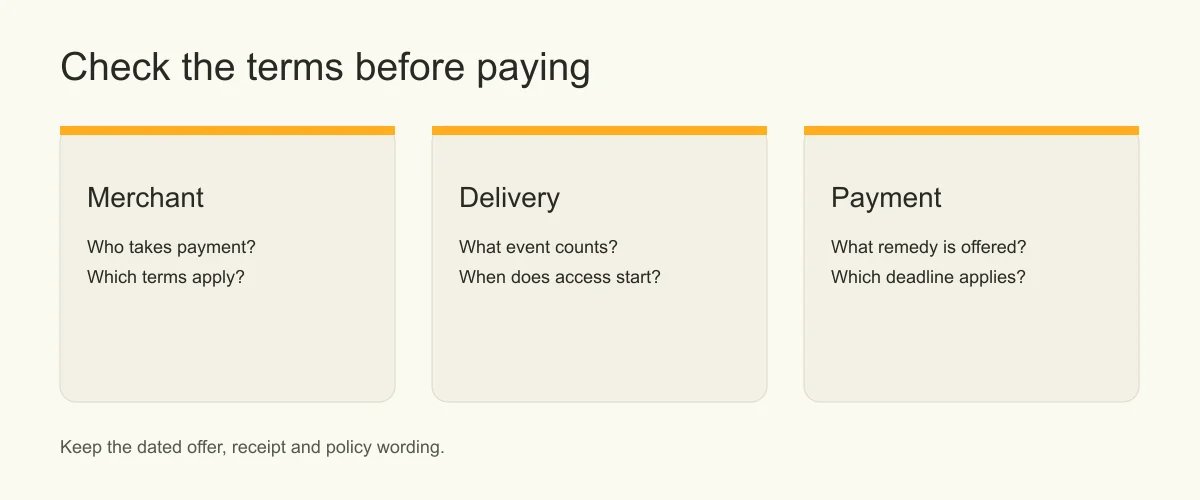
Separate access delivery from later performance
Digital sellers may describe delivery as an account invitation, key, download link or access activation. The precise definition matters if a policy changes after delivery. A seller might separately describe outages, update periods, compatibility changes and account sanctions. Read those clauses as written; a general “no refunds” phrase should not be turned into a conclusion about every transaction or a person's statutory rights.
Reviews and vouches can report a buyer's experience with a delivery or refund request, but they are not the seller's current policy. The review guide explains how to read those reports in context. This page does not promise that a seller will grant a refund for a later detection, ban or change of mind.
Payment routes have different protection rules
The seller's refund policy, a card issuer's dispute process and a payment platform's buyer program are separate routes with separate conditions. The FTC recommends checking the payment method before purchase and notes that credit cards carry legal protections in the United States. It warns that gift cards, wire transfers and cryptocurrency can be difficult to recover. Those are general consumer warnings, not a finding about any named cheat seller.
PayPal's US Purchase Protection terms say eligible transactions may be considered for an item not received or an item significantly not as described. PayPal decides eligibility under its rules and lists exclusions, including personal payments. The appearance of a PayPal logo or a checkout option does not itself establish coverage for a particular purchase. Our catalogue does not have a consistent structured payment-method field, so this guide gives no provider payment-share figure.
Use an honest account of the transaction in a dispute
For a US credit-card billing error, the CFPB says to contact the card company promptly and send a written billing-error notice within 60 calendar days after the charge appears on the statement to protect those rights. The CFPB also cautions that defective goods or services may involve a different dispute process. A billing error, a delivery disagreement and buyer regret are not interchangeable claims.
Keep the order, receipt, seller terms, correspondence and statement. Describe the transaction accurately to the seller or payment provider and follow the provider's current procedure. A charge dispute is not a substitute for inventing non-delivery or other facts. This is general consumer information, not financial or legal advice for a particular case.
Applicable consumer law can differ from seller wording
For EU distance purchases, Your Europe describes a general 14-day withdrawal right and exceptions. One digital-content exception can apply when online content begins downloading or streaming after the consumer expressly agrees to lose the withdrawal right by starting performance. A download alone is not a universal rule for every purchase. National implementation, merchant location, transaction type and the exact consent record matter.
Read the official consumer guidance for the relevant country and the current seller terms. A seller's “final sale” wording cannot by itself answer every statutory-right question. This guide does not determine whether a particular cheat purchase qualifies for withdrawal or another remedy.
Sources: [4]
Keep a small record of what was promised and paid
The FTC recommends keeping the company name, order date and amount, return policy, delivery promise, messages and payment statement. For a digital purchase, also record the exact offer, subscription length and any checkout terms displayed when you paid. A dated copy helps separate a later policy change from the policy shown during the transaction.
Check the seller and merchant identity on the receipt. If a reseller handled payment, the developer's product page alone may not describe that sale. The provider evaluation guide explains how to compare claims, while CheatsMatch's rating method labels a provider's published statement separately from independently supported evidence.
Make the remedy question specific
Before paying, write down which entity sells the product, what the written refund conditions cover, and how the chosen payment method handles a problem. If any part is missing, ask the seller for a written answer or leave the question open. A documentation flag in the catalogue does not fill that gap.
If a problem occurs, compare the actual event with the current seller policy, receipt and applicable payment or consumer rules. Keep the account factual and within the relevant deadline. That is a more useful basis for a decision than assuming every “no refunds” line or payment brand has the same effect.
Frequently asked questions
Do cheat providers give refunds?
Terms vary by seller and product. In the September 23, 2026 CheatsMatch snapshot, 44 of 80 in-scope provider records have a recorded policy-presence flag, but that does not tell you who qualifies or whether a request will succeed. Read the current seller and checkout terms for the specific purchase.
Does paying with PayPal guarantee buyer protection?
No. PayPal's US program applies only when its eligibility and claim conditions are met, and PayPal decides claims under its policy. A displayed payment option is not proof of coverage for a particular digital product or transaction.
Can a seller always refuse a refund after a download?
No universal answer follows from the word “download.” Seller terms, transaction facts, payment rules and applicable law matter. Your Europe describes specific conditions for an EU digital-content withdrawal exception; check official guidance for the relevant country.
When should I dispute a card charge?
Use the issuer's official process promptly for a genuine issue and describe it accurately. For a US credit-card billing error, the CFPB says a written notice within 60 calendar days after the charge appears on the statement protects certain rights; defective goods or services may use a different process.
Sources and check dates
Numbers beside a fact or score refer to the sources below. Provider descriptions are claims, not independent product tests.
- FTC: Buying From an Online Marketplace · checked 2026-09-30
- FTC: Online Shopping · checked 2026-09-30
- CFPB: How do I dispute a charge on my credit card bill? · checked 2026-09-30
- Your Europe: Returns and the right of withdrawal · checked 2026-09-30
- PayPal US Purchase Protection Program · checked 2026-09-30
- CheatsMatch: How we rate products · checked 2026-09-29