Vanguard vs Easy Anti-Cheat vs BattlEye vs FACEIT: Anti-Cheat Systems Compared
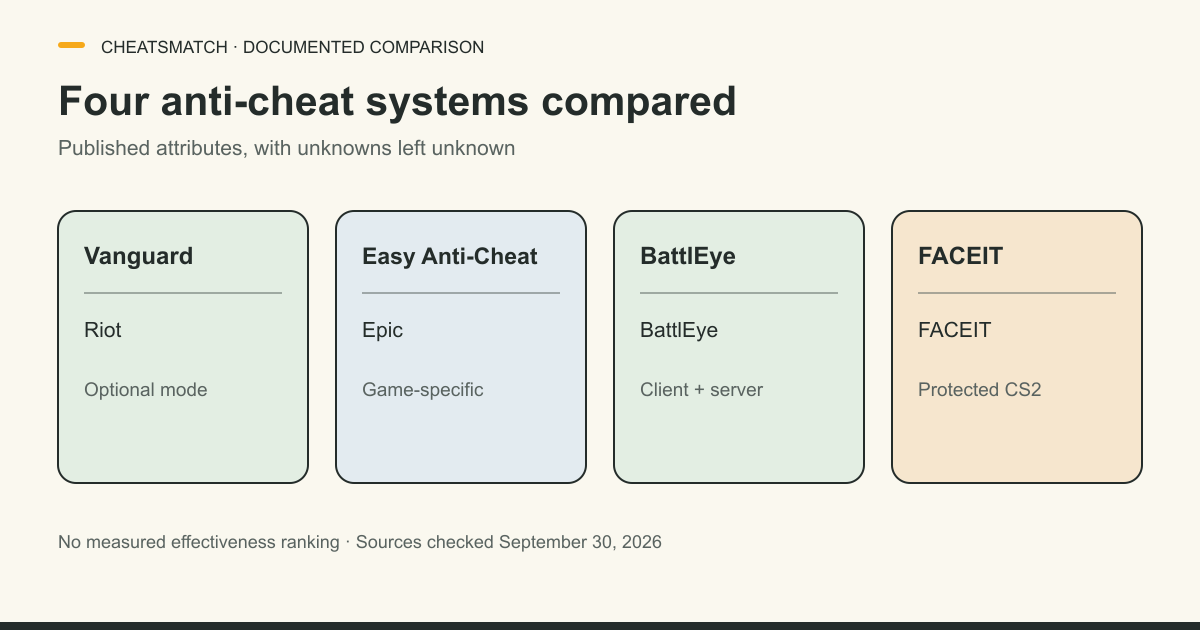
Riot Vanguard, Easy Anti-Cheat, BattlEye and FACEIT Anti-Cheat publish different details about their PC game protection. A useful comparison separates components, driver timing, requirements and the games or matches covered. The four-row table below uses operator sources checked September 30, 2026; an undisclosed attribute stays unknown. It does not rank detection effectiveness, because these pages do not provide a shared independent measurement.
Compare documented attributes, not a winner
An anti-cheat comparison can establish what each operator has published, where the protection applies and what the checked source does not say. It cannot establish which system catches more cheating without a common measurement across comparable games and conditions. Riot, Epic, BattlEye and FACEIT publish different kinds of material: architecture, service overview, product description and protected-match support. The table treats those as evidence for narrow claims rather than interchangeable test reports.
Driver access and startup time are different columns. A kernel component can be documented without a verified universal start schedule. A game's security requirement can also differ from an optional operating mode for the anti-cheat. For readers who start with a system name, the anti-cheat directory contains detailed guides to each system. The Valorant comparison covers provider-reported listings for that game, not Vanguard effectiveness. The games hub lets readers move to other covered titles without treating a service name as proof of game-specific support.
Four anti-cheat systems side by side
The matrix records four operators' published attributes, checked September 30, 2026. “Not established” means the cited pages do not support a universal answer for that cell; it does not mean a component or requirement is absent. Each system name links to its separate CheatsMatch profile after the linked-table feature is validated.
The table is a documentation snapshot, not a controlled trial. A current game patch, selected Vanguard mode or operator support update can change a practical requirement without making another row's old statement false. Read the row's source and the target game page together before assuming a universal deployment.
| System | Published components | Driver timing | Documented requirement | Protected context |
|---|---|---|---|---|
| Riot Vanguard | Riot describes client, kernel driver and platform. | Riot described boot loading in 2020; eligible PCs can opt into game-start on-demand mode from 2026. | Valorant on Windows 11 requires TPM 2.0 and UEFI Secure Boot; optional Pre-Check has additional conditions. | Riot describes its protection for Riot titles; the Valorant PC rules are cited here. |
| Easy Anti-Cheat | Epic describes layered service; separate support confirms kernel access in certain EAC game driver-error context. | Universal driver start time not established by checked Epic pages. | No universal game requirement established by checked pages. | Epic service supports integrations; each game's deployment needs its own publisher source. |
| BattlEye | BattlEye describes client and server integration and user/kernel-mode scanning. | Universal driver start time not established by checked BattlEye page. | Current game-specific security requirement not established by checked page. | BattlEye says integrations can be customized by game. |
| FACEIT Anti-Cheat | FACEIT names app, boot-loaded kernel driver and server SDK. | Driver loads at PC boot according to FACEIT support. | FACEIT says Secure Boot and TPM 2.0 are required; its anti-cheat is available for Windows 10 and 11. | FACEIT-protected Counter-Strike 2 matches, per the cited support article. |
Riot Vanguard has an optional 2026 on-demand path
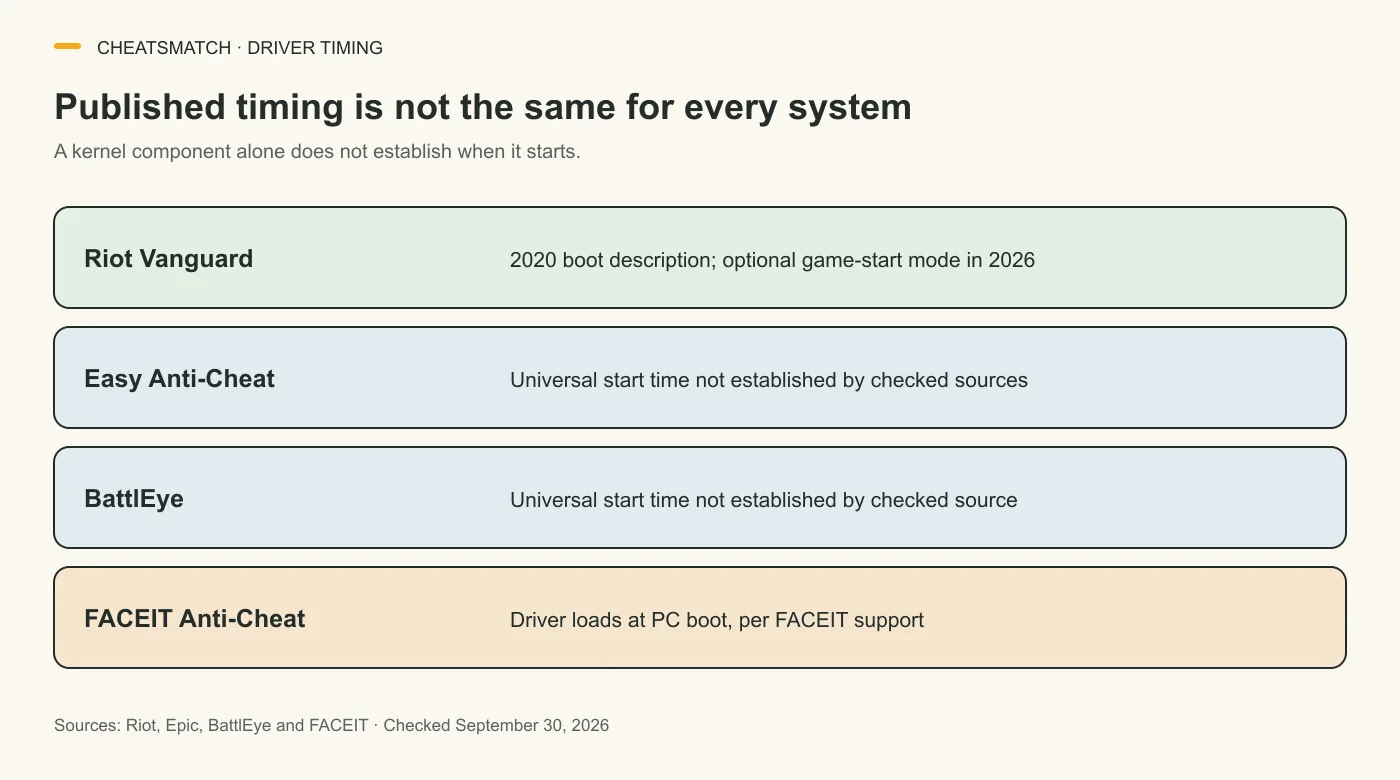
Riot's April 2020 Vanguard architecture article lists a user-mode client, a kernel-mode driver and a platform component. It described the driver loading with Windows at that time. Riot's June 24, 2026 On-Demand announcement changed the available schedule for eligible, sufficiently secured PCs: users can choose a mode that starts the driver with a Riot game and runs it while playing. Riot says the option is voluntary. Therefore “Vanguard always runs from boot” is an outdated universal description.
This mode choice is separate from Valorant's published PC requirement. Riot's Valorant specification explicitly requires TPM 2.0 and UEFI Secure Boot on Windows 11. The On-Demand post lists extra Pre-Check conditions for the optional schedule; those should not be recast as universal minimum requirements for every Valorant installation. A comparison of driver timing must name the selected mode and date. It cannot infer what the driver collected or whether one schedule detects cheating better.
Easy Anti-Cheat disclosures depend on integration
Epic's Easy Anti-Cheat overview describes a modular, layered service with prevention, heuristics, gameplay analysis and report signals. It lists broad service platform support, but that is not the same as an individual game's available platform. Epic's EAC driver-error article says kernel-level access is needed to help detect cheating in the context of certain EAC game driver problems, including Fortnite and Rocket League. It does not give a single driver startup schedule for all EAC games.
The driver-error page also warns that turning off a Windows kernel protection feature can reduce device security. This comparison does not recommend that troubleshooting change; it only uses the article for the limited kernel-access fact. A reader comparing games should use the publisher's current game support and Epic's relevant error page. Neither the service overview nor the driver-error article establishes a universal TPM, Secure Boot or boot-time rule for every EAC integration.
BattlEye describes client and server protection
BattlEye's About page says the service integrates on both the client and server sides of a game and uses scanning in user and kernel modes. It also says integrations can be customized for each game. Those are vendor descriptions of components, not an independent audit of scanning or a measurement of detection quality. Its page makes broad promotional claims; this table keeps only the component facts it directly states.
The checked BattlEye About page does not establish one current driver start schedule or a universal Secure Boot and TPM rule for every game using the service. A named game's publisher documentation is needed for that deployment. The absence of a general requirement in this source is not evidence that no game has one. The separate BattlEye profile carries game-specific context and source links; the comparison row should be read as an attribute summary only.
Sources: [6]
FACEIT describes protected Counter-Strike 2 matches
FACEIT's support page, updated October 23, 2025, describes three parts for its protection of Counter-Strike 2 matches: an app required during a protected match, a kernel driver loaded at PC boot and a server-side SDK. It says its anti-cheat is available for Windows 10 and 11 and requires Secure Boot and TPM 2.0 for FACEIT play. Those are specific FACEIT support statements, not a description of every game mentioned elsewhere on the FACEIT website.
FACEIT also says the software activates and collects game and anti-cheat data only while Counter-Strike is running. That is FACEIT's stated collection scope, not an independent privacy audit. Its boot-loaded driver and match-time app are different parts of the system, so “driver loads at boot” should not be shortened to “all anti-cheat activity runs from boot.” The Counter-Strike 2 game comparison is a separate listing context; it does not establish that FACEIT-protected matches and ordinary matchmaking use identical security conditions.
Sources: [7]
Why the table cannot name the best detector
The four checked operator pages do not provide a shared independent measure of detections, false positives, match conditions or coverage that would rank these systems fairly. Riot's architecture, Epic's service overview, BattlEye's About page and FACEIT's protected-match support answer different questions. A driver with broader Windows privilege is not, by that fact alone, more effective or safer; Microsoft documents what kernel privilege permits, while the operators describe how they use their components.
The practical comparison is narrower: identify the exact game, whether the cited anti-cheat applies, the published PC requirements, the selected mode and the date of the source. If a provider claims its tool supports a named system, that is a separate provider claim and not an operator endorsement. The anti-cheat mechanism guide explains signatures, client checks, server analysis and reports without assigning a winner. If independent, comparable effectiveness data becomes available, it would require its own methods and denominator to support a ranking.
Frequently asked questions
Which anti-cheat is best?
The checked Riot, Epic, BattlEye and FACEIT pages document different components and scopes; they do not provide a common independent effectiveness benchmark. This comparison therefore does not name a winner. Choose the row for the exact game or protected match and read the official requirements.
Does Vanguard always load at boot?
Riot's 2020 architecture article described a boot-loaded driver. Riot announced an optional on-demand mode for eligible PCs on June 24, 2026, in which the driver starts with a Riot game. The current schedule depends on eligibility and the selected mode.
Does Easy Anti-Cheat always start a kernel driver with Windows?
Epic's indexed EAC driver-error support confirms kernel-level access in some game contexts, but the checked Epic pages do not establish a universal startup schedule across EAC games. This page leaves that table cell unknown. Use game-specific publisher material for a current requirement.
Is FACEIT Anti-Cheat used for every game shown on FACEIT?
FACEIT's anti-cheat support article describes its app, driver and SDK for protected Counter-Strike 2 matches. A game appearing elsewhere on FACEIT's website does not establish that the same anti-cheat applies. Check the exact protected match and FACEIT's current support page.
Sources and check dates
Numbers beside a fact or score refer to the sources below. Provider descriptions are claims, not independent product tests.
- A Message About Vanguard From Our Security and Privacy Teams · checked 2026-09-30
- Incoming: Vanguard On-Demand · checked 2026-09-30
- Minimum and Recommended PC Specs · checked 2026-09-30
- Easy Anti-Cheat: Anti-Cheat Services for Online Games · checked 2026-09-30
- EAC driver error 1275 · checked 2026-09-30
- BattlEye: About · checked 2026-09-30
- What is FACEIT Anti-cheat and how does it work? · checked 2026-09-30
- User mode and kernel mode · checked 2026-09-30