FACEIT Anti-Cheat: How It Works and What CS2 Players Need
FACEIT Anti-Cheat is FACEIT's security client for protected Counter-Strike 2 matches on its platform. FACEIT describes three parts: an app, a boot-loaded driver and a server-side SDK. Its support pages list Secure Boot and TPM 2.0 requirements. Checked September 29, 2026, those pages conflict on when Windows 11 becomes mandatory. This guide keeps each statement tied to its source and date.
What FACEIT Anti-Cheat is
FACEIT Anti-Cheat is software that FACEIT says it built for competitive Counter-Strike matches on its platform. Its current support description names protected Counter-Strike 2 play, not every match a player can launch from the game client. FACEIT also publishes its own hardware and Windows setting requirements for access to those protected matches.
The CheatsMatch anti-cheat directory lists FACEIT as a separate system. A player choosing a FACEIT match needs to follow FACEIT's notices for that match. The presence of other games in FACEIT's site footer is not evidence that each game uses this anti-cheat.
Sources: [1]
How the three components work
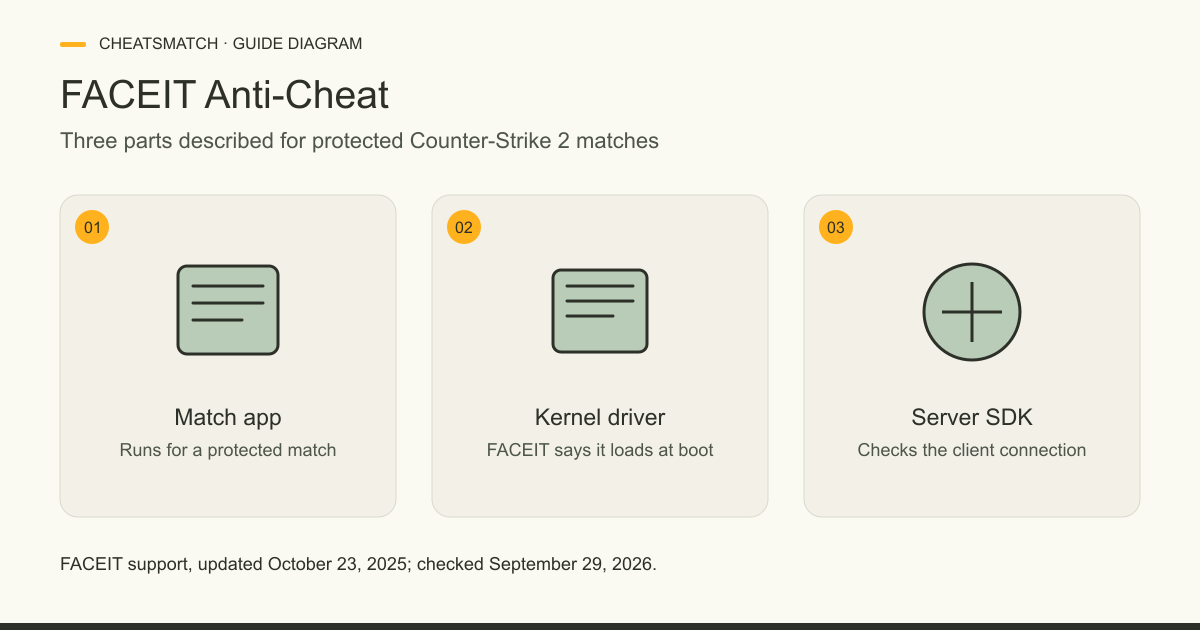
FACEIT describes three parts of its Anti-Cheat: an app that must run during a protected Counter-Strike 2 match, a kernel-mode driver loaded when the PC boots and a server-side SDK that checks the client connection. These are FACEIT's component descriptions. They do not state a detection rate or establish how another game integrates the software.
FACEIT says the driver can be disabled from its tray icon and re-enabled after a restart. The same support article says game and anti-cheat data collection activates when Counter-Strike is running. Boot loading and match-time activity are different statements. Neither should be expanded into a universal privacy or safety verdict. FACEIT links a separate privacy notice for its detailed data practices.
For the Windows meaning of kernel mode, read the kernel-level anti-cheat guide.
Sources: [1]
Which Counter-Strike 2 matches use it
FACEIT's component explainer says the app must run whenever a protected Counter-Strike 2 match is played on FACEIT. Its separate support article says a player cannot queue or connect to a Counter-Strike match requiring Anti-Cheat without the app running. The wording attaches the requirement to FACEIT matches that require it. It does not say all Counter-Strike 2 matches everywhere need the FACEIT client.
The Counter-Strike 2 game page covers the game more broadly. Valve Anti-Cheat has its own system page; that separate route should not be read as a statement that FACEIT's client replaces or configures it. For an actual match, the FACEIT queue and its current notice determine whether the FACEIT app is required.
What PC security settings FACEIT lists
FACEIT's October 2025 support materials describe Secure Boot and TPM 2.0 as required for its Anti-Cheat, with November 25, 2025 named as the all-player rollout date. They describe IOMMU and VBS as phased settings at that time, with different player groups receiving enforcement at different stages. The security FAQ also describes UEFI and GPT in relation to Secure Boot. These publisher statements are tied to the pages' update dates; the account's current prompt can differ.
The table separates features that FACEIT described as all-player requirements from the phased pair. It summarizes the published requirements; it does not provide instructions to alter firmware. A mistaken BIOS or partition change can prevent a PC from booting; FACEIT itself tells readers to consult the motherboard maker or a professional when unsure. Read the requirement shown in your FACEIT account or client before changing a setting.
| Setting | FACEIT statement | Source date and scope |
|---|---|---|
| Secure Boot | Listed as required for all players from November 25, 2025 | October 23, 2025 requirement checker; FACEIT match access |
| TPM 2.0 | Listed as required for all players from November 25, 2025 | October 23, 2025 checker and 2026-05-05 TPM article |
| IOMMU with VBS | Described as phased, with some groups already covered | October 23, 2025 checker and FAQ; account prompt varies |
Why the Windows version date is unclear
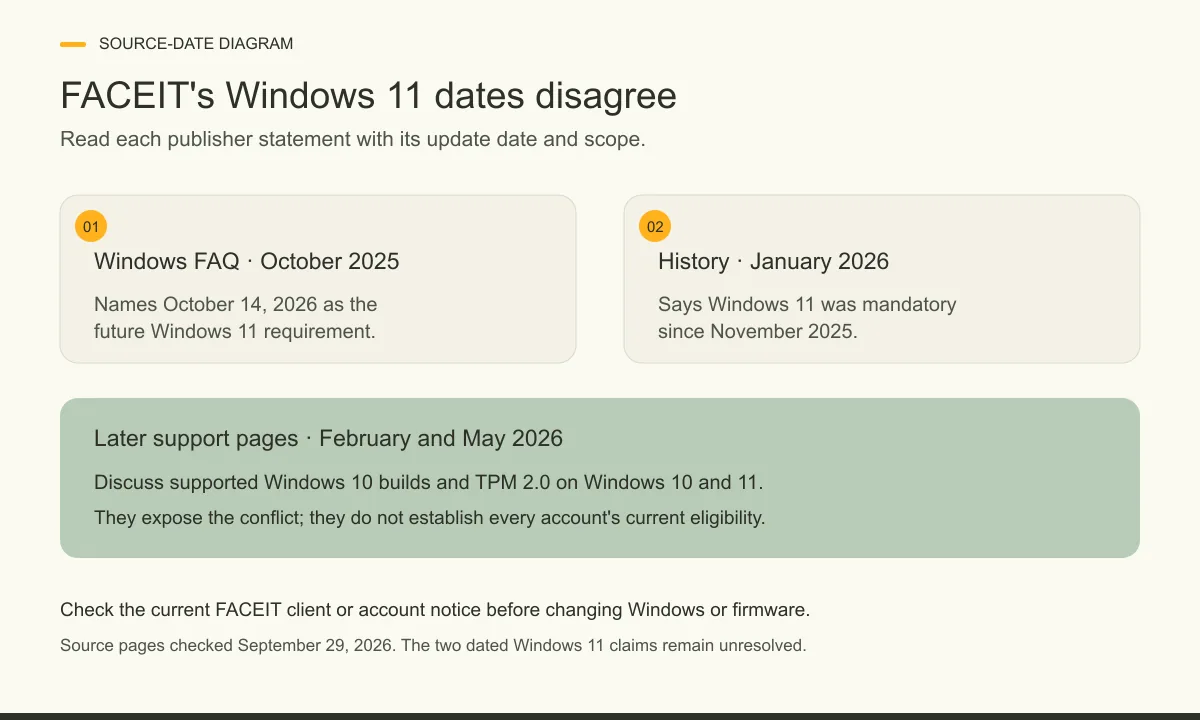
FACEIT's Windows Security Requirements FAQ, last updated October 23, 2025, says Windows 10 remained usable then and names October 14, 2026 for a Windows 11 requirement. A FACEIT history article updated January 6, 2026 instead says Windows 11 became mandatory in November 2025. Both are publisher pages, and their dates and claims conflict.
Two later operational articles complicate the history statement. FACEIT's February 5, 2026 security-update page discusses supported Windows 10 builds receiving security updates. Its 2026-05-05 TPM page addresses users on Windows 10 and 11. Those pages support documenting the contradiction; neither proves that every Windows 10 account is eligible today. The practical answer is to check the current FACEIT client or account notice and, if needed, ask FACEIT Support. This page does not turn one conflicting historical sentence into a universal current rule.
Where to get the official client and help
FACEIT's February 2026 Windows-update support article identifies `https://www.faceit.com/en/anti-cheat` as its official Anti-Cheat page and warns about misleading help sites. Use that publisher page for the client route rather than a third-party package listing or a file circulated elsewhere. This guide provides no installer binary and makes no claim about the behavior of an unverified copy.
For a requirement message, FACEIT's check article explains how its own notices relate to Secure Boot, TPM 2.0 and the phased settings. Its support articles also direct readers to FACEIT Support when a Windows update error persists. The relevant notice depends on the account and date, especially while the Windows-version pages disagree.
Updates and source limits
FACEIT's component description was last updated in October 2025. The Windows FAQ and requirement checker also carry October 2025 dates, while the history, Windows-update and TPM pages were updated in January, February and 2026-05 respectively. This guide checked them on September 29, 2026 and preserves the incompatible Windows-version statements instead of silently choosing one.
Recheck the Windows policy before October 14, 2026 and after any FACEIT support update. Recheck a security setting if the client's prompt changes. The article's confirmed game relationship is protected Counter-Strike 2 play on FACEIT; a footer link to another game or a third-party package listing is insufficient to add a second game to that claim.
Frequently asked questions
Is FACEIT Anti-Cheat required for every CS2 match?
FACEIT says its app must run during a protected Counter-Strike 2 match on its platform. Its support page also describes matches that require Anti-Cheat. Those statements do not apply the FACEIT client to every CS2 match elsewhere.
Does the FACEIT driver load at boot?
FACEIT's component explainer describes a kernel-mode driver loaded when the PC boots. It separately says the app must run for a protected CS2 match and that game and Anti-Cheat data collection activates while Counter-Strike is running.
Does FACEIT require Windows 11 now?
FACEIT's October 2025 FAQ names October 14, 2026 as a planned requirement date, but a January 2026 history page says Windows 11 was mandatory in November 2025. Later FACEIT support pages discuss Windows 10. Check your current FACEIT notice or ask Support before treating either article as universal current policy.
Where should I get FACEIT Anti-Cheat?
FACEIT's February 2026 support article identifies `https://www.faceit.com/en/anti-cheat` as its official Anti-Cheat page. Use that publisher route and FACEIT Support for requirements; this guide does not provide a binary.
Sources and check dates
Numbers beside a fact or score refer to the sources below. Provider descriptions are claims, not independent product tests.
- FACEIT: What is Anti-cheat and how does it work? · checked 2026-09-29
- FACEIT: What happens without required Anti-Cheat? · checked 2026-09-29
- FACEIT: How to check PC requirements · checked 2026-09-29
- FACEIT: Windows Security Requirements FAQ · checked 2026-09-29
- FACEIT: History of the Anti-cheat · checked 2026-09-29
- FACEIT: Missing Windows security updates · checked 2026-09-29
- FACEIT: Enabling TPM 2.0 · checked 2026-09-29
- FACEIT: Official Anti-Cheat page · checked 2026-09-29