
How Anti-Cheat Software Detects Cheats: Signatures, Behavior and Reports
Anti-cheat software helps game operators detect or prevent prohibited play through different client, server and review methods. Valve describes cheat signatures, Epic names heuristics and gameplay signals, Riot documents client and driver roles, and Activision has described replay analysis followed by human validation. These are operator-specific disclosures checked September 30, 2026, not one universal detection sequence. This guide explains each method and the limits of what public sources establish.
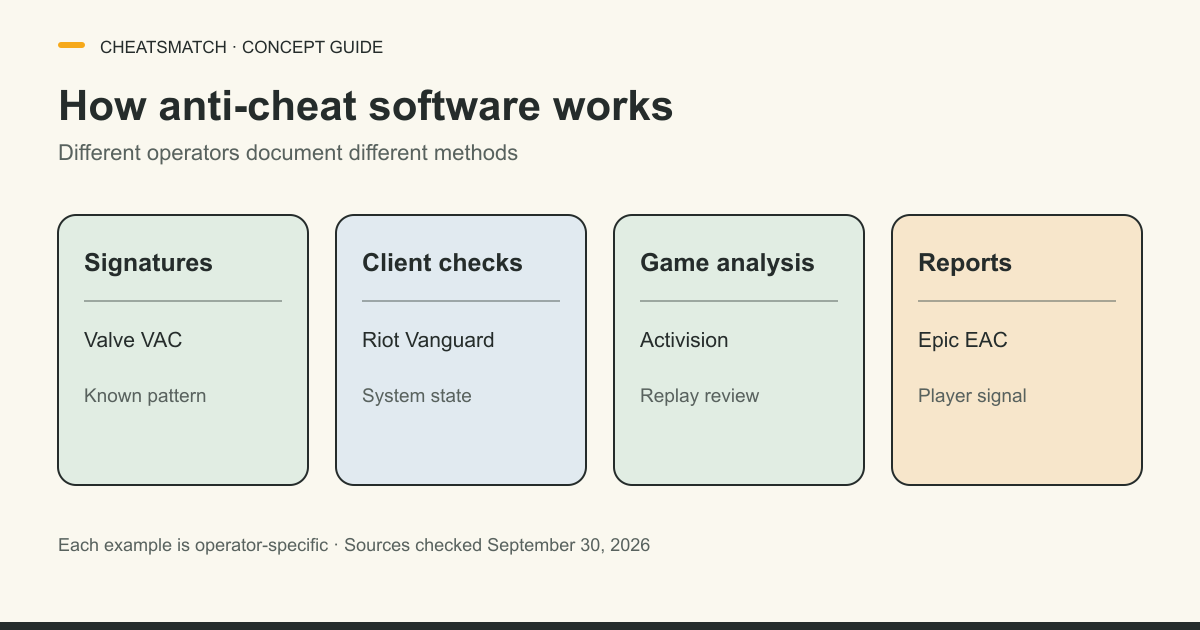
Anti-cheat uses more than one method
Anti-cheat software is a collection of possible checks and review processes, not a single program that every game runs the same way. Easy Anti-Cheat says its service combines prevention and detection and uses heuristics, gameplay analysis and player report signals. Riot's published Vanguard architecture separates client detection from driver-mediated system validation. Activision's RICOCHET team describes replay analysis and human-validated enforcement in a March 2025 update. Valve describes VAC as an automated system using cheat signatures on protected servers. These are distinct operator statements, not a universal recipe.
Start with the named game's publisher and system rather than assuming a game inherits every method associated with a vendor. The anti-cheat directory lists documented systems and their source pages. The Valorant game comparison groups listings for that game but does not test Vanguard's detection. The games hub lets readers switch to a specific title; its provider claims should stay separate from official anti-cheat disclosures.
| Documented method | Official example | Limit of the example |
|---|---|---|
| Known signatures | Valve says VAC identifies cheat signatures. | Valve's support description does not disclose every VAC signal. |
| Heuristics and gameplay signals | Epic names both for Easy Anti-Cheat. | Epic does not publish a per-game detection rule in that overview. |
| Client and system checks | Riot describes Vanguard's client and kernel driver roles. | Riot's 2020 startup wording needs its 2026 on-demand qualification. |
| Replay and review | Activision describes machine learning on replays with human-validated enforcement. | The March 2025 report is a dated Call of Duty example. |
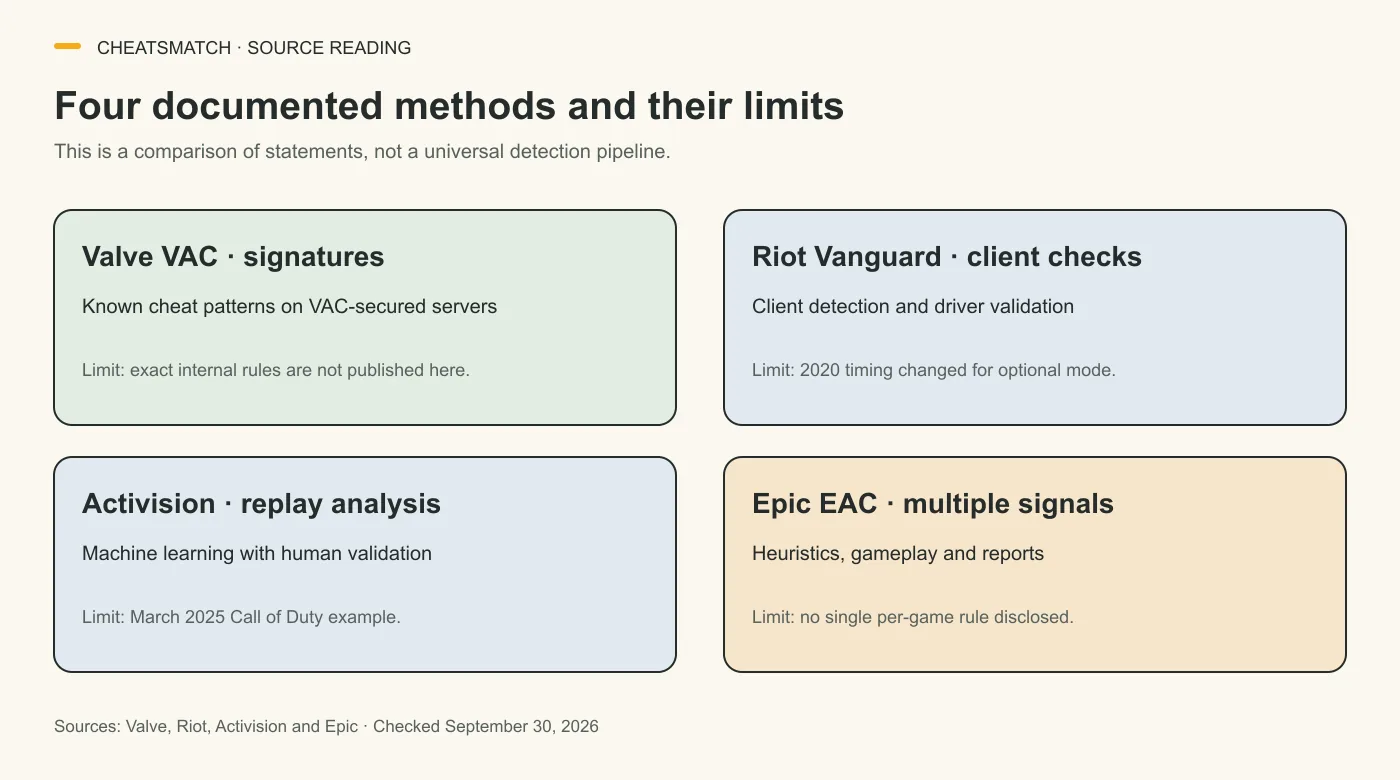
Signatures identify known cheat patterns
Valve's VAC support page, checked September 30, 2026, says its automated system uses cheat signatures to identify certain installed cheats when a player connects to a VAC-secured server. A signature is a recognizable pattern associated with known software. The support page gives the mechanism's category, not a public list of exact patterns or an assurance that VAC relies on nothing else. It also distinguishes VAC-secured servers from other server arrangements.
The useful distinction is between a published detection method and an inference about an individual case. Valve says VAC can restrict access to VAC-secured servers after identifying a cheat; it does not publish every internal decision rule in the support article. A search result or forum account cannot establish whether a specific program was identified, and this guide does not speculate about detection timing. The Valve Anti-Cheat profile supplies the game and support context for that system.
Sources: [2]
Heuristics and gameplay signals examine patterns
Easy Anti-Cheat's service overview, checked September 30, 2026, says it uses heuristics, gameplay analysis and player report signals. In this context, a heuristic is a rule or model that looks for suspicious properties rather than a single known signature. Epic does not publish the exact rules in that overview, so the page supports the broad category and not a claim about a particular Fortnite, Apex Legends or Rust detection event.
Gameplay signals add a different kind of evidence: actions in a match can be assessed without assuming that a specific client file was recognized. But a suspicious pattern is not the same as a proven violation. Epic describes prevention and detection as layers managed by game developers; individual games can integrate those layers differently. The Easy Anti-Cheat profile follows publisher documentation for named games and separates official game facts from provider-reported compatibility claims.
Sources: [1]
Client integrity checks look at the game environment
Riot's 2020 Vanguard architecture article describes a user-mode client that handles detections while a game runs and a kernel-mode driver used to validate memory and system state. Microsoft's Windows documentation explains why user mode and kernel mode have different privileges. That technical distinction describes possible access, not proof of what a vendor collected on a particular PC. Riot's privacy statements are Riot's account of its own system, not an independent audit by CheatsMatch.
The 2020 article says the driver started with Windows at that time. Riot's June 2026 update introduced an optional on-demand mode for eligible, sufficiently secured PCs in which the driver starts with a Riot game. Both dates are needed: repeating only the older sentence would make an outdated universal claim. BattlEye separately says its protection uses both user- and kernel-mode scanning along with client and server integration. These examples show design choices, not a ranking of their effectiveness. The Vanguard profile tracks Riot's current operating-mode distinction, while the kernel-level guide explains Windows privilege in depth.
Server-side analysis can review play
Activision's March 2025 RICOCHET update says a machine-learning system analyzed Call of Duty game replays to identify suspicious play for human-validated enforcement. That is a dated disclosure about one operator's system. It shows how server-held game data can support review without establishing that every game uses the same model, that a model decides bans alone, or that every unusual match is cheating.
The same update gives an important limit on interpretation: Activision describes Limited Matchmaking as a response to suspicious activity while its team examines evidence. It says placement there does not confirm a player cheated. The report also lists changes intended to give player reporters more context. Those details matter because a replay, an anomaly and an enforcement decision are separate stages in this particular disclosed process. The RICOCHET system profile gives the Call of Duty context and the date of other official updates.
Sources: [5]
Player reports are leads, not proof
Player reports are one input an operator can consider, not an independent proof that a person cheated. Activision's 2025 RICOCHET update says reports are useful but describes many inaccurate reports when a legitimate game-information advantage looked suspicious to the reporter. Valve's VAC support page states that users are not VAC-banned on reports alone. Those are two operator-specific policies, not a claim that every game ignores reports or handles them identically.
The distinction protects the meaning of a visible game event. A report records a player's suspicion. Activision describes replay analysis alongside player reports in its RICOCHET update. The reporter usually cannot see that internal evidence from the match screen. Likewise, an unusual result in a match is a reason to examine context, not a public diagnosis of another player's software. Consult the game's own reporting and appeal channels for an account-specific question.
Detection, investigation and enforcement are distinct
An anti-cheat signal, an investigation state and an enforcement action are different claims. Activision says its Limited Matchmaking state can follow suspicious activity while evidence is examined and is not a confirmed cheating finding. Valve describes a VAC ban as a later restriction of access to VAC-secured servers after its system identifies a cheat. Their policies illustrate why the word “detected” should not be used for every report, error or queue change.
Different operators publish different parts of their process. Epic's overview emphasizes prevention and detection layers; Riot's architecture separates client and driver duties; Activision describes review; Valve describes signature identification and VAC-secured-server access. Public descriptions leave gaps, and some are dated. A site claiming one product is the “best” at detecting cheats would need a common, independently measured outcome that these source pages do not supply. This guide describes documented functions and official routes only.
Frequently asked questions
Does anti-cheat only scan the PC?
No. Epic names gameplay analysis and player-report signals, and Activision has described replay analysis followed by human-validated enforcement. Riot and BattlEye also document client-side components. The mix belongs to the named game and operator; no single source establishes a universal detection pipeline.
What is a cheat signature?
A cheat signature is a recognizable pattern associated with known cheat software. Valve says VAC uses cheat signatures on VAC-secured servers. Its support page does not disclose exact patterns or every internal signal, so a player cannot diagnose an individual detection from the general description.
Can AI anti-cheat automatically prove cheating?
Activision's March 2025 RICOCHET update described machine learning that analyzes replays to flag suspicious play for human-validated enforcement. That example does not make the model alone a final verdict, and it does not establish how every game uses AI. Read the operator's dated statement for the particular game.
Does a player report cause a VAC ban?
Valve's VAC support page says users are not VAC-banned from reports alone; other factors are considered. A report is a lead, not a public view of Valve's evidence. Use Valve's current support material for an account-specific decision.
Sources and check dates
Numbers beside a fact or score refer to the sources below. Provider descriptions are claims, not independent product tests.
- Easy Anti-Cheat: Anti-Cheat Services for Online Games · checked 2026-09-30
- Valve Anti-Cheat (VAC) System · checked 2026-09-30
- A Message About Vanguard From Our Security and Privacy Teams · checked 2026-09-30
- Incoming: Vanguard On-Demand · checked 2026-09-30
- RICOCHET Anti-Cheat Update: Season 03 · checked 2026-09-30
- User mode and kernel mode · checked 2026-09-30
- BattlEye: About · checked 2026-09-30