
Rust Ban Appeals: EAC, Facepunch and Hardware Rules
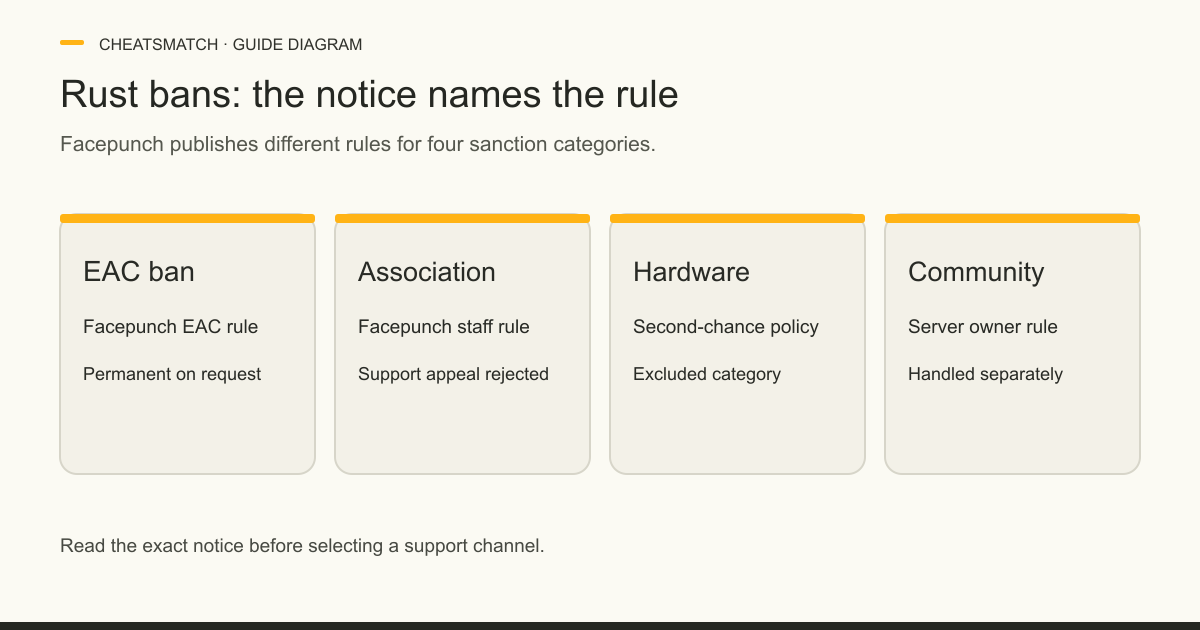
A Rust ban appeal depends on the issuer and the notice. Facepunch's support pages, checked September 29, 2026, describe four categories: Easy Anti-Cheat (EAC) bans, Facepunch bans for playing with cheaters, hardware bans under its second-chance policy, and community-server bans. Facepunch says an EAC ban will not be removed on request, while batches of incorrectly issued EAC bans are reversed automatically. A generic appeal form cannot override a category-specific rule.
What anti-cheat does Rust use?
Rust uses Easy Anti-Cheat. Facepunch's current Rust knowledge base has an EAC section, and its “EAC Banned” article describes the EAC banned notice shown when an account attempts to join a secured server. Facepunch supplies the Rust-specific enforcement description here.
The EAC service can also show authentication, integrity or service errors. An error heading in Facepunch's support index is not the same statement as the “EAC banned” notice. Before asking for a ban appeal, record the full message and the page where it appears. CheatsMatch's Rust game page separately compares provider-published product information; it does not test claims against EAC or change an account restriction. The game directory groups other covered game pages.
Match the Rust notice to its decision-maker
Rust ban categories have different published owners and outcomes, so the notice determines which policy to read. The table reflects Facepunch's own support text checked September 29, 2026. It does not diagnose a particular account or turn a server message into an EAC decision.
The table's hardware row describes eligibility for a specific Facepunch second-chance policy. It does not describe how a hardware restriction is detected, which components it covers, or a way to remove it. Facepunch's policy names the server owner; its text does not promise a review.
| Notice or category | Published decision rule | Official place to check |
|---|---|---|
| “EAC banned” | Facepunch says the account has been banned by EAC for cheating; it will not be lifted on request | Facepunch “EAC Banned” article |
| Ban for playing with cheaters | Facepunch says staff manually review before issuing it and reject support appeals | Facepunch association-ban article |
| Hardware ban | Facepunch's second-chance policy excludes hardware-banned players | Facepunch “Ban Second Chances” article and the account notice |
| Community-server ban | Facepunch says server owners handle these separately | That server's owner and rules |
Can an EAC ban in Rust be appealed?
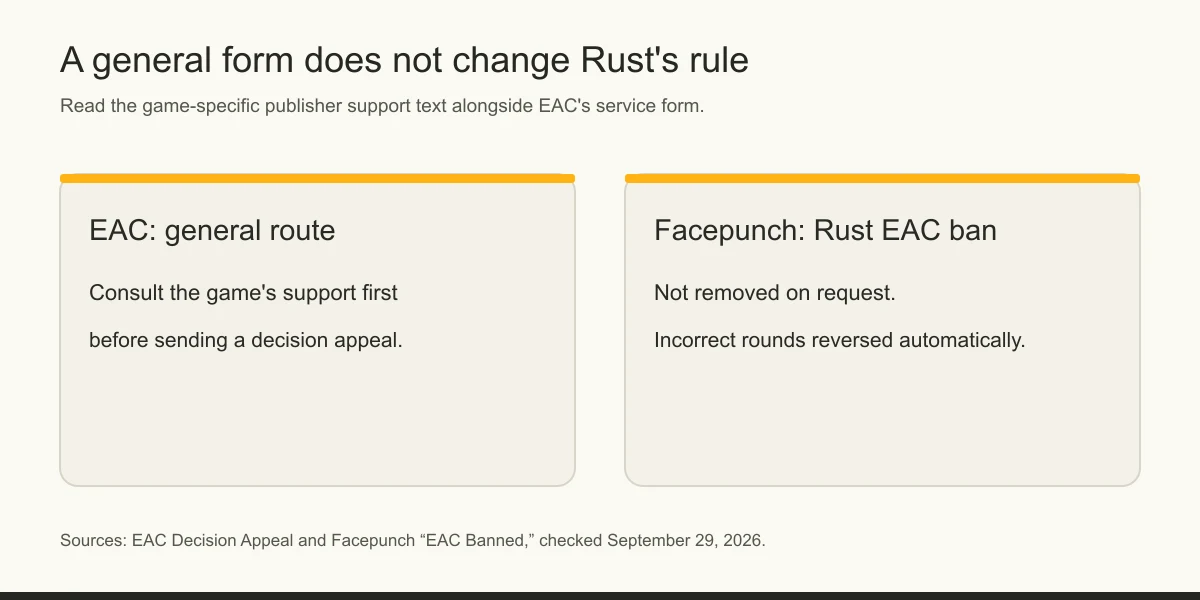
Facepunch says all EAC bans in Rust are permanent and are not lifted on request. Its September 26, 2026 support article says a support ticket or EAC appeal will not cause removal. It also says a batch of EAC bans found to have been issued incorrectly is automatically reversed by its servers. That is a review mechanism described by Facepunch, not a guarantee about an individual account.
Easy Anti-Cheat has a general appeal form that tells players of other games to consult the game's support channel before submitting there. The Rust-specific Facepunch article gives the narrower rule for the “EAC banned” notice. The existence of a general form should not be read as a promise that Facepunch will lift a Rust EAC ban on request. The game-ban appeals guide discusses how routes differ by game; Facepunch's Rust-specific rule controls this notice.
Facepunch says EAC bans are issued on a delay and that the account need not be online when the ban takes effect. The delay does not identify the event or software behind a particular case. Facepunch also says it does not disclose the detected-cheat details. A reader cannot infer the detection date or evidence from the day the notice appears.
What about a Facepunch ban for playing with cheaters?
Facepunch says a ban for playing with cheaters is manually placed after staff review and is final. Its September 17, 2026 article says appeals to support for this category are automatically rejected. That differs from the EAC notice, although both can prevent play on protected servers. The category must appear in the actual account notice or official support context; being grouped with another player in a match is not enough to infer this sanction.
Facepunch also says it does not share the evidence gathered for these cases and that the ban does not expire. Those are its stated policies for this one type of enforcement. The broader game-bans guide explains how platform, developer and anti-cheat labels can differ; it cannot determine which one applies to a particular Rust account.
Sources: [3]
Does Rust issue hardware bans?
Facepunch's September 27, 2026 “Ban Second Chances” article explicitly names hardware bans. It says people with hardware bans are not eligible for the policy and describes those sanctions as issued to repeat offenders. This is an official acknowledgement that the category exists. The article does not publish a component list, detection threshold or account-specific test for hardware status.
Facepunch's second-chance policy is not removal of the original ban. The article says existing bans and records remain in place. This guide does not give instructions for using another account or device; the safe factual answer to a hardware-ban question is the current policy statement and the reader's own notice. The Rust HWID spoofer comparison records provider-published compatibility claims, not evidence that a restriction can be changed.
Sources: [2]
Who handles a community-server ban?
Community-server bans are handled by the server owner, according to Facepunch's second-chance article. That makes the server's rules and notice the relevant first source. Facepunch's EAC article concerns an EAC-secured game ban; it does not establish a universal appeal channel for local server moderation.
If a message names a particular server, check that server's published rules and contact channel. Do not share account credentials with an unofficial service. A community-server decision can have a different scope from an EAC account restriction; Facepunch's pages should be read separately rather than treated as one ban policy.
Why can an EAC ban appear later?
Facepunch says EAC can issue an account ban on a future date after detection. Its support article specifies that a player does not need to be online when the action takes effect. The arrival date of a notice therefore does not establish when the underlying event occurred. Facepunch does not disclose the detected-cheat details in individual cases.
This is a timing explanation, not a ban-wave count or prediction. No independent count of Rust bans is needed to answer an individual appeal question. The official article's update date matters because Facepunch's second-chance policy was also changed in September 2026; check the current version before citing either rule.
A practical notice check
Start with the exact words of the Rust notice. If it says “EAC banned,” read Facepunch's Rust EAC article; if it names a Facepunch association sanction, use that article; if it names a community server, use the server owner's rules. A hardware label should be read against the account notice and Facepunch's current policy, without assuming a detection mechanism from a failed connection.
This sequence narrows the issuer and the published rule. It does not review an account, supply an appeal script or predict reversal. The sources below were checked September 29, 2026. Facepunch's policy pages carry September 2026 update dates, so this guide should be reviewed when they change.
Frequently asked questions
What anti-cheat does Rust use?
Rust uses Easy Anti-Cheat, as documented by Facepunch's Rust support pages and its “EAC Banned” article.
Can a Rust EAC ban be appealed?
Facepunch says an EAC ban will not be lifted on request, although a batch determined to have been issued incorrectly is automatically reversed. EAC's general form does not override that Rust-specific statement.
Does Rust have hardware bans?
Yes. Facepunch's September 2026 policy names hardware bans and excludes hardware-banned players from its second-chance policy. It does not publish a component-level test in that article.
Is a community-server ban the same as an EAC ban?
No. Facepunch says community-server bans are handled by server owners. The server's notice and rules determine its own contact channel.
Does a delayed Rust ban identify when EAC detected something?
No. Facepunch says EAC bans can take effect later, including while the player is offline. The notice date alone does not establish the underlying event date.
Sources and check dates
Numbers beside a fact or score refer to the sources below. Provider descriptions are claims, not independent product tests.
- Facepunch Studios: EAC Banned · checked 2026-09-29
- Facepunch Studios: Ban Second Chances · checked 2026-09-29
- Facepunch Studios: Banned for playing with cheaters · checked 2026-09-29
- Easy Anti-Cheat: Decision Appeal · checked 2026-09-29
- Rust official support · checked 2026-09-29