CS2 Trust Factor: What Valve Says and What You Can Check
CS2 Trust Factor is Valve's matchmaking system for grouping players by past experience in Counter-Strike 2 and on Steam. Valve says there is currently no way to check your value. Its FAQ describes two relative warning messages for eligible Prime lobbies and names some inputs while withholding a full factor list. The guidance was checked on September 29, 2026.
What CS2 Trust Factor does
Valve uses Trust Factor matchmaking to try to place similar Counter-Strike 2 players together. Its support FAQ says the system considers a player's past experience in CS2 and on Steam. Valve does not publish a personal value that a player can read, and it says the matching range can vary by time, region and the maps being queued.
The Counter-Strike 2 comparison on CheatsMatch covers provider-reported product listings. The game directory covers other PC games. Those listings and Valve's matchmaking guidance answer different questions: a provider listing does not reveal a player's Trust Factor or prove how Valve weighs an account.
Sources: [1]
Can you check your Trust Factor?
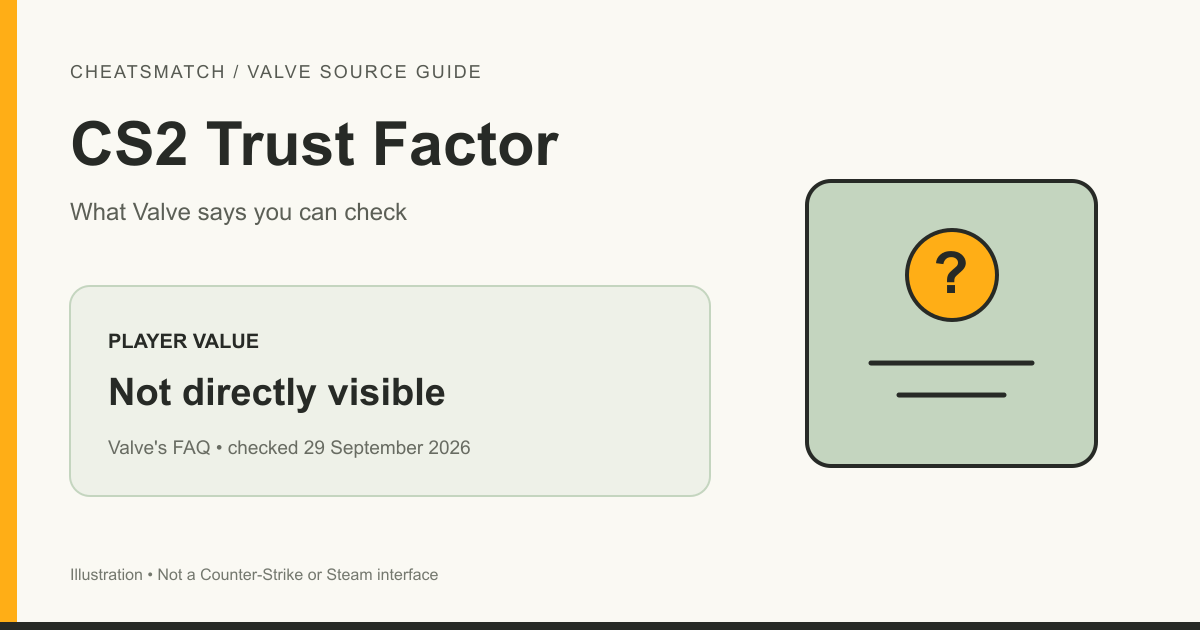
Valve says there is currently no way to check a CS2 Trust Factor value. Its FAQ does not direct players to a profile field, console command or numeric dashboard. A third-party site can show its own estimate or other data, but it cannot label that output Valve's unpublished Trust Factor value. Entering a Steam ID into a third-party checker does not change that source boundary.
There is no Valve-provided value to look up. A Prime lobby warning, when one appears, gives narrower information about the party. It is not the number itself.
Sources: [1]
What a Prime lobby warning means
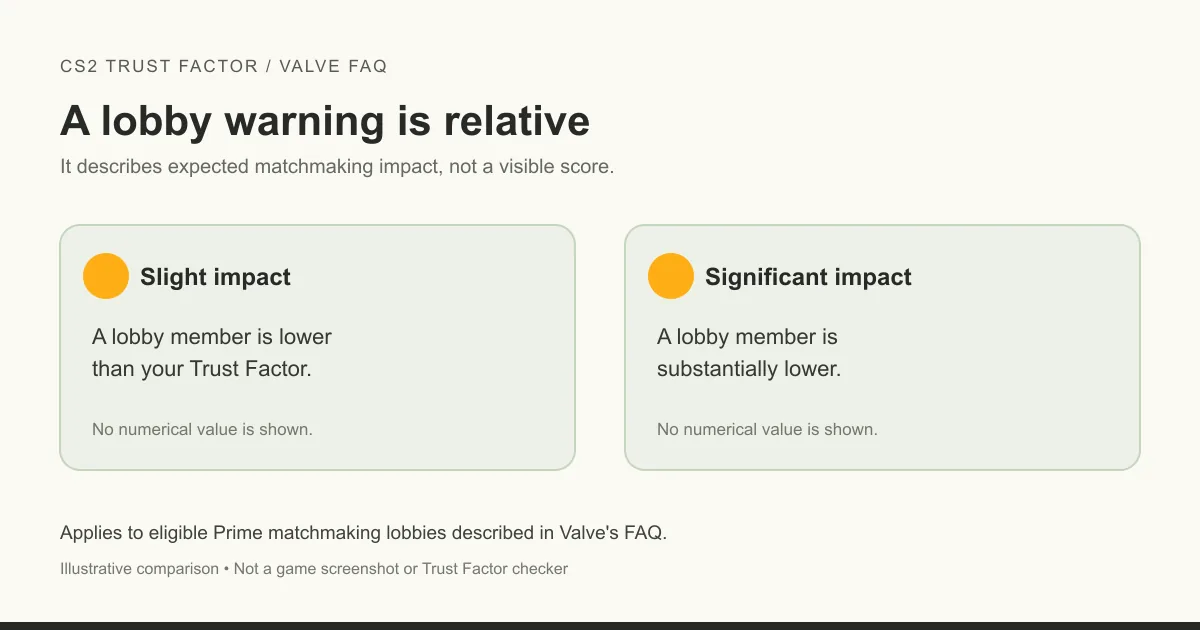
Valve's CS2 FAQ describes two warnings shown before a Competitive match to an eligible Prime player when another Prime member of the lobby has a lower Trust Factor. One warning says the matchmaking experience may be slightly affected; the other says it may be significantly affected. The messages compare players in that lobby and do not display a personal numerical score.
Valve says party matchmaking uses the lowest Trust Factor among party members. That makes the warning relevant when playing with friends, but it still does not tell either person their exact value. Valve also says a warning can appear to fewer users as a player's Trust Factor improves; it does not offer a schedule for that change.
| Warning level | What Valve says | What it does not show |
|---|---|---|
| Slight impact | A Prime lobby member has lower Trust Factor than yours, with a slight expected matchmaking impact. | No numerical value or complete factor list. |
| Significant impact | A Prime lobby member's Trust Factor is substantially lower than yours, with a larger expected impact. | No numerical value or universal account diagnosis. |
Sources: [1]
What Valve says affects Trust Factor
Valve does not publish a full list of Trust Factor inputs. Its FAQ says the system changes over time, and that a static factor list would become outdated. It describes past experience in CS2 and on Steam as general context. In a separate Prime question, Valve says Prime status can improve Trust Factor and names phone numbers and CS2 Rank among factors.
Those statements do not disclose a formula, factor weights or actions that automatically lower an account's value. Valve's FAQ does not verify online checklists that assign a fixed penalty to reports, queue time, overlays or a match result. Such a checklist is a third-party interpretation, not Valve's rule.
Sources: [1]
How Valve says to improve it
Valve advises positive participation in Counter-Strike 2 and the Steam community, and legitimate play in CS2 and other Steam games. Its FAQ says more play gives the matchmaking system more information about an account. It does not promise that a certain number of matches, days or account actions will produce a specific Trust Factor value.
Valve's Prime answer describes Prime status as beneficial and mentions phone numbers and CS2 Rank. That is published guidance, not a step-by-step formula. Follow Valve's broad advice by participating legitimately and using its current support FAQ for updates. The FAQ promises no specific value by a deadline.
Sources: [1]
Why poor matches do not prove low Trust Factor
Poor CS2 match quality by itself does not reveal a player's Trust Factor. Valve says the range of players on a server varies with time of day, region and queued maps. A difficult match, a long queue or an unfamiliar opponent may have more than one explanation; the FAQ does not designate any of these as a Trust Factor test.
Valve also says new players do not necessarily start with low Trust Factor because prior positive Steam-community experience can matter. A new CS2 profile and a low Trust Factor are not synonyms. For a party, Valve says matchmaking uses its lowest member factor, so a group experience can differ from solo play without revealing an exact score.
Sources: [1]
Valve feedback and current guidance
Valve's Trust Factor FAQ offers a feedback route for players who suspect poor CS2 matches relate to Trust Factor. It asks for a description of the experience and a Steam ID. That channel helps Valve investigate or improve matchmaking; the FAQ does not present it as a score lookup or an appeal that guarantees a factor change. Use the FAQ itself for the current contact details and wording.
The Valve Anti-Cheat page on CheatsMatch defines VAC and its separate ban topic. This guide stays with matchmaking; it does not claim a specific VAC-ban effect on Trust Factor. CheatsMatch's provider-evaluation guide explains evidence labels for product listings, which remain separate from Valve's hidden matchmaking value.
Sources: [1]
Frequently asked questions
Can a site show my exact CS2 Trust Factor?
Valve says there is currently no way to check the value. A third-party checker may show an estimate based on data it can observe, but that output is not Valve's unpublished Trust Factor.
Does a Prime lobby warning show my score?
No. Valve's Prime warning compares a member of an eligible CS2 lobby with you and describes a possible slight or significant matchmaking impact. It does not provide either player's numerical Trust Factor.
Does Valve publish what lowers Trust Factor?
Valve does not publish a full factor list for CS2 Trust Factor matchmaking. Its FAQ names past CS2 and Steam experience and some Prime-related inputs, but not a formula or fixed penalty schedule.
Does a new Steam account automatically start with low Trust Factor?
Valve says not necessarily. Prior positive Steam-community experience can matter when a player enters Counter-Strike 2, so newness alone is not a confirmed low score.
Sources and check dates
Numbers beside a fact or score refer to the sources below. Provider descriptions are claims, not independent product tests.
- Steam Support: CS2 Trust Factor Matchmaking · checked 2026-09-29