Ban Waves Explained: Publisher Examples and CS2 Tracker Limits
A ban wave is a group of game-enforcement actions issued together. As of September 29, 2026, two publishers in the cited record, Riot and Activision, have described waves: Riot discussed its VALORANT practice in 2020, and Team RICOCHET announced a Call of Duty Ranked Play wave in March 2025. Those statements do not establish a current Counter-Strike 2 schedule or official Valve total. Read each event with its publisher, date and source attached.
A ban wave groups enforcement actions
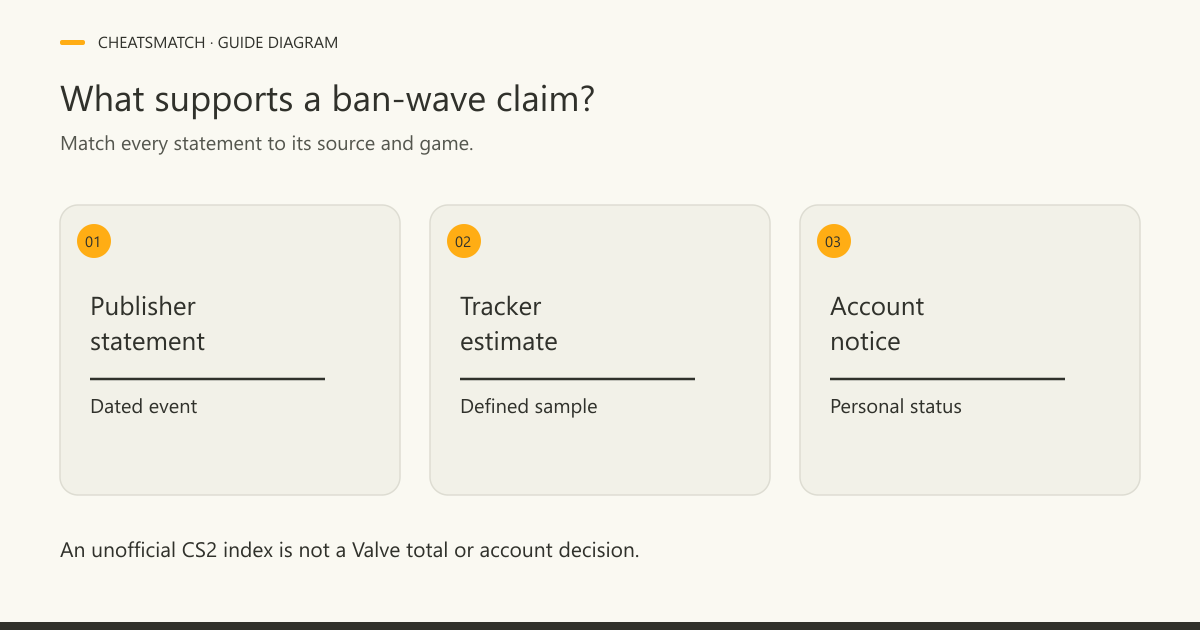
A ban wave is a publisher's batch of enforcement actions rather than a separate type of ban. The individual actions can still have different scopes under the relevant game's policy. Riot used the term in a 2020 VALORANT anti-cheat article; Team RICOCHET announced a specific Ranked Play banwave in March 2025. Neither statement defines every publisher's enforcement schedule.
The Counter-Strike 2 comparison identifies the covered game in CheatsMatch's catalogue. It does not turn a community count into an official Valve announcement. To interpret a wave claim, first ask which publisher said it, which game and period it covered, and whether the number describes accounts, individual bans or a tracked sample. A headline without those fields is not a reliable account-level answer.
Dated publisher examples
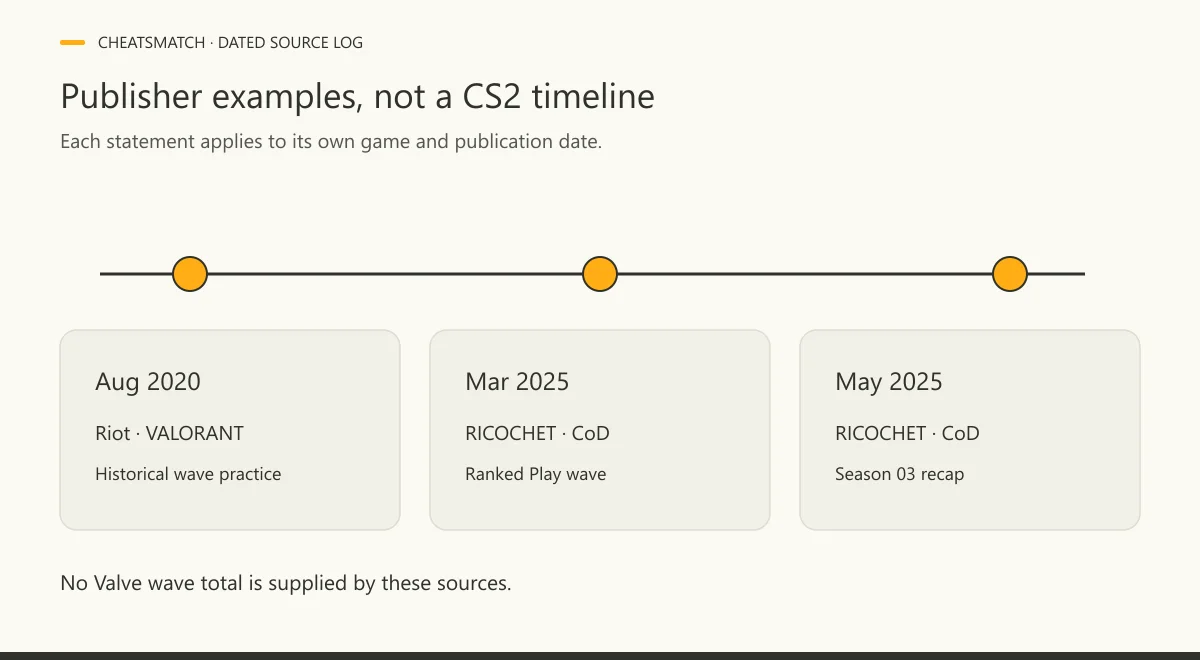
Riot and Team RICOCHET provide dated first-party examples of waves in their own games. The log below records only what each publisher published, with no inferred CS2 event and no imported tracker total. Each row's limit matters as much as its announcement.
The game comparison directory helps locate a title, while the named publisher source establishes the claim about that title. These historical rows are not a live tracker.
| Date | Publisher and game | Documented statement | What it does not prove |
|---|---|---|---|
| 2020-08-31 | Riot, VALORANT | Riot said it often used ban waves and sometimes acted early | No current Riot cadence or Valve practice; Riot article |
| 2025-03-28 | Team RICOCHET, Black Ops 6 and Warzone Ranked Play | Announced a banwave for verified teaming accounts | No CS2 event or count; RICOCHET update |
| 2025-05-07 | Team RICOCHET, Call of Duty | Described a large-scale wave in its Season 03 recap | No general rule for every game; RICOCHET recap |
Riot described waves in VALORANT
Riot's 2020 VALORANT anti-cheat article says it often used ban waves, while sometimes removing disruptive players ahead of a planned batch. The statement establishes that Riot used both grouped and earlier individual action at that time. It does not describe a universal anti-cheat rule or a current schedule for VALORANT, and it says nothing about Valve's Counter-Strike 2 policy.
Riot's 2024 Vanguard article also discussed why some enforcement was delayed and acknowledged that delay left players exposed before action. The historical account is useful for understanding that a publisher may weigh competing costs. It is not evidence that a particular account, cheat or current match has been detected, and it does not provide a player-facing way to predict a ban.
Team RICOCHET announced specific waves
Team RICOCHET's March 28, 2025 update announced a Ranked Play-specific banwave for accounts it said were verified as teaming in Black Ops 6 and Call of Duty: Warzone. The publisher's May 7 Season 03 recap separately described a large-scale wave tied to a cheat provider. These are dated Call of Duty statements, with different stated contexts. They do not establish a CS2 wave or a universal ban-wave pattern.
The publisher also reported in December 2024 that some account bans were happening hourly. That historical statement counters the assumption that all enforcement waits for a batch. The Call of Duty bans guide explains Activision's current account, limited-matchmaking and hardware policy. It is the appropriate next page for a Call of Duty sanction question, rather than a wave headline.
A CS2 tracker is not a Valve announcement
The publisher statements cited above are about VALORANT and Call of Duty, not Counter-Strike 2. In the official sources reviewed for this guide, no Valve statement supplies a current CS2 ban-wave schedule or total. This is a limit of this source set, not a claim that Valve has never discussed or issued grouped enforcement. The sampled CS2 ban-history tracker labels its totals as estimates from its own Steam index, not official Valve totals.
The Valve Anti-Cheat guide owns VAC background. A CS2 wave headline still needs its own publisher announcement or transparent tracker methodology before it can be reported as an event or count. This page does not repeat unverified month-by-month CS2 figures from search results.
Sources: [6]
Tracker counts need a denominator
The sampled CS2 ban-history tracker says its figures come from its own public Steam index and calls them estimates, not official Valve totals. An indexed sample can change as more accounts are observed, and the tracker lists VAC bans and game bans as separate categories. A reader should check what population, category, time window and refresh method a count covers before repeating it.
This guide uses no tracker total. Even a sharp change on a chart does not identify why any one account was sanctioned, prove that all accounts were caught by the same system, or establish that a publisher deliberately delayed action. A first-party dated statement can support a named event. A third-party chart can describe its own observations, with that limitation visible.
Sources: [6]
A wave does not diagnose an individual account
A ban-wave announcement describes grouped enforcement at the publisher level. An individual account's restriction depends on the official notice and the game's policy. Riot's 2020 article, for example, says both ban waves and earlier individual action were used; a player cannot infer the reason for a personal sanction from the date alone. A community chart cannot tell the reader which rule was applied to their account.
The game ban types guide explains account, game and device scopes under named publisher policies. Use the correct publisher's notice and support route for an account-specific question. This page gives no timing prediction and no technique to test or avoid enforcement.
Sources: [1]
Frequently asked questions
What is a ban wave?
A ban wave is a group of game-enforcement actions issued together. Riot's 2020 VALORANT article and Team RICOCHET's 2025 Call of Duty update both used the term for their own actions. A wave is not itself a separate account-ban type.
Does a CS2 tracker show official Valve totals?
The sampled CS2 ban-history tracker says its figures are estimates from its own index rather than official Valve totals. This guide does not reproduce those numbers. Check the tracker method and a dated Valve statement before calling a count official.
Do anti-cheats always wait for a wave?
No universal timing rule follows from the cited sources. Riot said in 2020 that it also acted early against some disruptive players, and Team RICOCHET reported hourly account bans in December 2024. Those are historical publisher statements, not a current CS2 schedule.
Can a wave explain my own ban?
A wave headline cannot identify the reason or scope of an individual account restriction. Read the official notice and the named game's policy. A tracker spike is a group-level observation, not an appeal decision or account diagnosis.
Sources and check dates
Numbers beside a fact or score refer to the sources below. Provider descriptions are claims, not independent product tests.
- VALORANT Anti-Cheat: Cheater, Reported! · checked 2026-09-29
- Vanguard x VALORANT · checked 2026-09-29
- RICOCHET Anti-Cheat Update, Season 03 · checked 2026-09-29
- RICOCHET Anti-Cheat Update, Season 03 Recap · checked 2026-09-29
- RICOCHET Anti-Cheat Update, December 2024 · checked 2026-09-29
- CS2 Ban History methodology note · checked 2026-09-29