
VALORANT Bans and Appeals: Behavior, Cheating and HWID
A VALORANT ban appeal depends on which Riot sanction the notice names. As of September 29, 2026, Riot's behavior-penalty FAQ lists a VALORANT game ban from 7 days to permanent for repeated conduct such as AFK or queue dodging. Riot's separate cheating article describes a permanent account ban, while its HWID FAQ describes a device restriction and possible re-evaluation. Check the exact notice and Riot source before using a support ticket.
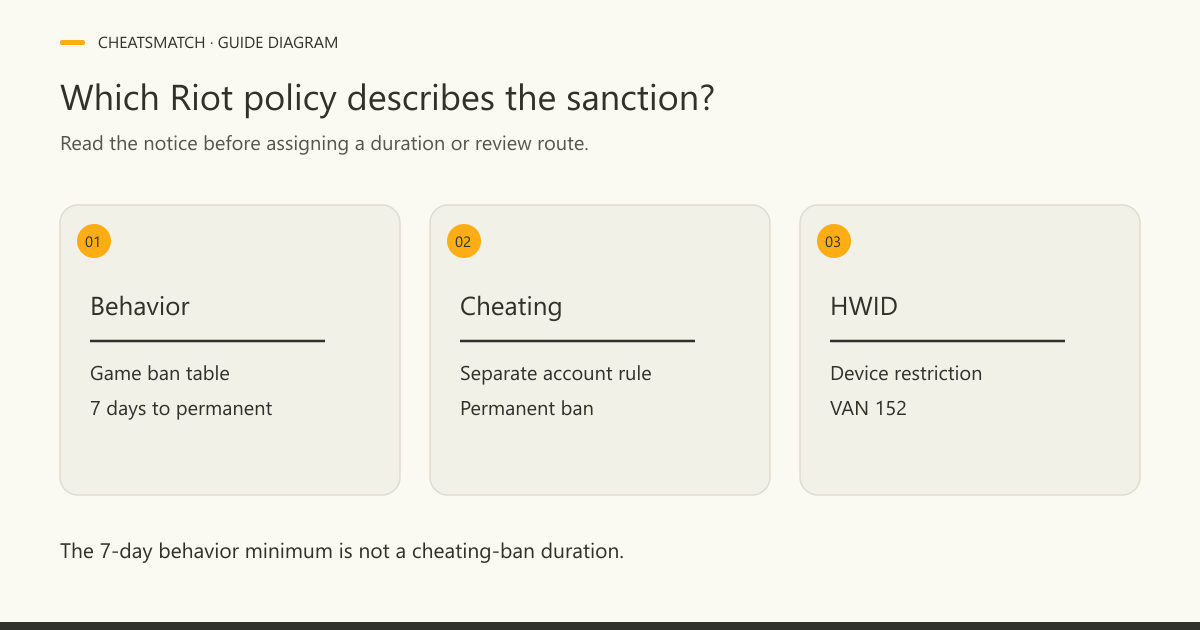
Identify the Riot notice first
Riot publishes different VALORANT penalties for player behavior, cheating and hardware ID restrictions. An error or queue symptom does not identify which policy was applied to an account. Read the message, the affected game, any date and the source page for that category. The VALORANT comparison identifies the game covered in CheatsMatch's catalogue, but Riot's account-specific notice and support route control a sanction question.
Riot's Bans and Reports hub is a general navigation page with game tabs. Its League of Legends material is not a VALORANT ban policy. For VALORANT, use the game's penalty FAQ and cheating article, plus Riot's separate HWID FAQ where relevant. This distinction prevents an account sanction from being assigned a duration drawn from a different conduct category.
Three Riot sanction contexts compared
Riot's three cited policy pages address different conduct and access effects. The table shows their published scope as checked September 29, 2026. It is not a diagnostic result for an individual player. The game comparison directory supplies game context; Riot support supplies the account-specific answer.
| Context | Riot's stated effect | Duration or review | Official source |
|---|---|---|---|
| Repeated AFK, queue dodging or friendly fire | VALORANT game ban in the behavior-penalty table | 7 days to permanent in this FAQ | Behavior FAQ |
| Cheating with unauthorized hardware or software | Permanent account ban | Permanent under the cheating article | Cheating article |
| Hardware ID restriction | Game access restricted; VAN 152 can appear | Some cases may be submitted for re-evaluation, without a guarantee | HWID FAQ |
Behavior penalties have their own durations
Riot's VALORANT Penalties and Bans FAQ discusses AFK behavior, queue dodging and friendly fire. Its table includes warnings, XP denial, Rank Rating deduction, a teamplay restriction timer and a VALORANT game ban. The game-ban row spans 7 days to permanent. Riot says the chosen penalty depends on offense severity and behavior history; it does not promise that every player passes through each step in order.
This duration range belongs to the behavior FAQ. It does not set the minimum or maximum for cheating or HWID cases. A restriction timer is also not the same table row as a game ban. The game ban types guide explains why an account, game and device restriction should be read under its named publisher policy.
Sources: [1]
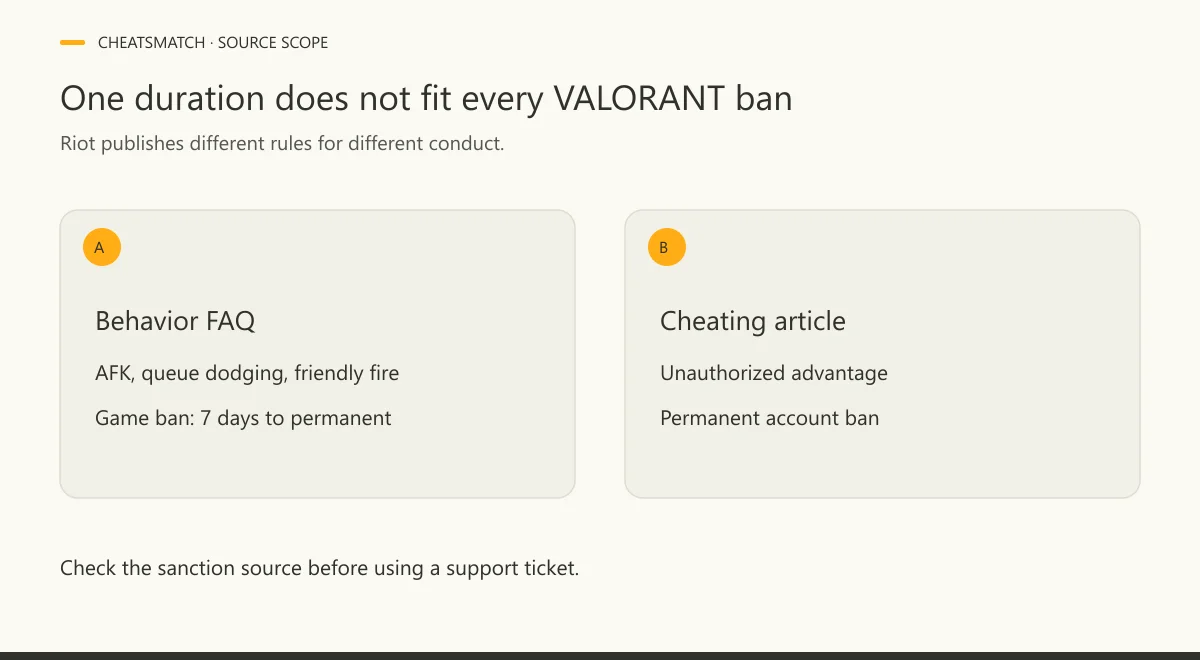
Cheating sanctions use a separate rule
Riot's 2026 VALORANT cheating article says that cheating with unauthorized hardware or software that gives an unfair advantage leads to a permanent account ban. It separately says queueing with cheaters brings a 180-day ban. Those statements are part of the cheating article, not the conduct table about AFK or friendly fire. This page reports Riot's policy; it cannot identify why a particular account was penalized.
An appeal template cannot replace the notice or Riot's source. The article does not state that an ordinary cheating account ban is eligible for reversal, nor does it give a general success rate. If a player needs account-specific clarification, use Riot's support route. Do not infer a cheating finding from an unrelated error code or from someone else's ban story.
Sources: [2]
HWID restrictions have a different scope
Riot's HWID FAQ says a hardware ID ban is different from a normal account ban. It restricts game access from the identified device, and Riot says a login attempt while the restriction is active results in VAN 152. The FAQ describes possible additional account consequences. It also says reinstalling a game or deleting the responsible account does not remove an HWID ban; this is a scope statement, not a troubleshooting instruction.
Riot says a player whose HWID ban followed negative behavior or suspected cheating can submit a player support request for re-evaluation. Riot explicitly says lifting the ban is possible but never guaranteed; certain threat cases are treated differently. That rule is specific to HWID cases. The HWID ban guide compares publisher definitions, but Riot's current FAQ controls a Riot restriction.
Sources: [3]
Use Riot's support route
Riot's support pages link to Submit a Ticket. Use the affected Riot account and the sanction details shown in its notice. The ticket page is an official contact route; its dynamic form does not by itself establish that every account ban qualifies for appeal or that a decision will be reversed. Riot's HWID FAQ expressly offers re-evaluation for some HWID cases, while the cited behavior and cheating articles do not give an equivalent general reversal rule.
Keep the categories separate when describing the issue to support: behavior game ban, cheating account ban or HWID restriction. Riot's own source for the named sanction is more reliable than a third-party appeal template. There is no verified review-time estimate or appeal success rate in the cited pages.
An error code is not a full diagnosis
Riot's VALORANT error-code page warns that its list is currently out of date because some errors display incorrectly. Its code 61 row says a player seeing a ban error should submit a ticket. Riot's HWID FAQ separately associates VAN 152 with an active HWID ban. Those references can guide which support page to read, but the warning prevents a confident account diagnosis from a code alone.
Do not assign a duration from the outdated code list. Read the current notice and Riot's sanction-specific policy. The code page's ticket route is useful for an unresolved message, not proof of appeal eligibility. Riot may update the list, so the source should be rechecked when the page is reviewed.
Frequently asked questions
Can I appeal a VALORANT ban?
Riot offers an official support-ticket route, but the cited VALORANT behavior and cheating pages do not give a general promise that every account ban is appealable or reversible. Riot's HWID FAQ specifically permits a re-evaluation request in some cases without guaranteeing that the restriction will be lifted. Use the notice and the relevant Riot policy.
Does the 7-day minimum apply to cheating?
No. The 7-day-to-permanent row appears in Riot's VALORANT behavior-penalty FAQ for conduct such as AFK and queue dodging. Riot's separate cheating article states a permanent account ban for cheating with unauthorized hardware or software.
What does VAN 152 mean?
Riot's HWID FAQ says a login attempt during an active HWID ban can produce VAN 152. Its error-code list currently warns that some errors display incorrectly, so the account notice and Riot support should resolve uncertainty about a specific case.
Does Riot describe an IP ban for VALORANT?
The Riot policy pages cited here describe account, game and hardware ID restrictions, but do not establish a VALORANT IP-ban category. A connection error alone does not prove one. Use Riot's notice and support route for an account-specific answer.
Sources and check dates
Numbers beside a fact or score refer to the sources below. Provider descriptions are claims, not independent product tests.
- Penalties and Bans FAQ (VALORANT) · checked 2026-09-29
- Addressing Cheating in VALORANT · checked 2026-09-29
- Understanding Hardware ID (HWID) Bans · checked 2026-09-29
- Bans and Reports · checked 2026-09-29
- Submit a Ticket · checked 2026-09-29
- Error Codes and Solutions in VALORANT · checked 2026-09-29