Free HWID Spoofers: What the Evidence Does and Doesn't Show
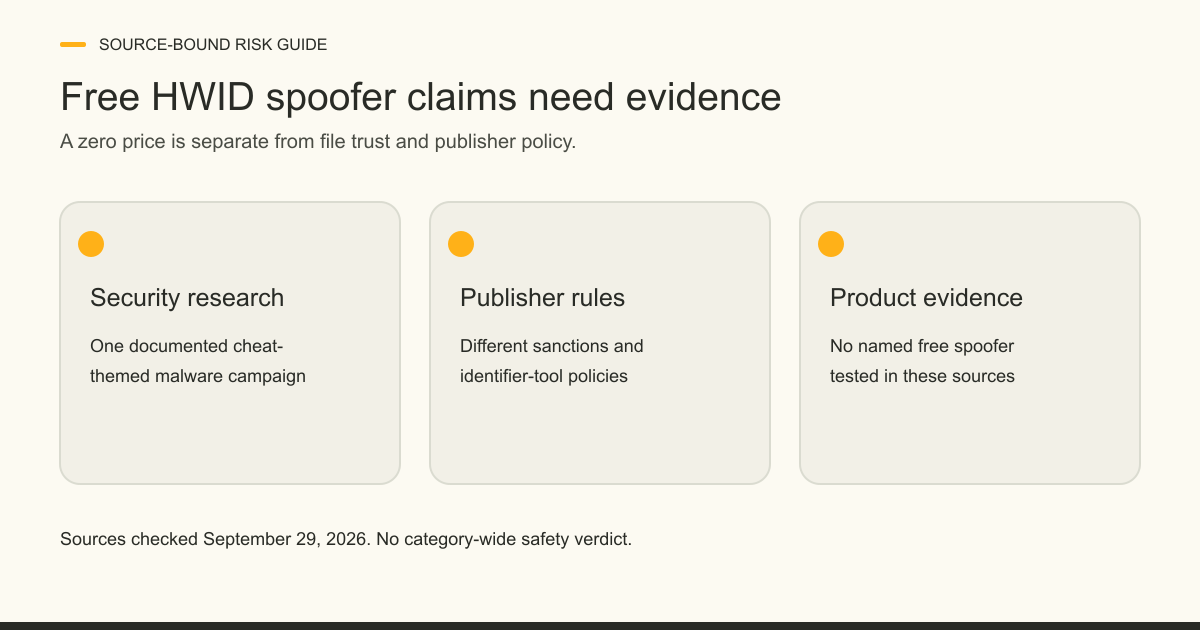
Free HWID spoofer listings advertise zero cost, not whether a file is trustworthy or a game will accept its claims. As of September 29, 2026, the sources checked here contain no verified test of a named free spoofer. Cisco Talos documented a 2022 malware campaign disguised as game cheats. Microsoft describes unwanted-software risks. Riot, Ubisoft, Activision and Epic publish distinct game rules. None of those sources proves that every free spoofer is malicious or effective.
What this page can verify
The word “free” tells you how a listing is priced. It says nothing on its own about what a file does, who maintains it or whether a game publisher accepts it. This guide checks public security research and publisher rules; it does not evaluate a specific utility. There is no tested free-product list or success rate here.
The HWID spoofer hub is a separate comparison of published product information. Its listings should be read as vendor claims with their own evidence limits, not as proof that a tool clears a ban. This page asks a narrower question: what can the available sources support before someone trusts a download claim?
What security research found
Cisco Talos reported in April 2022 that ZingoStealer, an information stealer, was distributed in campaigns disguised as game cheats and related content. One example involved a purported game-modification utility. That is a concrete historical warning about a lure, not a finding that the article analyzed a free HWID spoofer. Talos's report does not give a prevalence rate for spoofers.
Microsoft distinguishes potentially unwanted applications from malware. Its support page says unwanted apps can show ads, use device resources or offer unexpected software. Its Defender criteria also distinguish unknown software reputation from a confirmed malicious classification. A security warning is a reason to examine a file's provenance, not an automatic verdict on every tool in a category.
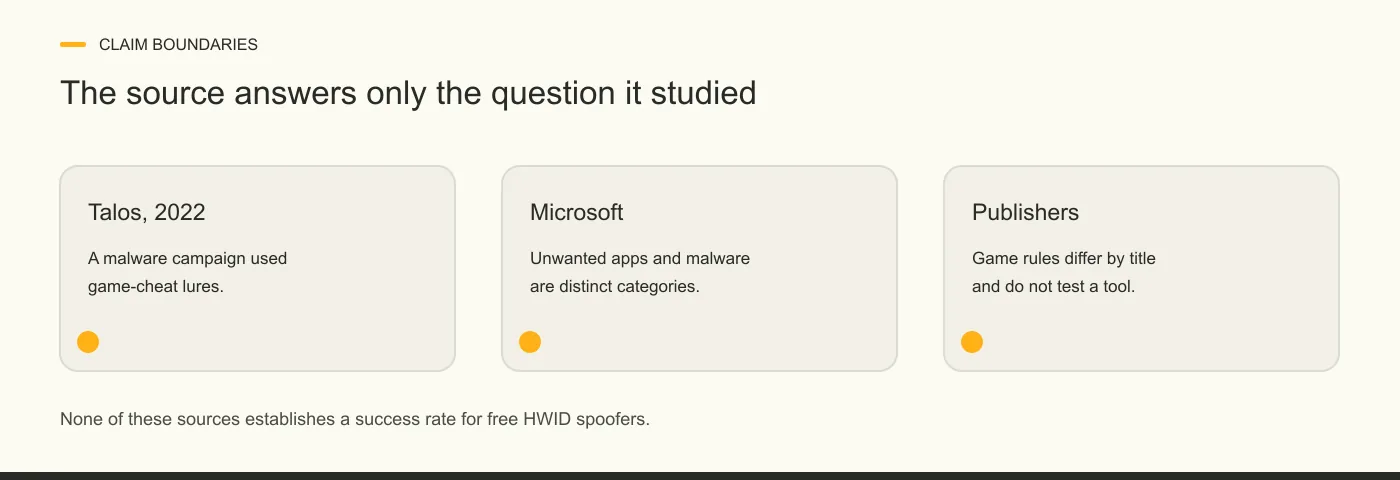
Cisco Talos's April 14, 2022 report documents ZingoStealer using game-cheat lures; it does not identify a free HWID spoofer. Those three rows speak to software trust. They do not answer whether a publisher would change a hardware sanction.
| Source | Verified finding | What it does not establish |
|---|---|---|
| Cisco Talos, April 2022 (Cisco Talos: ZingoStealer Threat Spotlight) | A documented information-stealer campaign used game-cheat or modification lures. | That a named free HWID spoofer was tested, or that every free spoofer carries malware. |
| Microsoft Support (Microsoft Support: Protect your PC from unwanted software) | Potentially unwanted apps can cause unwanted behavior without being classified as malware. | That a particular HWID tool is a PUA or malicious. |
| Microsoft Defender criteria (Microsoft Defender: How Microsoft identifies malware and PUA) | Unknown or uncommon software is a separate classification from confirmed malware. | That an unrecognized file is harmless or harmful without analysis. |
What game publishers say about hardware tools
Game rules are another source category. Riot describes an HWID ban as a physical-computer restriction and a separate sanction from an account ban. Ubisoft's July 2026 Rainbow Six Siege rules prohibit disguising a device identity to bypass restrictions. Activision's July 2026 Call of Duty policy defines spoofing as hiding or disguising hardware-device identity. Epic's Fortnite support page describes a Hardware Identifiers Warning for tools that hide or change identifiers and says an account may be permanently banned if the warning is ignored.
The cross-game policy table tracks publisher statements with dates and scope. A free label is no exemption from a game's published rules. The Fortnite HWID spoofer comparison records provider claims separately from Epic's policy.
| Publisher source | Verified policy point | What it does not establish |
|---|---|---|
| Riot, May 2026 (Riot Games Support: Understanding HWID Bans) | Riot explains a device HWID restriction and a support-review route. | That any free utility reverses an active Riot sanction. |
| Ubisoft, July 2026 (Ubisoft: Player Protection Core Rules) | Siege's rules prohibit identity spoofing to bypass restrictions. | That a named tool is detected or that every game has the same rule. |
| Activision, July 2026 (Activision: Call of Duty Security and Enforcement Policy) | The Call of Duty policy defines spoofing of hardware-device identity as an infraction. | That any particular free product works or has been sanctioned. |
| Epic, undated (Epic Games Support: Fortnite Hardware Identifiers Warning) | Fortnite support warns about tools that hide or change hardware identifiers. | Complete hardware-ban criteria or a tool-by-tool safety list. |
Which claims need independent evidence
Treat “undetected,” “safe,” “works for every game” and “removes a hardware ban” as claims requiring product-specific evidence. None of the primary sources in this guide tests a named free HWID spoofer against those promises. A feature list or an anonymous download post cannot fill that gap by repeating the claim.
Separate four questions before trusting any listing: who publishes the file, what independent analysis exists for that exact file, what the relevant game policy says, and whether the claimed outcome was verified on the same product version. The answers can remain unknown. Microsoft's distinction between unknown software and malware means an absence of a confirmed finding is not a safety certificate.
The spoofer-definition guide explains category language. It should not be read as a method for changing identifiers or an account restriction.
Does a price tag change the evidence?
No source checked here establishes that a paid HWID spoofer is safer or more effective than a free one. Price is a purchasing term, not a test result. The Talos case does not compare paid and free spoofers, and Microsoft does not classify this entire product category by price. Publisher rules address behavior and restrictions, not a tool's invoice.
A paid comparison can still be useful for recording published support, refund and scope information. That is different from verifying that a tool avoids detection or removes a penalty. Keep those questions separate when reading any comparison.
Where to check a restriction and compare listings
If the concern is an actual game restriction, use the publisher's notice and support page to identify the sanction. Riot's HWID-ban article describes a Player Support review request in eligible circumstances; the outcome is Riot's decision. A third-party listing cannot tell you what a publisher has recorded for your account or device.
If the concern is terminology, the ban guide separates hardware and account restrictions. If the concern is a product listing, the hub records vendor-published scope with its evidence limits. Neither route turns an unverified free offer into a recommendation.
Sources: [4]
Frequently asked questions
Are all free HWID spoofers malware?
The sources here do not support that blanket claim. Cisco Talos documented one 2022 malware campaign disguised as game-cheat content, not a survey of free HWID spoofers. Microsoft also distinguishes unwanted apps from malware and unknown files from confirmed malicious ones. (Cisco Talos: ZingoStealer Threat Spotlight) (Microsoft Support: Protect your PC from unwanted software) (Microsoft Defender: How Microsoft identifies malware and PUA)
Can a free spoofer remove a hardware ban?
No checked source verifies a named free spoofer doing that. Riot describes an HWID ban as a device restriction and directs eligible review requests to Player Support. A product claim alone cannot establish a changed publisher sanction. (Riot Games Support: Understanding HWID Bans)
Are paid spoofers safer than free ones?
Price alone does not establish safety or effectiveness in the checked research. Talos's case is not a paid-versus-free spoofer comparison, and Microsoft's PUA criteria classify software behavior, not its price. This guide has no tested products in either group. (Cisco Talos: ZingoStealer Threat Spotlight) (Microsoft Defender: How Microsoft identifies malware and PUA)
What does a Fortnite hardware-identifiers warning mean?
Epic says the warning appears when Fortnite detects a tool that hides or changes a computer's hardware identifiers. Its page says ignoring the warning can lead to account action, including a possible permanent ban. That article does not evaluate any named free spoofer. (Epic Games Support: Fortnite Hardware Identifiers Warning)
Sources and check dates
Numbers beside a fact or score refer to the sources below. Provider descriptions are claims, not independent product tests.
- Cisco Talos: ZingoStealer Threat Spotlight · checked 2026-09-29
- Microsoft Support: Protect your PC from unwanted software · checked 2026-09-29
- Microsoft Defender: How Microsoft identifies malware and PUA · checked 2026-09-29
- Riot Games Support: Understanding HWID Bans · checked 2026-09-29
- Ubisoft: Player Protection Core Rules · checked 2026-09-29
- Activision: Call of Duty Security and Enforcement Policy · checked 2026-09-29
- Epic Games Support: Fortnite Hardware Identifiers Warning · checked 2026-09-29