PC Cheat Catalogue Report 2026: What 1,492 Listings Show
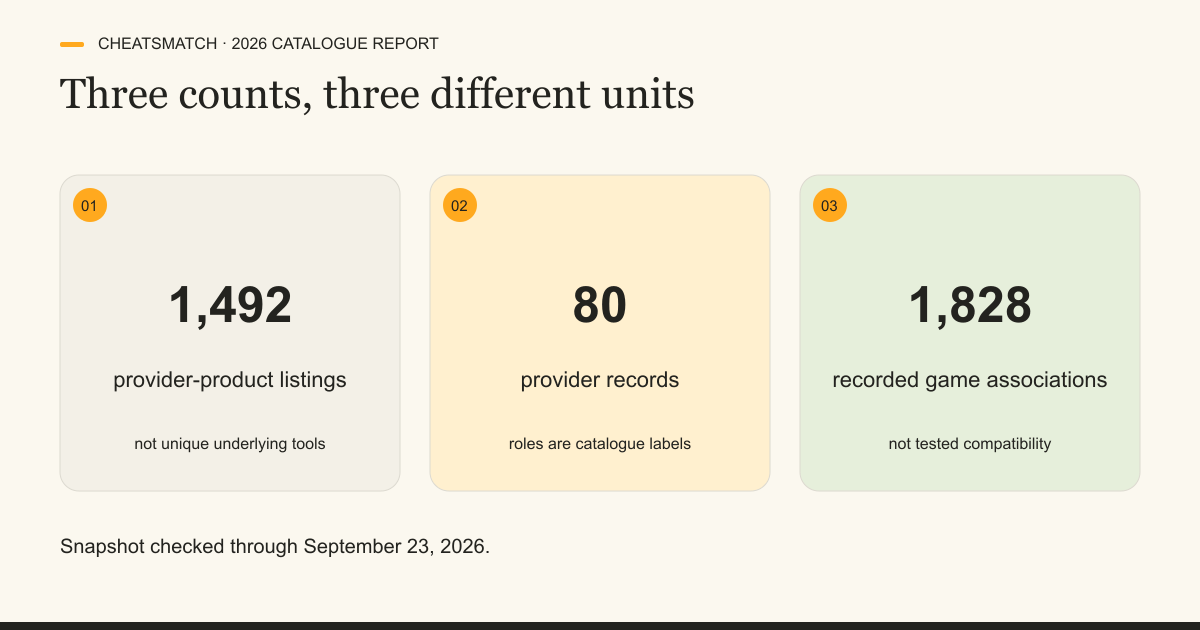
The 2026 CheatsMatch catalogue contains 1,492 eligible provider-product listings checked through September 23, 2026. They belong to 80 provider records and carry 1,828 recorded game associations. These are catalogue records, not independently verified products or proof of game compatibility. This report explains how the snapshot was selected, where records overlap, and which fields are missing, so every figure can be read with its denominator.
The catalogue snapshot and its scope
The CheatsMatch snapshot counts 1,492 provider-product listings under its Windows PC scope. Every included listing has an identified provider, at least one recorded claim and at least one source. The number describes the catalogue's eligible records, not the size of the whole PC cheat market or the number of unique underlying tools. A provider can have several listings, and resellers can record offers that refer to another developer's product.
The snapshot contains 80 provider records and 161 game records. It also records 1,828 product-game associations, a different unit from either listing or game record. Those associations include unresolved or inferred links, so the figure cannot be read as 1,828 verified game compatibility claims. All figures below come from the same catalogue snapshot checked through September 23, 2026.
The provider directory carries the individual profiles behind this count. A profile's source and check date remain necessary when reading a particular claim.
How records were selected and counted
The catalogue includes a product record when its provider exists, its scope includes Windows PC, and it has at least one claim and one source. It counts that record once as a provider-product listing. Reseller offers are not merged into independently verified underlying products. In this snapshot, 378 of 1,492 listings are flagged for duplicate review. A flag marks uncertainty for review; it is not proof that two records are the same product.
The catalogue groups product types using recorded category labels. A listing can have several labels, so type counts overlap and must not be added into a total. The dma, dma_based and dma_cheat labels share one DMA group, with a listing counted at most once in that group. Provider-reported status labels are counted as labels, not verified operation. This report does not turn a seller's status wording into a finding that a product works or is safe.
The methods and the rest of the editorial program are listed in the guide index and the rating-method page. Those pages explain why a documented claim and a verified outcome occupy different evidence levels.
Game associations in eligible records
The 1,828 recorded product-game associations arise from the 1,492 listings, while the source contains 161 game records. Neither number is a confirmed count of distinct games with tested compatibility. The catalogue flags 308 of 1,492 listings for review of a game association and two of 161 game records for review of game identity. These flags show where the catalogue has not settled an identity or association.
The table gives four recorded game-association slices. A listing can occur in more than one row because it may name multiple games; these rows should not be summed. Each row's denominator is the same 1,492 listing scope, with its own count of listings carrying that association.
The game directory and Rust page let a reader inspect game-specific records. A recorded association is a provider claim or catalogue link to check, not independent evidence that a product functions in that game.
| Recorded game association | Listings with association | Denominator |
|---|---|---|
| Rust | 101 | 1,492 listings |
| Apex Legends | 93 | 1,492 listings |
| Escape from Tarkov | 93 | 1,492 listings |
| Fortnite | 87 | 1,492 listings |
Provider and reseller distinctions
The 80 provider records have catalogue role labels: 51 developer, 18 reseller, three mixed and eight unknown. These four role counts sum to the provider-record denominator, but a role label is not an audit of business ownership or development work. It describes how the provider is recorded in this snapshot. A separate product listing can still be an offer for another party's underlying tool.
This distinction matters most when interpreting volume. The 1,492 listing count includes provider-product records, not unique source-code bases or independent software products. A seller may present several names or payment variants; the catalogue does not merge them without evidence. Activision's RICOCHET team has publicly warned that reseller branding can create an appearance of variety in its cheating-ecosystem account. That publisher observation supports caution, but it does not identify which CheatsMatch records share an underlying product.
Sources: [1]
Plan-term and currency coverage
The price comparison begins with 3,799 plan records, of which 3,742 meet its published-price and comparison criteria. Among those eligible records, 2,290 are in USD and 1,452 are in another currency: 918 EUR, 528 GBP and six RUB. These are plan records, not providers, products or purchases. Separate payment variants and reseller offers can appear as separate plans.
The catalogue keeps stated durations apart. A one-month label and a 30-day label occupy different rows, as do one-week and seven-day labels. It does not convert currencies, infer a monthly-equivalent rate or combine “lifetime” with other one-time descriptions. These choices avoid false precision. The price guide explains the term-specific medians with their sample sizes; this report uses the price totals only to describe catalogue coverage.
Missing and unverifiable fields
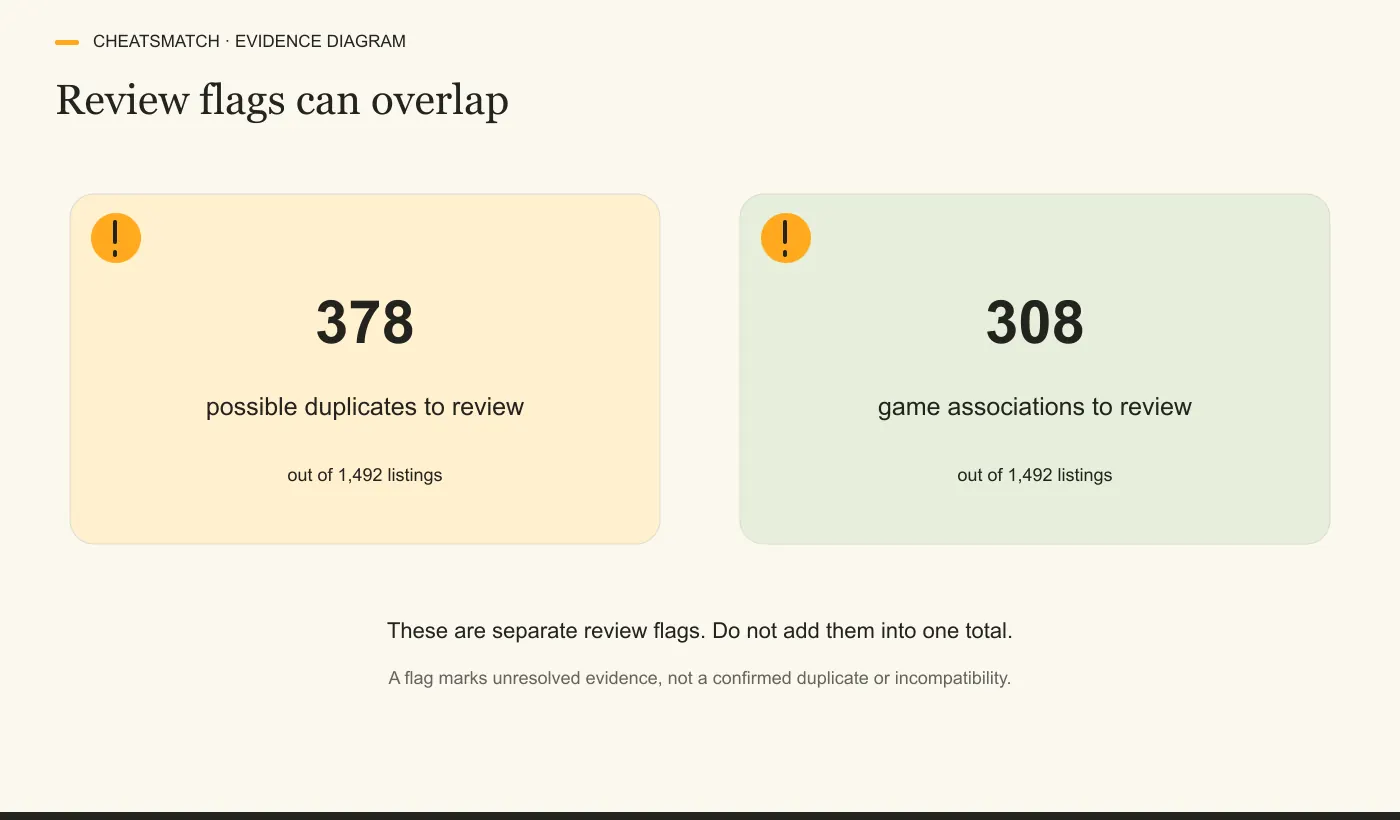
The review flags show what the snapshot cannot settle from recorded evidence. There are 378 listings flagged for duplicate review among 1,492 and 308 flagged for review of a game association among the same denominator. The type-label table has 320 listings with no type recorded. The game-record table has two flagged for review of game identity among 161 game records. These categories are different checks and may overlap, so adding them would overstate the number of affected listings.
The provider-policy observation is also incomplete: for 35 of 80 providers, whether a refund policy was published is not recorded. Forty-four have an explicit recorded-present flag and one an explicit recorded-absent flag. A recorded-present flag means the catalogue saw a published policy, not that the policy is generous, enforceable or suitable for a particular purchase. Missing means no usable observation in this field, not that no policy exists.
| Evidence field | Count | Denominator | What the count means |
|---|---|---|---|
| Possible duplicate needing review | 378 | 1,492 listings | Identity needs review. |
| Game association needing review | 308 | 1,492 listings | Association needs stronger evidence. |
| Type not recorded | 320 | 1,492 listings | No usable type label in the snapshot. |
| Refund-policy presence not recorded | 35 | 80 providers | Presence field lacks an explicit observation. |
What this snapshot cannot show
This snapshot cannot estimate the entire market, compare sales, establish growth over time or rank products by performance. It is a documented catalogue assembled under a defined scope, checked through one date. The listing total is not a census, and a type label is not a measured feature test. Game associations may be unresolved or inferred. Plan amounts are published records, not final checkout payments.
The most useful reading is narrower: a reader can see which record units CheatsMatch has, what fields are documented, and where a claim still rests on a provider statement. The guide to evaluating providers explains how to assess one profile's evidence before making an individual comparison.
Frequently asked questions
How many records qualified for this report?
The catalogue snapshot has 1,492 provider-product listings checked through September 23, 2026. Each has a provider, Windows PC scope, at least one claim and at least one source. The count is not the number of independently verified products.
Are resellers counted separately?
The 80 provider records include 18 labeled reseller, three mixed and eight unknown, alongside 51 labeled developer. A provider-product offer can remain a separate listing even when a reseller and developer refer to related tools. The catalogue flags 378 listings for duplicate review rather than merging them into unique products without evidence.
Does a listing prove a product works?
No. The catalogue counts documented claims and source records; its method explicitly says functional support was not verified. A provider's status label is a claim to read with its date and source, not a tested outcome.
Is this a market-size estimate?
No. The 1,492 records are eligible listings in the CheatsMatch catalogue, not a representative sample of every provider or offer. The report does not estimate sales, spending or market share.
Can one snapshot show a trend?
No. A trend needs comparable measurements across time with stable definitions and a consistent way to identify duplicate offers. This report uses one catalogue snapshot checked through September 23, 2026.
Sources and check dates
Numbers beside a fact or score refer to the sources below. Provider descriptions are claims, not independent product tests.
- Activision, Taking on the Cheating Ecosystem · checked 2026-09-29