
Is Using an HWID Spoofer Ban Evasion? Publisher Rules
Using an HWID spoofer to get around a restriction can fall under a publisher's ban-evasion or spoofing rules. On September 29, 2026, Ubisoft's Siege rules prohibit disguising a device identity to bypass restrictions, and Activision's Call of Duty policy defines hiding hardware identity as spoofing. Riot and Embark describe device bans but do not classify spoofer use in their cited pages. Fortnite warns about tools that hide or change identifiers. The rule depends on the game, conduct and current policy.
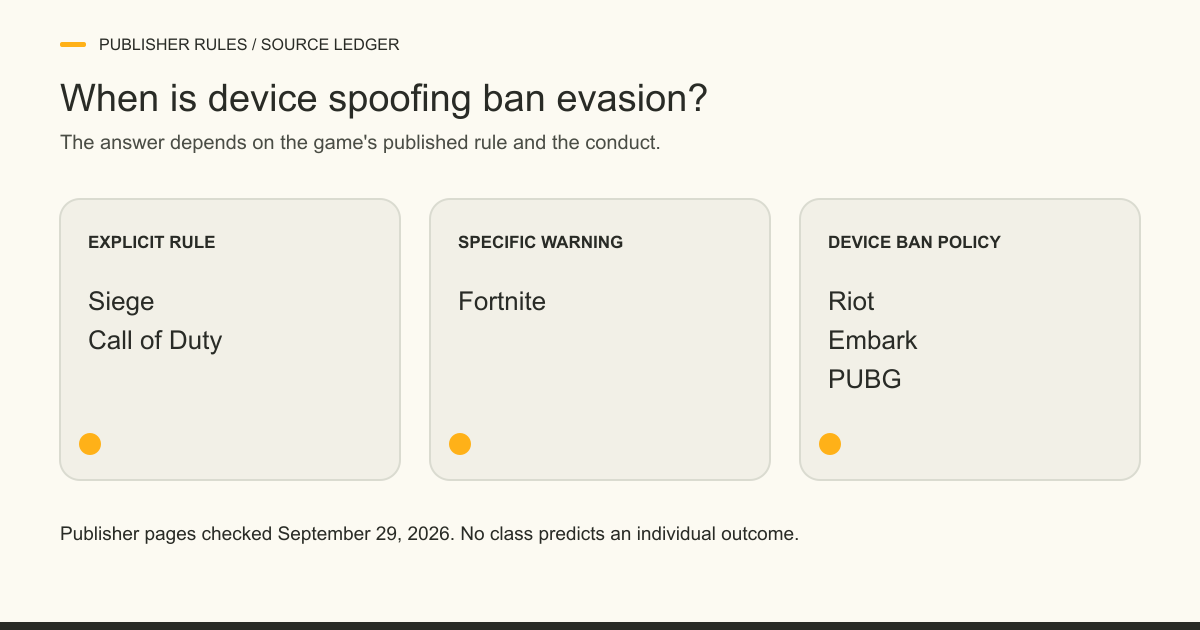
What publisher rules say in brief
There is no single game-industry rule that gives every use of an HWID spoofer one label. The two clearest checked policies are game-specific. Ubisoft's Rainbow Six Siege rules list spoofing a device identity to bypass restrictions among prohibited behaviors. Activision's covered Call of Duty policy defines spoofing as an attempt to hide or disguise hardware-device identity and separately lists security circumvention. Both policies can lead to sanctions; neither source evaluates a specific product.
Other publisher pages answer narrower questions. Riot and Embark explain hardware bans and access limits. Epic's Fortnite help page gives a title-specific identifier warning. The spoofer-definition guide explains the term itself, while this page compares what publishers have written.
Publisher policies compared
Each evidence class answers a different question. Explicit rule means the source names spoofing or circumvention as prohibited conduct. Specific warning means a game support page describes identifier-changing tools and possible action, without a complete rule for every situation. Device-ban policy only describes restrictions but does not classify every tool. A roadmap records planned work, not current sanction criteria.
Ubisoft's July 31, 2026 Siege rules name device-identity spoofing to bypass restrictions; Activision's July 31, 2026 Call of Duty policy defines hardware-identity spoofing. The cross-game ban ledger focuses on where publishers document a hardware restriction. This table focuses on whether the cited text addresses spoofing, ban evasion or only the restriction itself. Neither table measures how often a publisher sanctions players.
| Publisher or game | Evidence class | What the official source says | Source date; checked |
|---|---|---|---|
| Rainbow Six Siege | Explicit rule | Ubisoft prohibits device-identity spoofing to bypass restrictions and interference with enforcement. (Ubisoft: Player Protection Core Rules) | Jul 31, 2026; Sep 29, 2026 |
| Call of Duty | Explicit rule | Activision defines hiding or disguising hardware-device identity as spoofing, and lists security circumvention. (Activision: Call of Duty Security and Enforcement Policy) | Jul 31, 2026; Sep 29, 2026 |
| Fortnite | Specific warning | Epic's Hardware Identifiers Warning refers to tools hiding or changing computer identifiers and possible account action. (Epic Games Support: Fortnite Hardware Identifiers Warning) | Undated; Sep 29, 2026 |
| Riot games | Device-ban policy only | Riot describes an HWID restriction and penalties for another account used on a banned computer, without classifying every tool. (Riot Games Support: Understanding HWID Bans) | May 31, 2026; Sep 29, 2026 |
| Embark games | Device-ban policy only | Embark applies hardware bans across its titles and says they are final, without naming spoofers in this FAQ. (Embark ARC Raiders Help Center: Hardware Banning) | Updated Oct 29, 2025; Sep 29, 2026 |
| PUBG: BATTLEGROUNDS | Device-ban policy only | Its Rules of Conduct allow hardware-device access restrictions for specified misconduct; the penalty can vary. The separate roadmap describes planned anti-cheat work. (PUBG: BATTLEGROUNDS Rules of Conduct) (PUBG: BATTLEGROUNDS Anti-Cheat 2026 Roadmap) | Rules undated; roadmap Mar 24, 2026; checked Sep 29, 2026 |
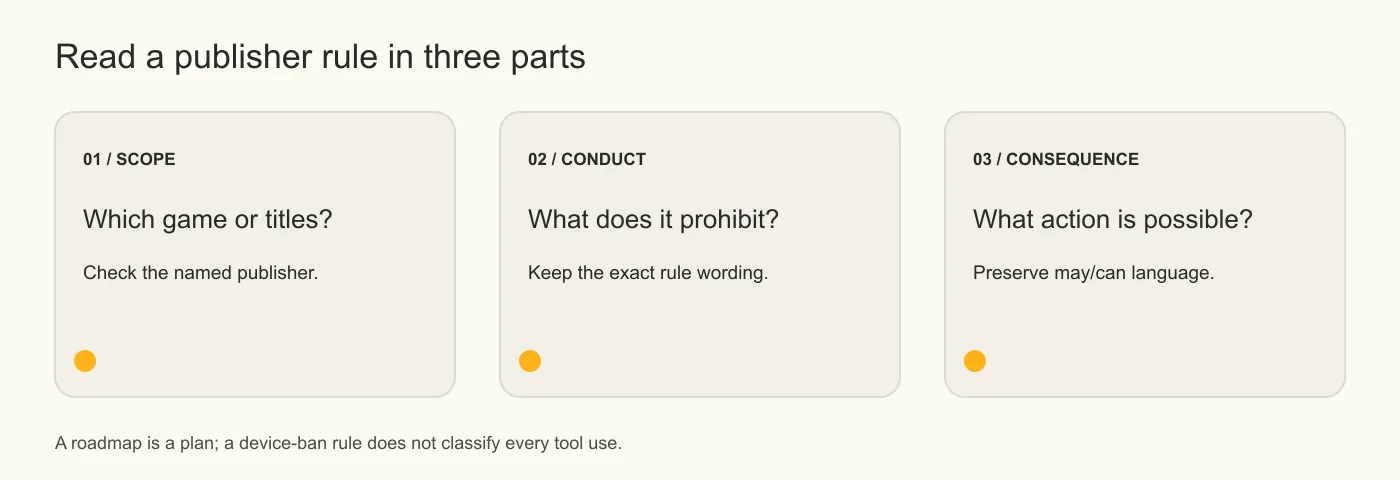
Where spoofing or circumvention is explicit
Ubisoft's July 31, 2026 Siege Core Rules describe “Spoofing” as disguising a device's identity to appear legitimate or bypass restrictions. The same rules prohibit attempts to interfere with security or enforcement systems and use of another account to evade an existing ban. They list possible temporary and permanent restrictions. The exact action depends on the violation; the policy is not a detection-rate report.
Activision's July 31, 2026 Call of Duty policy applies to covered console and PC titles from Modern Warfare (2019) onward. In its infraction definitions, “Spoofing” covers attempts to hide or disguise the identity of hardware devices. It also lists circumvention of security systems and says penalties may apply to accounts or hardware. Its hardware-ban section says a device restriction may span Call of Duty titles. These statements define policy scope, not the result of a particular spoofer.
What the other sources do and do not say
Riot's May 2026 HWID-ban article says a ban targets physical components and restricts access to Riot services. It warns that another account used on a restricted computer can face penalties. The cited article does not define every use of an HWID spoofer as a named infraction. That absence in one page is not a statement of permission.
Embark's ARC Raiders Help Center says hardware bans apply across all Embark titles and are final. The short FAQ does not discuss spoofer products. Epic's Fortnite help page is more specific about tools: a Hardware Identifiers Warning means it detected a tool hiding or changing identifiers, and Epic describes possible account action. That warning page does not publish a tool-by-tool rule or decide a particular account's status. The Fortnite game comparison lists product claims for the title; Epic's warning controls the policy question.
PUBG's current Rules of Conduct allow access restrictions from a specific hardware device for specified misconduct, with the imposed penalty subject to variation. They do not define every spoofer use as a named violation. Its March 2026 anti-cheat roadmap says the team will advance hardware-based re-entry blocks and detection of ban-evasion tactics. The roadmap is a plan; it does not establish a current, named-spoofer prohibition.
What sanctions and review routes the sources describe
Publisher consequences differ. Ubisoft lists temporary and permanent Siege sanctions depending on the behavior. Activision's policy includes account and hardware penalties; its hardware-ban section says those device bans are not eligible for appeal. Riot allows a Player Support request to re-evaluate eligible HWID bans, without promising a reversal. Embark says its hardware bans are final and non-appealable. Epic says ignoring a Fortnite Hardware Identifiers Warning can lead to account action, including a possible permanent ban.
Those outcomes are tied to separate policies. The generic hardware-ban guide explains why an account restriction and a device restriction should not be treated as the same record.
What a policy table cannot decide
This is a reading of seven public publisher pages, not a judgment about one person's conduct or a legal ruling. A publisher may have other terms or private enforcement facts. A page that does not mention spoofers cannot be interpreted as approving them, and a rule that prohibits device-identity spoofing does not establish that a named tool was used or detected in an individual case.
Product listings are a different kind of source. The HWID spoofer hub records vendor-published scope and evidence limits; it does not decide whether a product complies with a game's rules or changes a ban. Read publisher policy first when the question is sanction risk.
Where to check a specific restriction
Start with the game's exact notice and current official support page. Riot's HWID-ban page links its Player Support request route for eligible review. Activision directs players to enforcement-status information, while its hardware-ban section sets a separate appeal limit. Embark's FAQ says its hardware bans are final. Fortnite's specific Hardware Identifiers Warning explains that warning, not every possible game error.
The table's check date is September 29, 2026. Revisit a publisher page if the notice is newer than this review. The exact wording on the account or device notice matters more than a third-party guess about what a code means.
Frequently asked questions
Does Riot call every HWID spoofer ban evasion?
Riot's cited HWID-ban article describes a device restriction and consequences for another account used on a banned computer. It does not classify every spoofer use by name. That page's silence is not permission or a prediction about an individual case. (Riot Games Support: Understanding HWID Bans)
Does Siege prohibit spoofing a device identity?
Yes. Ubisoft's July 2026 Siege Core Rules list disguising a device's identity to bypass restrictions under prohibited spoofing. The rules also describe possible sanctions, without saying every violation has the same outcome. (Ubisoft: Player Protection Core Rules)
Does Fortnite warn about identifier-changing tools?
Yes. Epic's Fortnite help page says a Hardware Identifiers Warning can appear when it detects a tool hiding or changing computer hardware identifiers. The page describes possible account action if the warning is ignored. (Epic Games Support: Fortnite Hardware Identifiers Warning)
Can a spoofer remove a publisher ban?
These publisher policy pages do not verify any named spoofer removing a sanction. They describe restrictions, rules and official support routes. A product listing cannot establish that a publisher changed an account or hardware record. (Riot Games Support: Understanding HWID Bans) (Activision: Call of Duty Security and Enforcement Policy)
Sources and check dates
Numbers beside a fact or score refer to the sources below. Provider descriptions are claims, not independent product tests.
- Ubisoft: Player Protection Core Rules · checked 2026-09-29
- Activision: Call of Duty Security and Enforcement Policy · checked 2026-09-29
- Riot Games Support: Understanding HWID Bans · checked 2026-09-29
- Embark ARC Raiders Help Center: Hardware Banning · checked 2026-09-29
- Epic Games Support: Fortnite Hardware Identifiers Warning · checked 2026-09-29
- PUBG: BATTLEGROUNDS Anti-Cheat 2026 Roadmap · checked 2026-09-29
- PUBG: BATTLEGROUNDS Rules of Conduct · checked 2026-09-29